


EXPLORE ISSUES



‘I sense no one wants an argument. I add, “I believe Putin is at war with Ukraine because he’s afraid of what Ukraine has achieved as a democratic state, and economically. He sees your country as a threat to Russia.”‘
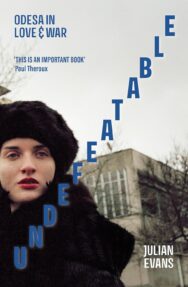
In the 1990s, Julian Evans fell in love and married in Odesa, and has had a decades-long relationship with the city ever since. His memoir is an compelling blend of the political and the personal, providing insight into the relationship between Russia and Ukraine whilst offering a beautiful portrait of one of the world’s most unique cities. We hope you enjoy this extract.
Undefeatable: Odesa in Love and War
By Julian Evans
Published by Scotland Street Press
24 November 2022
After twenty-four hours, the blackout already feels normalised. It feels usual to get into a Bolt, be driven along unlit city highways without traffic lights, feel my way along the blacked-out narrow lane at the back of Ira’s building and fumble open her garden gate. Vadym is in Ira’s kitchen with Seriozha and Oksana, Dima and Felitsia, and Felitsia’s new puppy, a baffled-looking long-haired chihuahua. The gas is working and Vadym and Dima are cooking a mountain of river crayfish, twice as many as it will be possible for the seven of us to eat. Bought alive at Privoz that morning, they are dropped one by one into the big pan of water flavoured with dill and other herbs. Yesterday’s strike has failed to take away a single element of the evening. The room is lit by a car battery on top of a kitchen unit and connected to LED strips, artfully stuck to the wall to light the table under the window and the cooking area, and to confirm the fuck-you-Putin-we’re-having-a-party atmosphere.
We start with Vadym’s samogon, an amber-coloured homemade spirit with a smooth, and I suspect untruthful, character. Rapidly conversation turns to the war, but it seems it wants to skirt around it at the same time. There is not a consensus. There seems to be discomfort about being a Russian-speaking Odesan or even a Russian-identifying Odesan. Some guests, despite hating Putin, want to ‘just get it over’.
‘These are obstacles we need to overcome,’ someone says in Russian. ‘We need to have peace again.’
‘It’s President Zelensky’s fault.’ Vadym says, ‘He’s a very good actor, so he plays the role of president very well, but he’s a bad president.’
‘Why do you say that?’ I ask.
‘He’s a bad leader for Ukraine.’
I try again. ‘Can you explain why?’
‘We want peace. He shouldn’t have let the war happen.’
This feels like a high bar of criticism, given that President Zelenskyy had little chance of knowing Putin’s true intentions or, even if he did, of discouraging them. I guess that most of the guests just want the president to solve their anxiety and discomfort, to make this horrible thing that is happening go away.
‘What do you think?’ Oksana asks me.
‘Of course I don’t like the war at all,’ I say. ‘But I believe Putin has to be defeated. I don’t think there’s an alternative. If he is not defeated, would people in Odesa like to see themselves ruled from Moscow?’
‘Ukraine doesn’t like Odesa. That’s the problem,’ Seriozha says.
Felitsia says sharply, ‘Julian, you live in England. You have a ticket home. You don’t live in Ukraine, you’re not Ukrainian. So you can’t say what Ukraine or Ukrainians should do.’
‘You’re right. But Odesa and Ukraine changed the course of my life. Odesa is part of my past and present. I admire that Ukraine is also fighting for Europe’s future and stability.’
I sense no one wants an argument. I add, ‘I believe Putin is at war with Ukraine because he’s afraid of what Ukraine has achieved as a democratic state, and economically. He sees your country as a threat to Russia.’
Odesa is historically majority Russian-speaking. But beneath that fact, many Odesans identify with Russian culture more than Ukrainian. My implication that Russia is inferior produces a courteous silence. I try to lessen the tension by offering a toast to my mother-in-law, Alla, who died of cancer two years ago and whom everyone here knew and loved. It’s still awkward. This is an evening of warmth and generosity held in my honour, but it’s weighed down by unexpected ambivalence.
I have to leave, to beat the eleven o’clock curfew. As I go, Ira pushes a big foil box crammed with cold raki and samphire salad into my hands, along with a battery torch–table light. ‘Don’t worry. We’re friends here. Nobody was offended. Everyone can say what they think.’
The Bolt drops me at Rishelievska. I go around the corner past the black frontage of the hotel on my way to the three floors of freezing fire-escape stairs. I hear Ilya’s voice behind me.
He’s grinning. ‘We have light! And lifts are working.’
Undefeatable: Odesa in Love and War by Julian Evans is published by Scotland Street Press, priced £24.99.
RELATED BOOKS

ALSO ON BOOKS FROM SCOTLAND
-

David Robinson Reviews: From Scotland with Love by Fred Bridgland
‘There are so many unsung heroes in Fred’s book that I almost lose count.’
-
Winter Round Up of New Scots and Gaelic Books
‘what would happen if someone really scrieved in thir ane langwij / didn’t turn on their mouth lit i …
-

David Robinson Reviews: Blurred Faces by Allan Radcliffe
‘Radcliffe writes with an enviably economical and engaging style.’
-
Alfred Buckham: Daredevil Photographer
‘ALFRED BUCKHAM (1879–1956) was a daredevil photographer. A maverick of early aviation, he created h …
-
‘She is still walking but he has stopped. She turns to find that he is waiting for a response to som …
-
David Robinson Reviews: Upon a White Horse by Peter Ross
‘Ross is always lucid, almost reverent, about the whole process of archaeological discovery.’
FEATURED AUTHOR:
David Torrance

David Torrance is a constitutional specialist at the House of Commons Library and a widely published historian of Scottish and UK politics. He has written unauthorised biographies of SNP politicians Alex Salmond and Nicola Sturgeon, as well as the biog …
FEATURED PUBLISHER:
Barrington Stoke

Barrington Stoke is an award-winning, publisher, and the market leader for struggling, reluctant and dyslexic readers. The company was founded by Patience Thomson and Lucy Juckes, a mother and daughter-in-law team with personal experience of the way th …