


EXPLORE ISSUES



‘This Bright Life is written with empathy, humour and precision and reminds us just what an enjoyable, thought-provoking, whole-picture novelist Karen Campbell can be.’
Karen Campbell continues to write fantastic novels full of heart, of people and places that deserve their stories told. David Robinson is impressed by This Bright Life‘s humanity and insightfulness.
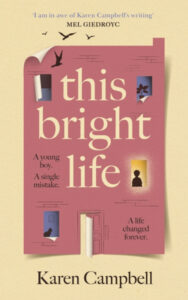
This Bright Life
By Karen Campbell
Published by Canongate
Nearly 40 years ago, the Guardian newspaper ran a TV ad that impressed me so much that I can still remember it. A skinhead is shown running towards a businessman with a briefcase. From one angle, it looks as though he is about to mug him. A wider angle shows a hoisted palette of bricks about to spill on top of the businessman’s head. Far from being a mugger, in other words, the skinhead is a potential lifesaver. ‘It’s only when you get the whole picture,’ the voiceover concludes, ‘that you can see what’s going on.’
I couldn’t help thinking of this while reading Karen Campbell’s new novel, This Bright Life. It too has a mugging at its heart – a real one this time – and two central characters even more different than a skinhead and a businessman. It too demands that we see the whole picture, and it too adds to our comprehension.
The novel begins inside the head of Gerard, a 12-year-old boy. He’s on his bike, freewheeling down Whitehill Street in Glasgow’s Dennistoun. His brain is freewheeling too. It’s not even the summer holidays, but already he’s thinking about his senior school, which of his friends will be going there and which won’t, wondering which nicknames he’ll shed and which he’ll probably get stuck with. His bantering mates in the Broncos (‘a gang named after a horse will get your head panned in at secondary’) are off up to Celtic Park but Gerard heads home because it’s lunchtime, so his mum will probably be up by now.
Those two opening pages are a mini-masterclass in writing character. Drenched with empathy they may be, but there’s a precision about them too. Those nicknames, that matey banter, those drifting thoughts about the future – each carefully triangulates what kind of person Gerard is. That’s a hard enough challenge, but Campbell adds to it. Because despite all his mates’ teasing, she also makes us realise that there is something seriously wrong with him. As he heads downhill to his home in a squalid flat in Duke Street, Gerard wonders what it would be like to pedal downhill as fast as he can into the traffic, keeping his eyes firmly shut all the time.
But Campbell hasn’t finished getting inside people’s heads, and straight away she takes us behind the eyes of an 82-year-old widow. Margaret lives in a ground floor flat opposite the Buffalo Bill statue (Gerard and the Broncos have just visited it) in the home she shared with her husband Bert for six decades before his death the previous year. Within another half a dozen pages her unobtrusive, secluded life is just as firmly delineated as young Gerard’s vibrant, ragged, edgy one.
Now for the bigger picture. The home Gerard returns to is hellish. His junkie mother is out for the count, his screaming baby sister has a dirty nappy, and his seven-year-old brother is desperate for food. There’s none in the flat, and nothing to buy it with in his mother’s purse. There’s only one thing he can think of to do, and so goes out onto the street, and is wondering how he’ll be able to rob the local greengrocer’s till when he spots an old lady – Margaret of course – with a purse sticking out of her handbag. As he grabs it, Margaret turns and falls badly on the pavement. She is seriously injured. Gerard runs off home.
At this point, Campbell introduces her third main character. Claire is a solicitor in her thirties going through the double traumas of divorce and moving house when she witnesses the mugging and rushes over to help the pensioner, who seems to be choking. She removes the old lady’s dentures, and puts them in her pocket. An ambulance arrives and rushes the pensioner off to hospital. Five minutes later, Claire spots the young mugger in the street and phones the police. They arrest him. The pensioner, he is told, has been very badly hurt indeed. If she dies, the police warn him, he could be facing a charge of culpable homicide. Meanwhile Claire puts her hand in her pocket and finds the dentures she forgot to hand over to the ambulance crew.
Three characters, three completely different stories, and yet Campbell manages to bring each fully to life. They also change in entirely credible ways: returning from hospital, Margaret’s infirmity nudges her towards depression and resentment at having to rely on her neighbours. Claire begins to overcome her habit of overthinking and gradually becomes more at peace with herself. Both also have their own secrets which are gradually revealed. But the novel’s focus remains firmly on Gerard. When we see the whole picture – the junkie mum, the drugs, the crime, the unremitting poverty, all on top of the fact that he cannot read or write – is there any realistic chance of redemption? And just suppose there is, how can you write that story without it sounding, er, like an ad for the Guardian?
Discussing homelessness – the main theme of her last novel, Paper Cup – Campbell recalled how ‘profoundly disturbing’ she found it in the five years in her twenties in which she served as a Glasgow policewoman to encounter ‘a netherworld of people with nothing and nowhere to go’ in the middle of a bustling city. I can’t help wondering whether she met young lads like Gerard too; certainly the Child Protection Hearing feels perfectly authentic (‘Remember, this is about conversation, not confrontation’), not least in the befuddlement they create in Gerard’s mind. Here he is, unable to read but in a world of acronyms, an ACE child (Adverse Childhood Experience) on an ICSO (Interim Compulsory Supervision Order) before his first session with the CAMHS (Child and Adolescent Mental Health Team) psychologist.
Try as all these adults might, they can’t untangle the confusion Gerard feels. When the psychologist asks him to look at where his feelings come from, he knows he is lost. ‘Normal folk don’t need to pull feelings out their heads and ask them what they’re doing there’ he thinks to himself. But even in a (mercifully, for once, unsatirised) middle-class foster home, that feeling of lostness doesn’t go away: how can it when he is separated from his siblings, unsure when he’ll see them next or when he’ll be told he’ll have to move on. No wonder he longs for his mother – the one fixed point in his life, no matter how much he knows he can’t rely on her – even when it looks like she might be asking him to break the law…
With so many things against him, the outlook for Gerard might appear to be grim. But this is a novel of hope. There is, it reminds us, such a thing as society, and it’s there in the quiet humanity of the volunteers who take kids like him guerrilla gardening or on trips to city farms, or in the kindness of a Glasgow waitress who puts a cake next to a crying woman customer (‘There you go hen, it’s on the house’) or foster parents who homeschool their charges and pick up on what they’ve not understood about reading and writing. This Bright Life is written with empathy, humour and precision and reminds us just what an enjoyable, thought-provoking, whole-picture novelist Karen Campbell can be.
This Bright Life by Karen Campbell is published by Canongate, priced £16.99.
RELATED BOOKS

ALSO ON BOOKS FROM SCOTLAND
-

David Robinson Reviews: From Scotland with Love by Fred Bridgland
‘There are so many unsung heroes in Fred’s book that I almost lose count.’
-

Winter Round Up of New Scots and Gaelic Books
‘what would happen if someone really scrieved in thir ane langwij / didn’t turn on their mouth lit i …
-

David Robinson Reviews: Blurred Faces by Allan Radcliffe
‘Radcliffe writes with an enviably economical and engaging style.’
-
Alfred Buckham: Daredevil Photographer
‘ALFRED BUCKHAM (1879–1956) was a daredevil photographer. A maverick of early aviation, he created h …
-

‘She is still walking but he has stopped. She turns to find that he is waiting for a response to som …
-
David Robinson Reviews: Upon a White Horse by Peter Ross
‘Ross is always lucid, almost reverent, about the whole process of archaeological discovery.’
FEATURED AUTHOR:
Iain MacLachlain

Iain Maclachlain is an award-winning first-time novelist from Morayshire. He believes passionately in writing in his local North-east Scots. From a working-class background, Iain was shortlisted for the Penguin/ Random House WriteNow programme in 2020.
FEATURED PUBLISHER:
Little Door Books

Little Door Books was officially launched as an independent publisher in 2016. We work collaboratively with established and emerging authors and illustrators, offering them greater input in the creation of their high-quality, exciting, and ultimately b …