


EXPLORE ISSUES



‘Caroline Eden not only writes about places you might never have been to, but from her Edinburgh kitchen writes about food in a way that gets to the heart of what life is like there and makes you want to find out more.’
David Robinson finds you don’t need to be a foodie to enjoy Caroline Eden’s books on travelling and eating.
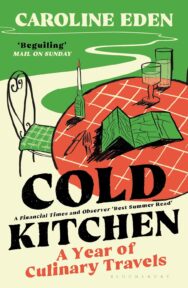
Cold Kitchen
By Caroline Eden
Published by Bloomsbury
It’s probably unfair to judge a book by the number of rabbit-holes it sends its reader down. For one thing, that could be because it is poorly written, or because it doesn’t explain things properly, or just because of downright ignorance on the part of the reader.
In the case of Caroline Eden’s Cold Kitchen, the first two reasons certainly don’t apply. Not only is it a delight to read, but its Edinburgh-based author’s culinary expertise wafts deliciously off the page. She knows her stuff, and has the books to her name that prove it: Green Mountains: Walking the Caucasus with Recipes came out last month, the last in her ‘colours’ trilogy that includes Red Sands: Reportage and Recipes through Central Asia (2020) and Black Sea: Dispatches and Recipes through Darkness and Light (2018).
Cold Kitchen: A Year of Culinary Journeys, which is just out in paperback, is a kind of ‘taster’ for her work – the extra, quintessential ingredient being the care she takes to bring back home, to her New Town basement kitchen, at least some of the flavours of her travels. I say ‘at least some’ because we all know how difficult this can be – how, for example, that bottle of wine that tasted so darkly velvety when the Mediterranean sun was on our shoulders seems such a let-down when drunk in overcast Scotland, or how that accompanying dessert fell so disappointingly short of the golden memory. And yet, even though I am not a foodie, and am such a poor cook that I won’t even attempt any of the book’s recipes, I loved this book. Why?
One of the reasons is Eden’s effectiveness as a scatterer of rabbit holes, and we’ll get to that in a minute, but another is the way each of her chapters is a journey in its own right. It might start off in her kitchen, with her cutting Spanish melons, but before you know it she’s in Samarkand, describing what’s special about the produce sold by the Uzbek roadside melon-sellers, even in night-time, even in November, how they taste ‘like overripe pears with Bourbon vanilla’. And though she might throw in a pinch of esoteric knowledge (qovunxona, n, Uzbek melon shed) or stir in a snippet on the role of melons in Chinese or Mughal history, or Burns’s assassinated first cousin (another melon fan), she brings it back home, like the fine essayist she is, to cubing melon in her basement, with her pet beagle looking up, and enough of her own memories to season the recipe.
In other words, there’s a balance here, as there is in all good writing about food. Between the past (cherished meals in the South Caucasus) and the present (can you really bring it all back home?). Between the most easily romanticised, far-flung places (the remote valleys of Tajikistan, say) and a little electric stove in a cold Edinburgh basement. Between personal anecdotes and memories and the history, nature and culture of the country one is travelling in. Get the balance wrong, and a book can slip away into boorishness on one side and fact-heavy dullness on the other. Eden’s book skilfully skips clear of both.
What makes this even more impressive (to me anyway) is that I am hardly her typical reader. My tastebuds are so insensitive that I have in the past turned down an offer to be a newspaper’s restaurant critic, even though I can easily imagine how much my nearest and dearest would have enjoyed all that free haut cuisine. And although there are plenty of memoirs and travel books on my shelves, I don’t think there’s another one like this with food at its heart.
As a result, I have huge pools of ignorance about food. Take, for example, nigella. No, not Nigella. Nigella I know about, nigella – one of the world’s oldest spices, mentioned in the Old Testament apparently – I didn’t. Burberry I know about – but what’s a barberry? What’s goutweed when it’s at home (and don’t tell me it’s the same as ground elder, because that’s no help either). Sea buckthorn? Never heard of it, yet in Eden’s (brilliant) chapter about taking the trans-Siberian railway to Vladivostok, she casually mentions how partial the Russians are to the stuff and that her Edinburgh neighbour has a business harvesting it – and that it’s a superfood that probably powered the armies (and the horses) of Genghis Khan and Alexander the Great. A superfood that’s changed history and grows in East Lothian? Down the Google rabbit hole I went.
Or take cloudberries. Have you ever seen one? They are rare but they do grow here and in northern England, so there’s a small chance that you might have – small because this single-stemmed berry only seems to grow in high northern places and even then only when there is snow in winter and the right combination of damp, sun, rain and even fog afterwards. Here’s Eden writing about finding and eating one in Glen Affric: ‘I lingered over that single cloudberry, cherishing it, more than caviar, more than whisky or truffles, more than anything else I had eaten, drunk or smoked before.’ I’ll have some of what she’s having, I thought to myself, once more consulting Dr Google.
In fact, if there’s one problem with Eden’s book it’s that she is the kind of guide who opens up a subject so well that you can’t help wanting to find out more. This makes it a slow read: rabbit holes open up in front of you at every chapter. Writing about Baltic cuisine – unfairly neglected, she points out, and a lot more than a pickle paradise – she made Latvia’s capital Riga sound so enticing that I started Googling whether there’s a train linking it with Estonia to the north and Lithuania to the south (as indeed there is: and express trains on it only started running this year). At that great European crossroads city of Lviv, three months before the Russian invasion, she stayed its ultra-grand George Hotel, where Balzac used to stay en-route to seeing his mistress and where the composer/pianist Liszt once waved to his fans from very the balcony of the room she was staying in (£48 a night, says booking.com).
I could carry on in this vein, but you get the picture: Caroline Eden not only writes about places you might never have been to, but from her Edinburgh kitchen writes about food in a way that gets to the heart of what life is like there and makes you want to find out more. In Cold Kitchen, she quotes approvingly from the writer Lesley Branch, whose motto ‘Travelling widely and eating wildly’ could clearly, on this evidence, be her own too.
Cold Kitchen by Caroline Eden is published by Bloomsbury, priced £10.99. Her book Green Mountains: Walking the Caucasus with Recipes is published by Quadrille, priced £28.
RELATED BOOKS

ALSO ON BOOKS FROM SCOTLAND
-


The Nightkeeper’s Apprentice by Jude Reid
‘She’d never seen anything like it. The whole sky was lit up in ribbons of colour – blue, green, yel …
-

David Robinson Interviews: Gavin Francis
‘He’s not my GP so I can’t say this for sure, but based on this book – wise, informed, well-written, …
-
The Cromarty Library Circle by Shona MacLean
‘No one in the room could have been unaware of what it was that Dr Fraser alluded to. The horrors pe …
-

In Search of Gems by Kenneth Steven
‘It still amazes me that these magnificent shells grow in a river. Never mind whether they have pear …
-

Winterbourne by Elisabeth Wolf
‘The Coopers stared at each other for a second, two seconds. ‘It’s a sign—’ said Cooper.’
-
David Robinson Reviews: From Scotland with Love by Fred Bridgland
‘There are so many unsung heroes in Fred’s book that I almost lose count.’
FEATURED AUTHOR:
Ajay Close

Born in Sheffield, Ajay Close worked as a newspaper journalist, winning several awards, before becoming a full-time author and playwright. Her first novel, Official and Doubtful, was longlisted for the Orange Prize. Her fourth, A Petrol Scented Spring, …
FEATURED PUBLISHER:
404 Ink

404 Ink is an alternative book publisher based in Edinburgh. Established in mid 2016 we sought to provide an alternative literary programme for the Scottish reader market and beyond by publishing unusual fiction, non-fiction, poetry and comics in Engli …