


EXPLORE ISSUES



‘It still amazes me that these magnificent shells grow in a river. Never mind whether they have pearls inside; they’re treasures just as they are.’
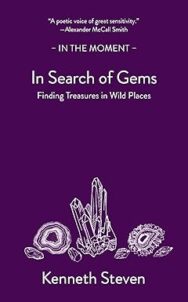
In Search of Gems is a wonderful collection of reminiscences and nature writing about precious stones and crystals that can be found around Scotland. Each memory and exploration is then followed by a beautiful poem. In this extract, Kenneth writes of pearls, and the pearl-fishing travellers that searched for them and sold them in the summer months.
In Search of Gems: Finding Treasure in Wild Places
By Kenneth Steven
Published by Saraband
It so happens that half the world’s freshwater pearls are found in Scotland. It’s the case too that the Romans knew this, and that that’s one of the reasons they were intrigued to come here in the first place. I like to think that at some point in those early times, a traveller made it to the markets of Rome. He was curious to follow the rivers and in the end pursued them until he found his way to what was then the capital of the world. And in his purse he had a handful of pearls and he showed them to someone and they wondered, asked questions, even though they had no words in common. But he came back rewarded to his northern land all the same, and what he had brought with him was never forgotten.
It’s clear that knowledge of pearls and fishing for pearls has been with the travelling community from time immemorial. A whole culture grew up around it; they created special crooks that could go deep into river water to search for the most likely mussel shells. Because it wasn’t that every one might contain a pearl: it was the crooked ones, the misshapen ones. What had happened was that some piece of grit had got inside the shell. The shell almost sensed that this had taken place, that something alien was present. New material, what we know of as mother of pearl, was swirled and smoothed around the foreign body. And more and yet more as the shell grew. So the travellers would keep an eye on the crooked shells that were in one particular river; they would turn them, make sure that all was as it should be when they came back to that river the following summer. It might have been that it was first and foremost the men who had the opportunity of fishing for pearls: the women were too busy at other tasks. One way or another, this was not considered their domain.
I think of the sheer joy that must have been derived from exploring those rivers in the summer months and keeping watch on those mussels that held the pearls. The travellers knew how to lift those particular shells, the mis-shapen ones, and by then another year of growing had passed. It was the joy of summer in nature. As travelling folk they were a part of the natural order of the seasons and the years in Scotland, as much as the Sami people were with their herds of reindeer in Arctic Scandinavia. Yet the paradox that in both instances the settled community didn’t begin to understand their way of life, but instead despised them. The youngsters were mobbed in school and the neighbours in their villages and towns, by contemptuous locals. Yet back then it was the travellers who knew nature best; who were one with the rhythm and the dance of the seasons.
The travellers were able to tell from which river a particular pearl had come, and more than likely those experts from the settled world could too. It was all to do with the minerals that were found in any particular body of water. So there would be a subtle blue sheen from one certain river, or a gold glow from another. I strongly suspect that such knowledge would be handed down from one generation to the next; not only this, but all the lore that governed this culture.
In the old days, and I’m really imagining the nineteenth century here and the first decades of the twentieth, the travellers would visit the castles and the lodge houses where the well-to-do ladies loved their pearls. On the doorsteps, the travellers would show off their handfuls of pearls, most likely towards the end of those summer months, and be rewarded with a few coins for them. There was a particular jeweller on the banks of the Tay by the name of Cairncross, and the travellers would take their treasures here too, for they knew this was a place they’d get a fair price for their pearls. Until not long ago, the biggest pearl fished from a Scottish river was kept here. You had to ask to see it; the pearl was kept in a safe in a back part of the premises, but would be brought out for you to see.
*
I went back a few years ago to visit a beach I’d known on the River Lyon. I was with a group of American students and teaching a Scottish course. I wanted them to know about pearl fishing and we happened to be passing this place I’d known of old. I ran with several of them to this beach on the river, for if possible I wanted to bring back at least one shell to show the whole group. The river didn’t let me down: there were perhaps half a dozen mussels there on the reddish sand. I took one, even though now you’re not even supposed to take a shell if you find one. Some of the largest can grow to be the size of a whole hand; this one wouldn’t have been longer than my little finger. It still amazes me that these magnificent shells grow in a river. Never mind whether they have pearls inside; they’re treasures just as they are. May we learn to look after them, to keep them safe.
Pearls
They were the reason the Romans came here –
river things, spun into milky globes over years
and years.
I often wonder who it was who found them first;
those mussels, dark shells whorled and folded
like hands in prayer, embedded in deep feet of
shingle.
The travellers knew who they were. The unsettled
people
who followed the seasons, the stars, yearned only
the open road
They carried the knowledge of pearls inside
them, secret,
could tell the very bend over river each pearl had
come from –
this one like the pale globe of Venus at dawn,
this one a skylark’s egg, and this the blush of a
young girl’s lips.
Yet the Romans never reached the Highland
rivers
where the best pearls slept. They were kept out
by the painted people, the Pictish hordes
bristling on the border like bad weather.
The pearls outlived even the travellers, whose
freedom
was bricked into the big towns long enough ago,
who did not understand any longer the
language of the land.
In the last part of the north,
in the startling blue of the rivers,
the shells still grow. Their pearls are stories
that take a hundred years to tell.
In Search of Gems: Finding Treasure in Wild Places by Kenneth Steven is published by Saraband, priced £8.99.
RELATED BOOKS

ALSO ON BOOKS FROM SCOTLAND
-

David Robinson Reviews: The Loch of the Bees
‘The past’s current flows through the characters in his fiction so strongly that it almost becomes t …
-

The Nightkeeper’s Apprentice by Jude Reid
‘She’d never seen anything like it. The whole sky was lit up in ribbons of colour – blue, green, yel …
-

David Robinson Interviews: Gavin Francis
‘He’s not my GP so I can’t say this for sure, but based on this book – wise, informed, well-written, …
-
The Cromarty Library Circle by Shona MacLean
‘No one in the room could have been unaware of what it was that Dr Fraser alluded to. The horrors pe …
-

Winterbourne by Elisabeth Wolf
‘The Coopers stared at each other for a second, two seconds. ‘It’s a sign—’ said Cooper.’
-

David Robinson Reviews: From Scotland with Love by Fred Bridgland
‘There are so many unsung heroes in Fred’s book that I almost lose count.’
FEATURED AUTHOR:
Sylvia Hehir

Sylvia was awarded a doctorate in creative writing from University of Glasgow in 2018 and is a former recipient of a Scottish Book Trust New Writer Award. Her debut YA thriller, Sea Change, published by Stirling Publishing 2019, was winner of the Pitlo …
FEATURED PUBLISHER:
Hachette UK

Hachette UK is the UK’s second largest book publishing group. The award-winning adult publishing divisions are Orion; Little, Brown; John Murray Press; Hodder & Stoughton; Headline; Quercus; Octopus, and Bookouture. They publish fiction and non-fic …