


EXPLORE ISSUES



‘I’ve always been obsessed with folkore around the sea and I think coming from two island nations – Britain and the Philippines, I’m interested in places where the economy and history is entwined with the land and sea.’
If you’re looking for an epic adventure on the high seas with a rag tag crew in a magical world inspired by south-east Asian mythology then Katalina Watt has provided! We caught up with her to find out more about her fantasical debut.
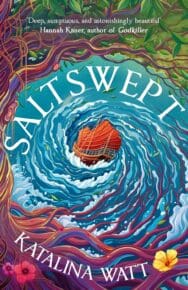
Saltswept
By Katalina Watt
Published by Hodderscape
Congratulations on the release of your debut novel, Saltswept. Can you tell our readers what to expect and what you wanted to explore in writing it?
Thank you! This is the first in a fantasy duology inspired by Southeast Asian folklore with queer main characters following a pirate, an acolyte, and a farmer on their quest of hijinks on the high seas. I wanted to explore eco-fiction and colonialism through a classic fantasy quest narrative and add elements of more contemporary fiction with classic things we love about the genre. There’s nature magic, courtly intrigue, and dark academia as well as swashbuckling, The world of the Earthsalt Duology is queer-normative, with disabled folks, and rainbow families with a cast of characters who are outcasts in various ways.
You come from a publishing background. How have you enjoyed the publishing experience from a writer’s perspective? Was it as you expected?
It’s certainly been helpful to understand the industry from the other side. It helps keep me grounded and remember that decisions are business as well as artistic ones and not personal to me or my book. I love the collaborative process and I’ve been lucky that my team and I can geek out about the specifics together. It’s important to remember that everyone is on the same team and wants the book to be the best it can be, but you have to get on the same page matching those expectations and realities. One of my favourite moments was recording the Acknowledgements for the audiobook, a real full circle moment for me having spent a lot of my publishing career in audio.
Why did you decide to set your fantasy adventure at sea?
A seafaring quest is the fantasy equivalent of a road trip. I have a curiosity and healthy respect for the sea. I don’t have seafaring experience but researching this book was so much fun and fascinating. I’ve always been obsessed with folkore around the sea and I think coming from two island nations – Britain and the Philippines, I’m interested in places where the economy and history is entwined with the land and sea. It can be bountiful – many people rely on the sea for their livelihood, but it can also be dangerous. I’ve got a morbid streak and found diving, particularly cave diving, captivating to research. People who work and live in and around the ocean are so admirable and brave from my perspective.
We have a bit of a soft spot here at BooksfromScotland for books that feature a ragtag bunch of protagonists. What were the challenges in handling a wide range of characters?
I wanted to challenge myself to write three different POV characters, all in first-person present tense, which is perhaps unusual for an adult fantasy novel. We follow Ris, a widowed farmer, Finlyr a rogue and a pirate, and Hanan who is a temple acolyte. I had an immediacy and could get right into the characters’ heads with clarity, as the cast start separately but come together. It was a challenge to identify whose perspective is needed at given points in the narrative, what secrets they’re hiding from each other, and what motivates them. There’s a lot of fun to be had playing with what the reader knows versus what the various characters know. The secondary characters were also great fun to write because we get little snippets of their insights but we never get to be fully in their heads.
You introduce your own magic system in Saltswept. Can you tell us more about creating this as part of your fantastical world-building?
In this world magic exists and is based on the idea of balancing energies in the natural world, but not everyone can use it. Those that can’t misunderstand and are afraid of magic. Those that can are called ‘gifted’, or more unkindly ‘touched’ and have a natural intuition for it, which can be awakened. When it is, they are taken to the temple of Aistra to train as an acolyte with the hopes of being chosen for the great honour of serving the monarchy.
From a craft perspective, I used a world-building bible which is adapted from a template as a basis for creating Paranish. It was useful to think about the macro and microscale of world-building, everything from the economy and climate to cultural norms, urban planning etc. In some ways it’s very liberating to create a secondary world in fantasy because you have a lot of freedom to choose and shape the world you want. But you also have to be intentional and cohesive with your choices so this feels like it could be a real place and so you don’t internally contradict the way your world works. It wasn’t only helpful for me with editing and writing the sequel, but also for my publishing team. It’s the iceberg where the reader only sees the tip, but all that ground-work is beneath the surface of the water and adds to the verisimilitude.
Why do you think fantasy has had such a resurgence over the last few years?
I think it’s a combination of escapism and activism. Imagining a different world or different way of living is what fantasy is about and always has been, and it’s wonderful to see more diverse stories in the fantasy sphere and mainstream support for authors who have not been traditionally represented in the book industry. Fantasy stories can be both cosy and intimate in terms of stakes – focusing on one person’s arc in one place for example, but it can also be epic in scale – and sometimes in the same narrative. I’m so excited for the future of fantasy; we’re so fortunate to have so many passionate and dedicated readers and authors in this community.
Who or what are your writing influences?
Garth Nix, Ursula Le Guin, J.R.R. Tolkien, Emily Brontë, Angela Carter, Sarah Waters, Toni Morrison, and Becky Chambers to name a few!
Are there any other speculative fiction books coming from Scotland’s writers that you’re looking forward to reading this year?
We are very blessed to have so many excellent speculative fiction writers and here is just a sampling of what’s on offer this year!
The Salt Bind by Rebecca Ferrier, The Inn at the Foot of Mount Vengeance by Chiara Bullen, Homesick by Rhiannon Grist, The Eynhallow Saga Book 2 by Heather Palmer, A Snake Among Swans by Hannah Kaner, In This City Where It Rains by Lyndsey Croal, The Cove by Claire Schultz, A Million Points of Light by C.L. Hellisen, Masquerade by L.R. Lam, The Haunting of Avis Lovelock by M.K. Hardy, The Mirrored Halls by Cailean Steed, Vervain Hollow by Catriona Silvey, Abyss by Nicholas Binge.
Saltswept by Katalina Watt is published by Hodderscape, priced £20.00.
RELATED BOOKS
ALSO IN THIS ISSUE
 The Wise Witch of Orkney by Anna Caig
‘Elspet turns her thoughts to what lies ahead but her foresight fails her; this is a situation beyon …
 Common Ground: A Q & A with Elissa Soave
‘I’ve always been interested in how community works, what makes a good community, and how is it that …
ALSO ON BOOKS FROM SCOTLAND
-

David Robinson Reviews: The Loch of the Bees
‘The past’s current flows through the characters in his fiction so strongly that it almost becomes t …
-

The Nightkeeper’s Apprentice by Jude Reid
‘She’d never seen anything like it. The whole sky was lit up in ribbons of colour – blue, green, yel …
-

David Robinson Interviews: Gavin Francis
‘He’s not my GP so I can’t say this for sure, but based on this book – wise, informed, well-written, …
-
The Cromarty Library Circle by Shona MacLean
‘No one in the room could have been unaware of what it was that Dr Fraser alluded to. The horrors pe …
-

In Search of Gems by Kenneth Steven
‘It still amazes me that these magnificent shells grow in a river. Never mind whether they have pear …
-

Winterbourne by Elisabeth Wolf
‘The Coopers stared at each other for a second, two seconds. ‘It’s a sign—’ said Cooper.’
FEATURED AUTHOR:
Abigail Abbas

Abigail Abbas began her career in financial PR. She left the City to raise her children and worked as an illustrator, later embarking on an MA in Illustration at Camberwell College of Art. Photo Copyright – Charlotte Knee Photography
FEATURED PUBLISHER:
Hallewell Publications

Hallewell Publications is a small publishing house based in Argyll which concentrates largely on a single project: a popular series of walking guides which covers Scotland and selected areas of England. We currently have over 50 titles in print (for a …