


EXPLORE ISSUES



‘Everest is … was … should be … a sacred mountain.’
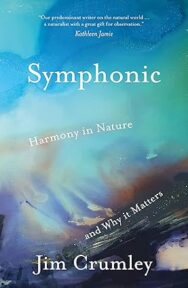
Jim Crumley is one of Scotland’s best nature writers. His latest book, Symphonic, sees him visit places in Scotland and around the world searching for harmony in nature and asking how we can build a meaningful relationship with our planet. In this extract, he looks at the wonder and plunder of Everest.
Symphonic: Harmony in Nature and Why It Matters
By Jim Crumley
Published by Saraband
I dream of Everest. Who doesn’t who loves mountains?
Yet I never wanted to climb it. I was never cut out to climb it. Summits never enticed me. Even in the hard(ish) mountaineering phase of my life, it was always the company of mountains that beckoned; it was their take on the world I sought – that and the creatures that lived there, for these are the only true mountaineers. I have never seen Everest in real life. The closest I ever came to it is Switzerland. Yet I dream of Everest, and the sense of Everest percolates my dream. And the dream recurs, irregularly, but it does recur, a handful of times over perhaps forty years, the mountain seeking reacquaintance. The dream does not explain my presence, nor hint at what I might achieve there, except that it insists on the renewal of a bond. Even in my dream I don’t climb the mountain, I circumnavigate it: sunwise, always sunwise, so I move in harmony with the mountain. The dream insists on that too.
Black Elk, the famous holy man of the Oglala Sioux, had this to say on the importance of ritualising sunwise movement in a book called Black Elk Speaks (1932), written by poet John G. Neihardt based on conversations translated for him by Black Elk’s son:
You want to know why we always go from left to right like that. I can tell you something of the reason, but not all. Think of this: is not the earth the source of life, and does not the flowering stick truly come from there? And does not man advance from there toward the setting sun of his life? Then does he not approach the colder north where the white hairs are? And does he not then arrive, if he lives at the source of light and understanding which is the east? Then does he not return to where he began, to his second childhood, there to give back his life to all life, and his flesh to the earth whence it came? The more you think about this, the more meaning you will see in it.
*
I know about Black Elk at all because a woman in Austin, Texas, somehow came across two of my books, A High and Lonely Place (1990), which is about the Cairngorms, and The Heart of Skye (1994), which is a short collection of linked essays about the island. Having read these sometime in the mid-1990s, she sent me Black Elk Speaks because she thought I would be interested in what Black Elk had to say. She was right. I know nothing about her – we never met – and after my letter of appreciation for her gift, we did not stay in touch. Her great gift, though, was an awakening in me through Black Elk the idea that nature’s voice is the only common language the whole world knows, because the whole world IS nature. It has just echoed down the years one more time the moment I started to explain my dream’s insistence on a sunwise orientation.
Obviously, there is only so much faith you can place in a dream, even a recurring one that targets my affinity for mountain landscapes, but dream and real life share one common factor: I fear for Everest.
Everest is … was … should be … a sacred mountain. Long before Great Britain barged in beating empire’s drum, long before British surveyors realised they had the world’s highest mountain on their hands, it had two sacred names: Chomolungma in Nepal, meaning Goddess Mother of the Earth; and Sagarmartha in Tibet, meaning Goddess of the Wind. Indigenous sensibilities towards it over uncounted centuries honoured both the sacred and the female: Sir George Everest, after whom the mountain was clumsily re-named by the empire pedlars in around 1860, was neither of these things. But he was sensitive enough to think the honour was an unwise precedent, and he was right. The controversy would last for more than fifty years. Subsequent research suggests the surveyors wilfully dismissed the indigenous names, even denying that such names existed. Yet in the very early years of the eighteenth century, French Capuchin friars recorded the mountain’s name on a rough map of their travels, and that name was Chomolungma. So there is an argument to be made that the rubbishing of Mount Everest began with the British Survey of India the better part of 200 years ago, and the process continues unabated to this day. What characterised the acquisitive frenzy of empire building across the world by the European elite was the roughshod trampling of indigenous peoples’ sensibilities towards their own land, their own legend-making, their own place within nature’s limitless family of creatures and landscapes. That infinitely varied harmony wilted under a plague of discord.
The sacred mountain that was, and the profane one it has become, are symbolised for me by two twenty-first-century photographs taken three years apart. The profane Everest was photographed by Nepalese climber Nirmal Purja on 22 May 2019. It showed the final stretch of the south-east ridge leading to the summit crammed with more than 300 climbers, a jostling two-way queue of technicolour impatience, the summit of the world brought low by two different species of greed. One was the irredeemable ugliness of what Everest mountaineering has become, for it cares nothing for the mountain and everything for the bragging rights of the ultimate tick on mountaineering’s ultimate list. The other species of greed was the attitude of the authorities in Nepal and Tibet, not to mention the worldwide travel industry, which see in Everest only the goddess that goes on giving. Meanwhile, the squalor on the mountain is monumental. That photograph travelled the world generating headlines of disbelief and international disgust. Yet there was also a different species of anger within all those vested interests which cash in on Everest; anger that the truth had been told so graphically first on the front page of the New York Times, thence transmitted to the rest of the world in an instant. Behind that particular anger lay the fear that Everest would lose its colossal pulling power. Let’s hope.
Then, three years later, on this side of a pandemic during which hardly anyone travelled anywhere, American photographer Kittiya Pawlowski trekked into the Khumbu Valley, not to compound mountaineering’s restored post-pandemic profanity on Everest, but rather to seek out an encounter with one of nature’s most elusive creatures, knowing it was still alive and just about holding its own in the wider Himalaya. What she produced was an image of quite extraordinary beauty that restored to Everest at least the illusion of sanctity. The top 10,000 feet of Everest occupies three-quarters of the photograph, fleeced in great depths of snow, brilliantly sunlit, and raked by long diagonals of blue shadow. Its beauty and grandeur are restored, but only by distance: it appears unbesmirched by humanity’s detritus. But Everest is simply the photograph’s background, supplying context and atmosphere, not the be-all-and-end-all, not this time. The scene-stealer lurks in the deep shadow of a roughly triangular foreground, the photograph’s bottom right-hand corner. Somewhere around 18,000 feet on a flank of Pumori, tantalisingly lit, and occupying about half-a-square-inch of the whole image is the object of the photographer’s pursuit – a single snow leopard.
What Kittiya Pawlowski has achieved is nothing less than a vision of Chomolungma. Behold the sacred mountain!
One other thing about Everest and the dream. Circumnavigating the mountain was not a new idea when it insinuated itself into my decades-long preoccupation with what Everest has suffered at our hands, and then into my dreams. Those British surveyors were attempting their own version of it in the 1870s, deploying an admittedly ingenious method of circumnavigating the ban on almost all aliens in Tibet. The surveyors trained Indians disguised as religious pilgrims who were allowed in, and these men made notes on hidden scraps of paper and counted paces on prayer wheels. One such, Pundit Hari Ram, was reported to have ‘completed half a circuit in 1871, travelling in a wide arc north through Tibet from Darjeeling to Kathmandu’. That is one very wide arc. Some 112 years later, American climbers Jan Reynolds and Ned Gilette published an account of their own circuit, which they also split into halves, one in spring, the other in autumn. In total, it took them four months, and they walked 300 miles, all of it above 17,000 feet. They summarised it thus in a book called Everest Grand Circle:
‘We had seen Everest from all sides, and turned for home with a deep and intimate affection – a reverence – for the highest mountain.’
The words ‘deep’, ‘intimate’, ‘affection’ and ‘reverence’ are more or less unknown in the vocabulary of modern Everest mountaineers. Their absence is self-evident in the annual tonnage of stench and squalor that mountaineering inflicts on the mountain. Mountaineers leave it behind as a token of their disrespect and irreverence. Yet for thousands of years before mountaineering was invented, the native peoples of Tibet and Nepal had evolved their relationship with the mountain into that of an eternal goddess on the doorstep. Compare and contrast with Ed Hillary’s now famous celebratory greeting for fellow climber George Lowe as he and Sherpa Tenzing descended after their successful ascent in 1953:
‘We knocked the bastard off!’
Symphonic: Harmony in Nature and Why It Matters by Jim Crumley is published by Saraband, priced £14.99.
RELATED BOOKS
ALSO IN THIS ISSUE
 The Salt Bind by Rebecca Ferrier
‘It cried again, loud enough to shake the ferns at Kensa’s waist and call her towards it, towards El …
 All At Sea by Jonathan Whitelaw
‘One of the requirements of being a crime writer, you get to do horrible things to and in places you …
ALSO ON BOOKS FROM SCOTLAND
-

David Robinson Reviews: The Loch of the Bees
‘The past’s current flows through the characters in his fiction so strongly that it almost becomes t …
-

The Nightkeeper’s Apprentice by Jude Reid
‘She’d never seen anything like it. The whole sky was lit up in ribbons of colour – blue, green, yel …
-

David Robinson Interviews: Gavin Francis
‘He’s not my GP so I can’t say this for sure, but based on this book – wise, informed, well-written, …
-
The Cromarty Library Circle by Shona MacLean
‘No one in the room could have been unaware of what it was that Dr Fraser alluded to. The horrors pe …
-

In Search of Gems by Kenneth Steven
‘It still amazes me that these magnificent shells grow in a river. Never mind whether they have pear …
-

Winterbourne by Elisabeth Wolf
‘The Coopers stared at each other for a second, two seconds. ‘It’s a sign—’ said Cooper.’
FEATURED AUTHOR:
Heather Parry

Heather Parry is a Glasgow-based writer and editor. Her debut novel, Orpheus Builds a Girl, was shortlisted for the Saltire Society Fiction Book of the Year Award and longlisted for the Polari First Book Prize. She is also the author of a short story c …
FEATURED PUBLISHER:
Black & White Publishing

Since 1999, Black and White Publishing has produced a wide range of titles with over 300 now in print, including 30 in the award-winning Itchy Coo imprint of children’s books in the Scots language, the B&W classics list and the Broons and Oor Wulli …