


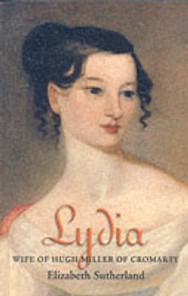
ABOUT THIS BOOK
PUBLISHER: Birlinn General
FORMAT: Paperback
ISBN: 9781862322219
RRP: £9.99
PAGES: 208
PUBLICATION DATE:
August 26, 2002
BUY THIS BOOK
As an Amazon Associate and Bookshop.org affiliate we earn from qualifying purchases.
Lydia: Wife of Hugh Miller of Cromarty
Elizabeth Sutherland
The name and writings of Hugh Miller, born in Cromarty in 1802, have always been and still are well known. Apart from an entry in the “Dictionary of National Biography” his wife, Lydia, born in Inverness in 1812, has remained undeservedly in obscurity. Now, in this book, she is at last brought on stage. Elizabeth Sutherland tells us of Lydia’s upbringing and education, and the romantic story of how she fell in love with and married a “plain working man”, as Hugh described himself, with little formal education and apparently few prospects. We are taken through the tragedy of the early death in Cromarty of their first-born child to their move to Edinburgh in 1840 when Hugh was appointed editor of “The Witness” newspaper. We learn how their deep love and Lydia’s active help supported Hugh through the difficult years leading up to the Disruption in the Church of Scotland in 1843, in which he played such an important part, and beyond, while she became a published, though anonymous, author herself.Her life and that of her children after Hugh’s suicide in 1856 is described, and we discover how, to the detriment of her own health, she devoted the first six years of her widowhood to editing and publishing posthumously her husband’s writings, which otherwise might never have become available to the public. Elizabeth Sutherland’s research has built a skilful picture of a remarkable woman, whose love and strength were a vital ingredient of Hugh’s lasting reputation.
Reviews of Lydia: Wife of Hugh Miller of Cromarty
"Exceptionally well-researched and composed." –"The Herald"
Elizabeth Sutherland
Elizabeth Sutherland lives in Ross-shire. She had an Orcadian father and a mother from Fife, which she claims makes her a Pict. After training at Edinburgh University to be a social worker, she married an Episcopalian clergyman and lived in four Scottish parishes. On her late husband’s retirement in 1982 she took over Groam House museum in Rosemarkie and was responsible for its becoming a Pictish Centre.
ALSO ON BOOKS FROM SCOTLAND
-

The Scottish Colourists: Art & Life by Alice Strang
‘Together the quartet embodied a new spirit in Scottish art and they are celebrated as Scotland’s le …
-
David Robinson Reviews: Our Noble Selves by Kate Atkinson
‘As I suggested at the start, there’s a whole heap of plot in Our Noble Selves – spies, murders, and …
-
‘They had spoken perhaps ten sentences each and it had already begun. Moira’s resentments, her preju …
-

Ayont the Thistle by Jim Mackintosh, Alan Riach and James Robertson
‘Nane ae this then but – ma hert daen its hing/ an yon wee smile ae yours in the saft smir ae the ga …
-

David Robinson Reviews: This Door of the Seas
‘He sees what he wants to. And it makes a kind of sense too – especially to colonists from Scotland, …
-

The Broons and Oor Wullie Celebrate their 90th Birthdays!
‘Whatever the future may hold, we can be sure that The Broons and Oor Wullie will always be a part o …
FEATURED AUTHOR:
Fi Buchanan
Fi Buchanan is a food writer and chef who owned Glasgow’s legendary Heart Buchanan café and deli. Winner of a Glenfiddich Spirit of Scotland award, she presented the BBC series TeenCanteen, has worked behind the scenes on many tv food shows and has giv …
FEATURED PUBLISHER:
DC Thomson Media

DC Thomson is one of the leading media organisations in the UK. Our headquarters are in Dundee but we also have offices in Glasgow, Aberdeen and London – in the world-famous Fleet Street. We publish newspapers, magazines and have diversified into new m …