


ABOUT THIS BOOK
PUBLISHER: Manchester University Press
FORMAT: Paperback
ISBN: 9781526106834
RRP: £14.99
PAGES: 272
PUBLICATION DATE:
February 1, 2017
BUY THIS BOOK
As an Amazon Associate and Bookshop.org affiliate we earn from qualifying purchases.
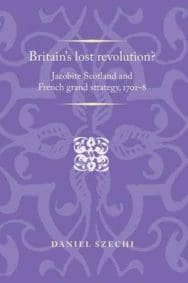
Britain’s Lost Revolution?: Jacobite Scotland and French Grand Strategy, 1701-8
Daniel Szechi
Peter Lake
Anthony Milton
Jason Peacey
Alexandra Gajda
This book is a frontal attack on an entrenched orthodoxy. Our official, public vision of the early eighteenth century demonises Louis XIV and France and marginalises the Scots Jacobites. Louis is seen as an incorrigibly imperialistic monster and the enemy of liberty and all that is good and progressive. The Jacobite Scots are presented as so foolishly reactionary and dumbly loyal that they were (sadly) incapable of recognising their manifest destiny as the cannon fodder of the first British empire. But what if Louis acted in defence of a nation’s liberties and (for whatever reason) sought to right a historic injustice? What if the Scots Jacobites turn out to be the most radical, revolutionary party in early eighteenth-century British politics? Using newly discovered sources from the French and Scottish archives this exciting new book challenges our fundamental assumptions regarding the emergence of the fully British state in the early eighteenth century.
Reviews of Britain’s Lost Revolution?: Jacobite Scotland and French Grand Strategy, 1701-8
'Published in the year of the Scottish independence referendum, Britain's lost revolution? is a deeply researched and readable account of the alternatives that existed at the time of the Anglo-Scottish Union of 1707. It presents a lost past of radical change and European realignments. Built on totally new research in UK and international archives, Szechi tells the story of the revolution that never was in a way that illuminates the present and provides endless opportunity for counterfactual history. This is a What If? book par excellence' Professor Murray Pittock, University of Glasgow — .
Daniel Szechi
Daniel Szechi is Professor of Early Modern History at the University of Manchester
ALSO ON BOOKS FROM SCOTLAND
-


The Scottish Colourists: Art & Life by Alice Strang
‘Together the quartet embodied a new spirit in Scottish art and they are celebrated as Scotland’s le …
-

David Robinson Reviews: Our Noble Selves by Kate Atkinson
‘As I suggested at the start, there’s a whole heap of plot in Our Noble Selves – spies, murders, and …
-

‘They had spoken perhaps ten sentences each and it had already begun. Moira’s resentments, her preju …
-

Ayont the Thistle by Jim Mackintosh, Alan Riach and James Robertson
‘Nane ae this then but – ma hert daen its hing/ an yon wee smile ae yours in the saft smir ae the ga …
-

David Robinson Reviews: This Door of the Seas
‘He sees what he wants to. And it makes a kind of sense too – especially to colonists from Scotland, …
-

The Broons and Oor Wullie Celebrate their 90th Birthdays!
‘Whatever the future may hold, we can be sure that The Broons and Oor Wullie will always be a part o …
FEATURED AUTHOR:
Peter Marshall

Peter Marshall, a native of the Orkney Islands, has since 2006 been Professor of History at the University of Warwick, and is a leading expert in the history of the Reformation and its impact in the British Isles and beyond. He is a two times winner of …
FEATURED PUBLISHER:
Leamington Books

Leamington Books publishes a variety of fiction and non-fiction titles under our ethos, Transformative Publishing. Our authors are chosen for their undiscovered talents, unique perspectives and one-of-a-kind stories to tell. Leamington’s work is driven …