


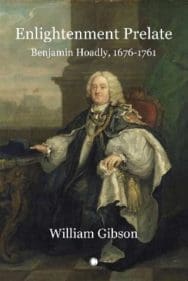
ABOUT THIS BOOK
PUBLISHER: James Clarke & Co Ltd
FORMAT: Paperback
ISBN: 9780227176771
RRP: £30.00
PAGES: 348
PUBLICATION DATE:
August 30, 2018
BUY THIS BOOK
As an Amazon Associate and Bookshop.org affiliate we earn from qualifying purchases.
Enlightenment Prelate: Benjamin Hoadly, 1676-1761
William Gibson
Benjamin Hoadly (1676-1761), Bishop successively of Bangor, Hereford, Salisbury and Winchester, was the most controversial English churchman of the eighteenth century. He has unjustly gained the reputation of a negligent and political bishop, and with this publication, Gibson attempts to reappraise the legacy of this influential man. It was Hoadly’s sermon on the nature of Christ’s kingdom that sparked the Bangorian controversy which raged from 1717 to 1720. His sermons, books and tracts poured from the press in huge quantities and were widely read by Anglicans and Dissenters alike, yet his commitment to the ideology of the Revolution of 1688 and to the comprehension of Dissenters into the Church of England earned him the antagonism of many contemporary and later churchmen. This book is the first full-length study of Hoadly to be published, and is a powerfully revisionist study. Hoadly emerges as a dedicated and conscientious bishop with strong and progressive principles. He asserted the right of individuals to judge the Bible for themselves without the shackles of ecclesiastical authority and sought to establish a liberal enclave in the Church to re-attract Dissenters. He also restored a strongly Protestant commemorative view of the Eucharist to the Church. But it was not simply his ecclesiastical work which made him such an important figure. Hoadly’s stout defence of rationalism made him a founder of the English Enlightenment. His views on the nature of political authority also drew heavily on John Locke, and Hoadly was responsible for bringing Locke’s views to a wide audience. It was his commitment to civil liberties which made him a progenitor of the American Revolution whilst his writing on the nature of civil authority was acclaimed by John Adams as a source of American liberties and of the US Constitution. He also advanced sincerity of belief over the right of the State to impose penalties for the failure to conform. In these principles he presaged the future direction of both religion and society.
Reviews of Enlightenment Prelate: Benjamin Hoadly, 1676-1761
The concern for 'peace and unity' emerges as a main theme in Gibson's interpretation and compels us to reshape our understanding of Hoadly as a champion of religious pluralism in a modern sense. By restoring Hoadly to his proper place in the history of the English Church, Professor Gibson adds new information to a subject much studied over the latest generation.ArchivesGibson's study of Hoadly is to be greatly welcomed. It is certainly a major piece of reassessment.Journal of Religious HistoryAlthough Gibson assembles a great deal of information about his subject's life and works, and although he discusses many points that are relevant to Hoadly's theology, the book is not primarily an analysis of his philosophical and theological beliefs. Gibson's main concern, he avows, is with Hoadly's manifold contributions to the defence and reform of the Anglican Church and its estabilishment as a truly National Church, serving as many of the people as possible.There can be no doubt that Gibson has shown that Hoadly was a much more substantial figure than many have been willing to believe.Enlightenment & DissentThe book has made a major contribution to knowledge of Hoadly's career and its broader meaning and it will be required reading for all who have a serious interest in early eighteenth-century British political and religious history.The Journal of the Historical Association
William Gibson
William Gibson, DLitt is Head of the Faculty of Arts at Basingstoke College of Technology. He is a Fellow of the Royal Historical Society and the Royal Society of Arts. In 2004 he was made Academic Director for Lifelong Learning at Oxford Brookes University. He has written widely on the post-Restoration Church and society, his most recent books being The Church of England 1688-1832: Unity and Accord (2001) and Religion and Society in England and Wales, 1689-1832 (1998).
OTHER BOOKS BY THE SAME AUTHOR

ALSO ON BOOKS FROM SCOTLAND
-


David Robinson Reviews: Our Noble Selves by Kate Atkinson
‘As I suggested at the start, there’s a whole heap of plot in Our Noble Selves – spies, murders, and …
-

‘They had spoken perhaps ten sentences each and it had already begun. Moira’s resentments, her preju …
-

Ayont the Thistle by Jim Mackintosh, Alan Riach and James Robertson
‘Nane ae this then but – ma hert daen its hing/ an yon wee smile ae yours in the saft smir ae the ga …
-

David Robinson Reviews: This Door of the Seas
‘He sees what he wants to. And it makes a kind of sense too – especially to colonists from Scotland, …
-

The Broons and Oor Wullie Celebrate their 90th Birthdays!
‘Whatever the future may hold, we can be sure that The Broons and Oor Wullie will always be a part o …
-

Pretty Valuable Things by A. J. Leslie
Harper considered Charles for a few moments, lit a cigarette, then said ‘we are treating it as murde …
FEATURED AUTHOR:
Lorraine Wilson

Lorraine is an award-winning writer, biologist, herder of cats and drinker of tea. Having spent years working in remote corners of the world she now lives by the sea in Scotland and writes stories full of the wilderness and folklore, exploring themes o …
FEATURED PUBLISHER:
The Islands Book Trust

Since 2003, IBT has published over 100 books or booklets on the history and culture (in English and Gaelic) of Scottish islands. In an earlier period we were publishing over 10 books pa. Our website shows the publications currently in print. Our most r …