


ABOUT THIS BOOK
PUBLISHER: Harvard University Press
FORMAT: Hardback
ISBN: 9780674972094
RRP: £27.95
PAGES: 312
PUBLICATION DATE:
August 31, 2018
BUY THIS BOOK
As an Amazon Associate and Bookshop.org affiliate we earn from qualifying purchases.
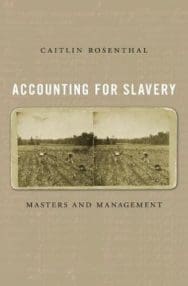
Accounting for Slavery: Masters and Management
Caitlin Rosenthal
Accounting for Slavery is a unique contribution to the decades-long effort to understand New World slavery’s complex relationship with capitalism. Through careful analysis of plantation records, Caitlin Rosenthal explores the development of quantitative management practices on West Indian and Southern plantations. She shows how planter-capitalists built sophisticated organizational structures and even practiced an early form of scientific management. They subjected enslaved people to experiments, such as allocating and reallocating labor from crop to crop, planning meals and lodging, and carefully recording daily productivity. The incentive strategies they crafted offered rewards but also threatened brutal punishment.The traditional story of modern management focuses on the factories of England and New England, but Rosenthal demonstrates that investors in West Indian and Southern plantations used complex accounting practices, sometimes before their Northern counterparts. For example, some planters depreciated their human capital decades before the practice was a widely used accounting technique. Contrary to narratives that depict slavery as a barrier to innovation, Accounting for Slavery explains how elite planters turned their power over enslaved people into a productivity advantage. The brutality of slavery was readily compatible with the development of new quantitative techniques for workforce organization.By showing the many ways that business innovation can be a byproduct of bondage, Rosenthal further erodes the false boundary between capitalism and slavery and illuminates deep parallels between the outlooks of eighteenth- and nineteenth-century slaveholders and the ethical dilemmas facing twenty-first-century businesses.
Reviews of Accounting for Slavery: Masters and Management
By paying close attention to slaveholders' methods of keeping accounts, Caitlin Rosenthal shows how and why they tried to reduce human beings to marks on a ledger. Anyone concerned with the sometimes dark history of management, data, and modern accounting practices needs to read this brilliant, carefully argued book.–W. Caleb McDaniel, Rice University Full of insights into the history of Atlantic slavery, Accounting for Slavery will force its readers to look with fresh eyes at the many freedoms and unfreedoms of the modern American workplace. This is an original book, which uniquely draws from and speaks to many disciplines, while written compellingly for a wide audience.–Jonathan Levy, University of Chicago
ALSO ON BOOKS FROM SCOTLAND
-


David Robinson Reviews: Our Noble Selves by Kate Atkinson
‘As I suggested at the start, there’s a whole heap of plot in Our Noble Selves – spies, murders, and …
-

‘They had spoken perhaps ten sentences each and it had already begun. Moira’s resentments, her preju …
-

Ayont the Thistle by Jim Mackintosh, Alan Riach and James Robertson
‘Nane ae this then but – ma hert daen its hing/ an yon wee smile ae yours in the saft smir ae the ga …
-

David Robinson Reviews: This Door of the Seas
‘He sees what he wants to. And it makes a kind of sense too – especially to colonists from Scotland, …
-

The Broons and Oor Wullie Celebrate their 90th Birthdays!
‘Whatever the future may hold, we can be sure that The Broons and Oor Wullie will always be a part o …
-

Pretty Valuable Things by A. J. Leslie
Harper considered Charles for a few moments, lit a cigarette, then said ‘we are treating it as murde …
FEATURED AUTHOR:
James McGonigal

James McGonigal is a poet was a lecturer in English at the University of Glasgow. He was, for many years, a close friend and confidant of the poet, Edwin Morgan and wrote an acclaimed biography of the poet, Beyond the Last Dragon, in 2010. McGonigal al …
FEATURED PUBLISHER:
Tippermuir Books Ltd

Tippermuir Books Ltd is a book publisher based in Perth. Established in 2009, Tippermuir seeks to add to the cultural life of Scotland by publishing interesting and worthy books in English and Scots. Our strength is our smallness and love of the writte …