


ABOUT THIS BOOK
PUBLISHER: James Clarke & Co Ltd
FORMAT: Electronic book text
ISBN: 9780718847616
RRP: £19.80
PUBLICATION DATE:
August 30, 2018
BUY THIS BOOK
As an Amazon Associate and Bookshop.org affiliate we earn from qualifying purchases.
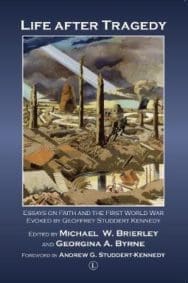
Life after Tragedy: Essays on Faith and the First World War Evoked by Geoffrey Studdert Kennedy
Michael W. Brierley
Georgina A. Byrne
Reviews of Life after Tragedy: Essays on Faith and the First World War Evoked by Geoffrey Studdert Kennedy
'Padres were given a rough ride by British memoir writers of the First World War. However, Geoffrey Studdert Kennedy, 'Woodbine Willie' to the soldiers, demonstrates how wrong they were. His reflections on the war and its implications for his own Christian faith resonate to this day. The innumerable insights in this powerful book make plain how the conflict's spiritual challenge still reverberates.'- SIR Hew Strachan, author of the Oxford University Press History of the First World War'Michael Brierley and Georgina Byrne have judiciously gathered these measured essays on ministry, suffering, tragedy, and hope: they leave the reader more immersed in sadness, admiration, desolation, and ultimately faith. After all, if Geoffrey Studdert Kennedy's life was a failure, so was that of Jesus.'- Sam Wells, Vicar, St Martin-in-the-Fields, London'Life after Tragedy is a profound and moving account of the struggle of Christian theology with the ravages of the First World War. . . . Essential reading for anyone trying to understand the earthquake that was the Great War.'- Jay Winter, Yale University'A significant contribution to the flourishing revisionist scholarship on religion and war, the central essays in this volume . . . offer a set of moving, often provocative reflections on the complex and transformative relations between faith and suffering that are as relevant now as they have ever been.'- Sue Morgan, University of Chichester, UK
Michael W. Brierley
Michael W. Brierley and Georgina A. Byrne are residentiary canons of Worcester Cathedral.
OTHER BOOKS BY THE SAME AUTHOR

ALSO ON BOOKS FROM SCOTLAND
-

David Robinson Reviews: Our Noble Selves by Kate Atkinson
‘As I suggested at the start, there’s a whole heap of plot in Our Noble Selves – spies, murders, and …
-
‘They had spoken perhaps ten sentences each and it had already begun. Moira’s resentments, her preju …
-

Ayont the Thistle by Jim Mackintosh, Alan Riach and James Robertson
‘Nane ae this then but – ma hert daen its hing/ an yon wee smile ae yours in the saft smir ae the ga …
-

David Robinson Reviews: This Door of the Seas
‘He sees what he wants to. And it makes a kind of sense too – especially to colonists from Scotland, …
-
The Broons and Oor Wullie Celebrate their 90th Birthdays!
‘Whatever the future may hold, we can be sure that The Broons and Oor Wullie will always be a part o …
-
Pretty Valuable Things by A. J. Leslie
Harper considered Charles for a few moments, lit a cigarette, then said ‘we are treating it as murde …
FEATURED AUTHOR:
Kapka Kassabova

Kapka Kassabova is a poet and writer of narrative prose. At the core of her work is a quest for transformative encounter with places and people. Margins, confluences, aftermaths – those are her places. In the last decade she has created a body of work …
FEATURED PUBLISHER:
Waverley Books

Quirky, special, niche and Scottish, Waverley Books publish well-designed, high-quality books on Scotland, history, trains, nostalgia, fiction, cookery. We’ve been publishing books for the past 25 years.