


ABOUT THIS BOOK
PUBLISHER: Baylor University Press
FORMAT: Hardback
ISBN: 9781481309479
RRP: £43.50
PAGES: 524
PUBLICATION DATE:
July 1, 2018
BUY THIS BOOK
As an Amazon Associate and Bookshop.org affiliate we earn from qualifying purchases.
Echoes of Scripture in the Gospels
Richard B. Hays
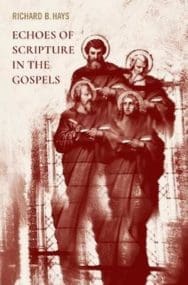
The claim that the events of Jesus life, death, and resurrection took place according to the Scriptures stands at the heart of the New Testaments message. All four canonical Gospels declare that the Torah and the Prophets and the Psalms mysteriously prefigure Jesus. The author of the Fourth Gospel states this claim succinctly: in his narrative, Jesus declares, If you believed Moses, you would believe me, for he wrote about me (John 5:46). Yet modern historical criticism characteristically judges that the New Testaments christological readings of Israels Scripture misrepresent the original sense of the texts; this judgment forces fundamental questions to be asked: Why do the Gospel writers read the Scriptures in such surprising ways? Are their readings intelligible as coherent or persuasive interpretations of the Scriptures? Does Christian faith require the illegitimate theft of someone elses sacred texts? Echoes of Scripture in the Gospels answers these questions. Richard B. Hays chronicles the dramatically different ways the four Gospel writers interpreted Israels Scripture and reveals that their readings were as complementary as they were faithful. In this long-awaited sequel to his Echoes of Scripture in the Letters of Paul, Hays highlights the theological consequences of the Gospel writers distinctive hermeneutical approaches and asks what it might mean for contemporary readers to attempt to read Scripture through the eyes of the Evangelists. In particular, Hays carefully describes the Evangelists practice of figural readingan imaginative and retrospective move that creates narrative continuity and wholeness. He shows how each Gospel artfully uses scriptural echoes to re-narrate Israels story, to assert that Jesus is the embodiment of Israels God, and to prod the church in its vocation to engage the pagan world. Hays shows how the Evangelists summon readers to a conversion of their imagination. The Evangelists use of scriptural echo beckons readers to believe the extraordinary: that Jesus was Israels Messiah, that Jesus is Israels God, and that contemporary believers are still on mission. The Evangelists, according to Hays, are training our scriptural senses, calling readers to be better scriptural people by being better scriptural poets.
ALSO ON BOOKS FROM SCOTLAND
-


The Scottish Colourists: Art & Life by Alice Strang
‘Together the quartet embodied a new spirit in Scottish art and they are celebrated as Scotland’s le …
-

David Robinson Reviews: Our Noble Selves by Kate Atkinson
‘As I suggested at the start, there’s a whole heap of plot in Our Noble Selves – spies, murders, and …
-

‘They had spoken perhaps ten sentences each and it had already begun. Moira’s resentments, her preju …
-

Ayont the Thistle by Jim Mackintosh, Alan Riach and James Robertson
‘Nane ae this then but – ma hert daen its hing/ an yon wee smile ae yours in the saft smir ae the ga …
-

David Robinson Reviews: This Door of the Seas
‘He sees what he wants to. And it makes a kind of sense too – especially to colonists from Scotland, …
-

The Broons and Oor Wullie Celebrate their 90th Birthdays!
‘Whatever the future may hold, we can be sure that The Broons and Oor Wullie will always be a part o …
FEATURED AUTHOR:
James McGonigal

James McGonigal is a poet was a lecturer in English at the University of Glasgow. He was, for many years, a close friend and confidant of the poet, Edwin Morgan and wrote an acclaimed biography of the poet, Beyond the Last Dragon, in 2010. McGonigal al …
FEATURED PUBLISHER:
Orkneyology Press

We are a bibliophile husband and wife team, Tom and Rhonda Muir of the Okney Islands. Orkneyology Press evolved from our website, Orkneyology.com. Curating remarkable stories by means of an independent press has been our ultimate goal since we began th …