


EXPLORE ISSUES



Christopher Whyte’s new poetry book is playful, mischievous, and unpredictable – a new departure for Gaelic literature in the twenty-first century, where readers can never tell what’s coming next or where they will be led. We’re delighted to feature an interview with the author, along with an excerpt from Mo Shearmon / What I Have To Say.
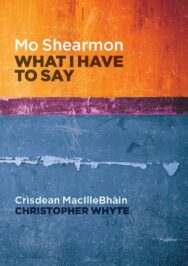
Mo Shearmon / What I Have To Say
by Christopher Whyte / Crìsdean MacIlleBhàin
Published by Francis Boutle Publishers
Peter Mackay interviews Christopher Whyte
Let’s begin with the title of the volume, which is also the title of the long poem that takes up more than half. ‘My Sermon’ makes you think of preaching or at least a serious, sustained argument, when what we actually get is rather different.
The Gaelic word ‘searmon’ is obviously related to the English word and both derive from Latin. But in Gaelic it can also mean something like ‘extended talking’ or even what they would call in Glasgow ‘shpeel’. I had in mind the more light-hearted meaning, of someone who enyoys talking, maybe likes the sound of his own voice, and jumps unpredictably from one subject to another.
Those constant changes are one of the attractive aspects of the poem and contribute to the general effect of light-heartedness. There is a lot of humour and mischief.
Yes, with the passage about the goblin who puts on a wig and pretends to be the minister, or generation after generation of students falling helplessly asleep at the lectures of one particular professor.
Also putting your critics into the poem, and representing their reactions before they even get the chance to speak. Not to mention the blanket…
The blanket is a faithful transcription of what a dear friend from Naples told me, about a household she came upon while active there as a social worker. A mother and four or five children who seemed to possess nothing more than an enormous blanket.
There are more serious sections too. Like about the deer and the squirrel, or that brief exchange with an English academic at a conference in Poland. Would you say that this is a structureless poem?
Not exactly. Not at all in fact.
How would you characterise the structure then? What makes you describe it in the afterword as ‘aleatoric’?
That’s a term I picked up when listening to serious music on Radio 3 as a teenager. It was fashionable in the 1960s to give instrumentalists choices about how they would play certain sections, or which versions they would play, so that the music never came out exactly the same way twice. They became co-creators if you like. The suggestion was that you could reorganise the sections of ‘Mo Shearmon’ as if you were shuffling a pack of cards, it would work just as well like that. To some extent this true, but not quite. Obviously I did my best to ensure variety of tone and subject matter, and there’s a definite softening and quietening as the end approaches.
Like the bit about the swallows in an Italian hilltop town around the rooftops at sunset – their ‘cuthachd aighearach’ or ‘exultant craziness’. That’s beautiful – and exuberant. How do you feel the poem relates to what you had written previously? I detect a gentleness, even a ‘benign’ quality that perhaps wasn’t there before.
I’m someone who has tended to work consistently with closed forms, because I found the discipline actually made putting the poems together easier. Here I was attempting something close to free verse paragraphs without, I think, ever quite succeeding. Regular lines kept wanting to intervene.
Are technical issues very significant for you as a poet?
I’d prefer not to make any hard and fast distinction between what you say and how you say it. The technique – there must be a better word! – is no less part of the message – if there is a message! – than the things you are talking about. That’s why I found myself translating the title into English in two different ways, without being able to decide between them – ‘What I Have To Say’ and ‘The Way I Talk’. Maybe there isn’t actually that much difference between the two.
Can you say something about the other poems in the book?
There are two sections, bringing together poems from summer 2016 and summer 2017. You see, again and again I conclude that I’m not going to write anything more in Gaelic, everything I have to say or needed to say has been said. You should never force yourself to write. Some of those poems helped me feel my way gradually back into the language, to get used to writing it again after a gap of nearly 8 years. They needed a lot of polishing and rewriting, whereas ‘Mo Shearmon’ practically flowed off the pen. Of course, I wasn’t using a pen!
Some focus on individual people, others deal with what it’s like to be growing old…
Well, I hadn’t reached 70 when I wrote them, but I have now, and getting close to the end of your life is certainly an issue you have to face up to.
In the past you took a very definite stance against doing and publishing English translations of your work. Yet as far as I can see, the translations here are your own.
I was very lucky to find an excellent and enthusiastic translator in Niall O’Gallagher, who of course is very well known now for his own work in Gaelic, quite different from mine. If it hadn’t been for Niall, probably nothing of mine would have appeared in print after I left for Budapest. He took the trouble to provide facing English versions and to submit them for publication. Otherwise I might effectively have fallen silent.
So why the change of approach?
Partly it was a practical question. Money isn’t available, as far as I know, to finance putting Gaelic poems into English. Whether it ought to be or not is a moot point. I wasn’t in a position to turn to someone and say, would you mind putting a poem of nearly 800 lines into English with a deadline and currently no certainty of publication? Perhaps I also felt that my point had been made and that, after 70, I could do whatever I felt like without raising too many problems. But the translation was done 5 years after the poem got written and specifically with a view to publication. Clive Boutle, who is a splendid man to work with, tends to concentrate on bilingual volumes and I was happy to go along with that. What I still find alien, and problematic, is Gaelic poets who produce the two versions more or less simultaneously, almost as if they were equivalents with the same value. For me there will always be an original and a translation. The latter could be done better and becomes superseded with time, so demands to be done over again.
You told me you’d recently been working on a book in Gaelic and Italian.
Yes, I’m very excited about that. The title is Non dimenticare gli angeli, Don’t Forget the Angels. Some of the translations are my own, others were done by Italian poets and translators working from my English literals. We’re hoping to locate a quality publisher in Italy willing to bring it out. Amazing as it sounds, I am pretty sure this would be a first. I mean, Gaelic appearing face to face with a European language that is not English in a sizeable book from one Gaelic author with a mainland European publisher.
Well, good luck with that! It sounds like an intriguing enterprise – let’s hope it can be successful.
Extract taken from Mo Shearmon / What I Have To Say
Mo shearmon a bhios uaireannan mar fhiadh sgeunach
nach fhaicear ach plathadh dheth am measg nan duilleagan
leis cho meata prìobhaideach ’s a tha e
agus an uair sin, gun rabhadh idir, mothaichidh tu dha
a’ streup suas air a’ bhràighe
is smaoinichidh tu gum faodadh sin a bhith
’na aisling bhon a tha am fiadh cho mòrail,
rìoghail, coileanta ’na mhosgladh
gach ball dheth a’ co-obrachadh le chèile
mar gun robh e ’g itealaich an àit’ a bhith siubhal,
creididh tu cuideachd gum b’ fheàrr math dh’fhaodte
nach robh sin ach ’na aisling bho nach bitheadh
modh no inneal ann an uair sin
beud no aimhleas a bhith beantainn dha,
bhiodh e do-ruighinn do-leònadh do-chiùrradh
mar gach rud a chruthaich mac-meanmna
no a thugadh dhuinn ann am bruadar,
cho iomlan, cuimir, do-chlaoidheadh –
agus their thusa riut fhèin:
‘Chan eil mise creidsinn ann an Dia sam bith,
chan e Crìostaidh no Muslamach a th’ annam,
cha bhi mi toirt mo thaic
do ghin de na seann-teagasgan
mu bhodach aosta, fòirneartach
no mu na h-àitheantan a sgrìobh e sìos
gu bhith gan leantainn leinn
no mu na peanasan sìorraidh
a tha a’ feitheamh oirnn
mur a bi sinn strìochdail gu leòr’ –
ach their thu cuideachd gur dòcha sin
am faireachdainn a bhiodh aig Dia fhèin
an uair a chruthaich e creutair ùr de fheòl ’s de fhuil
gu bhith ga shuidheachadh am bad àraidh dhen t-saoghal
What I have to say, at times
like a shy deer you only catch a glimpse of
through the foliage, because
it is so withdrawn and private
and then, without warning, you see it
climbing up the braeside
and you tell yourself it could be
a vision because its movements
are so majestic, kingly, consummate
all of its limbs working together
as if it were flying rather than running,
and you wonder if it might be better
for it to be a vision, because then
there would be no way or possibility
for harm or malice to reach it,
the deer would be inaccessible, invulnerable
like whatever the imagination produces
or something we see in a dream,
perfect, well-formed, invincible –
and you say to yourself:
‘I don’t believe in any kind of a god,
I am neither a Christian nor a Muslim,
I don’t support any of the old doctrines
about a venerable, violent old man
or the commandments he wrote down
for us to follow,
or the eternal punishment
waiting on us
if we are not sufficiently obedient’ –
but you also say that maybe this
was how God himself felt
after making a creature of flesh and blood
to set down somewhere in the world
Mo shearmon a tha cho annasach nua-fhasanta
’s gum bi èiginn air a’ Ghàidhlig
a cuarain as cliste ’s as luaithe thoirt a-mach
is ruith gu bras air a ceann dìreach ’na mo dhèidh,
a dh’fhaicinn dè tha dol a thachairt,
dè tha dol a dh’fhàs aiste
agus modh-obrach cho mùiteach sgaogach agam
nach ro-aithnichear càil, tha gach
earalas no ro-aithris gun stàth,
thig maoim air a’ chànan bochd seo!
What I have to say, so strange and innovative
Gaelic will have to look out the fastest,
most agile sandals it has and start
scampering after helter skelter
to find out what is going to happen, what is going
to become of it, seeing I go about things
in such a volatile and inconsistent way
it’s impossible to predict anything in advance,
forecasts and precautions have no meaning –
this poor language will enter into panic!
Mo shearmon mar chuthachd aighearach nan gobhlan-gaoithe
ann am baile beag san Eadailt air barr cnuic
le bòtharan corrach, caola ’s na taighean cho faisg
air a chèile, bidh tu ri plosgartaich mun ruigear leat
mu dheireadh an sguèar a dh’fhosglas air a’ mhullach –
mothaichidh tu gu h-obann dha na gobhlanan-gaoithe
gan cur air bhoil le camhanaich an latha
dìreach mar a bhios a’ chlann a’ ruith
a’ glaodhach ’s a’ brùchdadh a-mach
sna deich mionaidean mus tèid iad dhan leabaidh
an nàdar fhèin a’ fàsgadh bhuap’
gach aon luirg air smioralas no guaineas,
a’ cuimhneachadh mar a bhrùthas neach spong
gu teann eadar a mheuran gus a h-uile
boinn’ a fhliuich’ a dh’fhanas innte fhuadachadh –
na gobhlanan-gaoith’ gu trang a’ figheadh sa chamhanaich
lìn aibhisich len goban, a’ glacadh
snàthainnean an dorchadais an siud ’s an seo,
chan e na cuileagan no na meanbh-bhiastagan
itealach eile a cheapas iad, ach cinn
sreanganan na duibhr’ ag udal san adhar,
iad gu dìcheallach a’ saigheadh
eadar nam bunnacha-bac, a’ teannachadh
na lìn ud anns an tèid an’ oidhch’ a ribeadh
gu mall rùnaichte dh’aona-ghnothach,
plangaid dhubh a’ teàrnadh oirnn uile
a cho-èignicheas eadhon an fheadhainn as buaireasaiche
’s as an-fhoiseile dhen chloinn a ghèilleadh
ris a’ chadal a dheòin no a dh’aindeoin
What I have to say, like the exultant craziness
of swallows in an Italian hilltop village
with twisting, narrow lanes and the houses
so close to each other, you are panting
before you finally reach the square
that opens at the summit – all of a sudden
you notice the swallows going crazy in the twilight,
just the way children will run around
shouting and exulting in the ten
minutes before they get into bed,
nature itself squeezing out of them
every last trace of energy or mischief,
making you think of how you squeeze a sponge
tightly between your fingers to expel
every last remaining drop of moisture –
the swallows busy weaving in the dusk
a huge net with their beaks, catching
the strands of darkness here and there,
it’s not midgies or other flying
insects they intercept, but the ends
of threads of darkness floating in the air
as diligently they dart back and forth
between the eaves, intently weaving
that net tighter, gradually and deliberately
so night gets trapped in it,
a dark blanket descending on us
that forces even the most tempestous
and restless of children to yield in the end
to sleep, even if they’re still not tired of
What I have to say
Mo Shearmon / What I Have To Say by Christopher Whyte / Crìsdean MacIlleBhàin is published by Francis Boutle Publishers, priced £12.00.
RELATED BOOKS

ALSO ON BOOKS FROM SCOTLAND
-

David Robinson Reviews: The Loch of the Bees
‘The past’s current flows through the characters in his fiction so strongly that it almost becomes t …
-

The Nightkeeper’s Apprentice by Jude Reid
‘She’d never seen anything like it. The whole sky was lit up in ribbons of colour – blue, green, yel …
-

David Robinson Interviews: Gavin Francis
‘He’s not my GP so I can’t say this for sure, but based on this book – wise, informed, well-written, …
-
The Cromarty Library Circle by Shona MacLean
‘No one in the room could have been unaware of what it was that Dr Fraser alluded to. The horrors pe …
-

In Search of Gems by Kenneth Steven
‘It still amazes me that these magnificent shells grow in a river. Never mind whether they have pear …
-

Winterbourne by Elisabeth Wolf
‘The Coopers stared at each other for a second, two seconds. ‘It’s a sign—’ said Cooper.’
FEATURED AUTHOR:
John Gerard Fagan

John Gerard Fagan is a writer from Glasgow / Scotland who writes in Scots, Scottish Gaelic, and English. His debut memoir Fish Town about leaving Scotland to live in Japan was published by Guts Publishing. His second book Silent Riders of the Sea about …
FEATURED PUBLISHER:
Orkneyology Press

We are a bibliophile husband and wife team, Tom and Rhonda Muir of the Okney Islands. Orkneyology Press evolved from our website, Orkneyology.com. Curating remarkable stories by means of an independent press has been our ultimate goal since we began th …