


EXPLORE ISSUES



‘Most novels I’ve read don’t dig quite as deeply into the past as this, and the few that do don’t integrate the excitement of historical research into the story as thoroughly. Here I have only briefly touched on how Thom has been able to open up her family’s past in a way that brings the dead back to life.’
In this latest review of Eleanor Thom’s new novel Connective Tissue, David Robinson delves deep into the extensive research behind the book, its unique take on historical fiction and the ways in which it blurs fiction and biography.
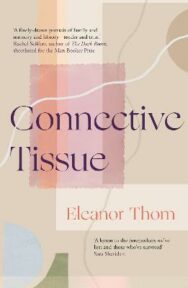
Connective Tissue
By Eleanor Thom
Published by Taproot Press
If you want the cold facts about what happened to the aunt Eleanor Thom never knew, go on the Yad Vashem website, the World Holocaust Remembrance Centre in Jerusalem, type her name into the Book of Names, and there it is. Each of the four and a half million Holocaust victims identified so far has a document which also shows where and when they were born, and what happened to them. Click through, and each has a map with four coloured pins on it: a blue one for where they were born, a green one for where they usually lived, a blue one for where they lived during the Second World War, and a red one for where they were murdered. For Ruth Tannenbaum, there are only two pins: one in central Berlin coloured blue, green and yellow, and the red one 350 miles to the southwest, marking the place where, at the age of five, she was murdered. Auschwitz.
When Eleanor Thom started writing her novel Connective Tissue, she didn’t know about Ruth. She knew that her grandmother Dora was from Berlin, that she was Jewish, that she grew up in a Jewish children’s home and worked in a Jewish old people’s home; that she came to England in 1938, met and married a Scot, and moved to Elgin. But Dora didn’t talk much about the first 22 years of her life in Berlin. Her four daughters thought she’d had a child called Ruth who had to be left behind, but no-one was sure what had happened to her. When Dora died in 1980, all of the family’s German past died with her.
Except it didn’t. Even in the two paragraphs you have just read, there are tendrils that can bring so much of it back to life. And that’s exactly what Eleanor Thom has done in Connective Tissue, which took her a decade to research and write. It is, she emphasises, ‘not a Holocaust novel’: she wasn’t there and doesn’t want to write as if she was. Dora’s family at 9 Meyerbeerstrasse and her cousin’s household at 26 Alexanderstrasse, Berlin – the place marked with that multicoloured pin on the map of Ruth’s short life – their story is what she wants to write about. Who were they, these people whom history has blanked out of her family’s memory? What were their lives like? How did they live? How did Dora get away to England, when she didn’t have any money, any relatives there, and didn’t speak the language?
The novel is set in both Third Reich Berlin and the near-present, when Thom – lightly fictionalised as Helena rather than Eleanor – is giving birth in an Ayrshire hospital. There are problems with uterine fibroids and the doctors are asking annoying questions about genetics; meanwhile, one of the mothers in the maternity ward has her baby taken away by social services. Parallels with the past bubble up, because Helena is researching her way into Dora’s life, and it’s clear that Thom is fascinated by the whole theme of how much or how little flows through from one generation to the next.
Before Thom could write fiction, though, she had to dig up the facts. Finding out about Dora after she arrived in Britain aged 22 was comparatively easy: she could ask her mother or her three aunts. But finding out about Dora’s life in Berlin before she was kicked out of Germany as a stateless Jew in 1938 was a lot harder.
The Tannenbaums weren’t remotely rich. They couldn’t afford the vast sums it cost to send their children on the Kindertransport trains to Britain. They didn’t have rich relatives in other countries who could help out. They didn’t have second homes or art treasures to sell or barter. They were – like 40 per cent of Berlin’s Jews even before Hitler’s rise to power, working-class, poor even: in their case renting a sparsely furnished inner-court flat north of Alexanderplatz. The very kind of people swept away by the Holocaust without leaving anything – diaries, photos, memoirs – behind.
If you want proof of how easily Berlin’s Jewish poor have slid into historical oblivion, it’s written in the very fabric of the city’s streets. For the last three decades, the Stolperstein project set up by German artist Gunther Demnig has commemorated individual Holocaust victims by placing a small brass plaque in the street or pavement outside their last home. Throughout Europe, there are now 100,000 of them, more commonly outside middle-class homes than working-class ones as the former are more likely to have Holocaust survivors or descendants. Certainly, there’s no Stolperstein outside Ruth Tannenbaum’s last home, 26 Alexanderstrasse, where she lived with Dora’s cousin Meta and her husband, who adopted Ruth and who also died at Auschwitz. Or at least, not yet.
If there ever is, it will be down to Thom’s determination to find out more about Dora’s early life in Berlin and the daughter she had to leave behind there. Connective Tissue derives a lot of its power from not spelling out the obvious facts of life in the city under the Third Reich. There’s no need. We know all about its horrors and the tracks that lead to the gas chambers. Except, we don’t quite remember where and when they started, the precise moment at when antisemitism went lethally official. So when Dora gives birth to Ruth in a German hospital in 1937 or takes her to a Jewish mother and baby home in the city, readers’ imaginations are already in overdrive, prepared for the worst.
What form that story would take, though, turned out to rely very much on that Jewish mother and baby home in Berlin. Its records had recently been digitised and when Thom emailed a New York German-Jewish history archive to ask whether they knew anything about Dora, a particularly alert intern remembered the Tannenbaum surname, and checked a book of recently added Holocaust sources. There it was: the first official confirmation that Thom’s grandmother did have a daughter in Berlin – and she was indeed named Ruth.
At this point, Thom has names and addresses with which to open up the Berlin archives. There’s a social workers’ file running to 100 pages because Ruth had to be adopted by Dora’s cousin until she could bring her over to Britain, which she would have done if the Second World War hadn’t got in the way. There were letters from Dora to her cousin, in which she gave enough detail about her life as a maid in wartime London, and her yearning for Ruth, for Thom to fully imagine and transmute into fiction.
Most novels I’ve read don’t dig quite as deeply into the past as this, and the few that do don’t integrate the excitement of historical research into the story as thoroughly. Here I have only briefly touched on how Thom has been able to open up her family’s past in a way that brings the dead back to life. Fascinatingly, though, her fiction has also changed the facts of her own life.
In 1938, Dora got a letter ordering her out of Germany within three weeks. Because her father had been born in what is now Romania but was then part of the Austro-Hungarian Empire, he was officially stateless. That meant that Dora was too, even though she had never lived anywhere else other than Germany. It also meant that Thom’s post-Brexit application for German citizenship on the grounds of having a German grandmother was initially turned down. This was patently unfair, and Thom’s research was used as part of a successful campaign to extend German citizenship to the descendants of people like Dora who had been kicked out of Germany by the Nazis.
Thom got her EU passport last November. Earlier this summer, she went across to the Bundestag – the very building where Hitler had once promulgated his antisemitic laws – to join in an official celebration of the fact that she was now something the Nazis claimed her grandmother Dora and aunt Ruth could never be: a German citizen.
Connective Tissue by Eleanor Thom is published by Taproot Press, priced £11.99.
RELATED BOOKS

ALSO ON BOOKS FROM SCOTLAND
-


Flight Patterns by Lorna J. Waite: An Appreciation by Janette Ayachi
‘I’ve recently heard poetry archives described as ‘fugitive, ephemeral’, but here the wish of collec …
-

The Scottish Colourists: Art & Life by Alice Strang
‘Together the quartet embodied a new spirit in Scottish art and they are celebrated as Scotland’s le …
-
David Robinson Reviews: Our Noble Selves by Kate Atkinson
‘As I suggested at the start, there’s a whole heap of plot in Our Noble Selves – spies, murders, and …
-
‘They had spoken perhaps ten sentences each and it had already begun. Moira’s resentments, her preju …
-

Ayont the Thistle by Jim Mackintosh, Alan Riach and James Robertson
‘Nane ae this then but – ma hert daen its hing/ an yon wee smile ae yours in the saft smir ae the ga …
-

David Robinson Reviews: This Door of the Seas
‘He sees what he wants to. And it makes a kind of sense too – especially to colonists from Scotland, …
FEATURED AUTHOR:
Julia Kelly

Julia is a mother, writer and teacher. She has been longlisted for The Mslexia Novel Prize, The Exeter Novel Prize, Penguin WriteNow and the Bath Novel Award. In 2021 she won the Blue Pencil First Novel Award. Having grown up in a house without televis …
FEATURED PUBLISHER:
Edinburgh University Press

Connecting people and ideas to inspire creative thinking, open new perspectives and shape the world we live in. Our ambition is to create a community of authors, editors, advisors and practitioners committed to publishing world-class academic research …