


EXPLORE ISSUES


‘They say it takes a village to raise a child. I believe it takes a village to get someone through serious illness.’
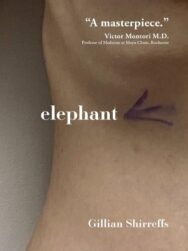
Gillian Sherriffs has written and compiled a unique account of her experience with breast cancer, one that is sure to resonate with many readers. Here, we extract the book’s prologue, which we hope will lead you to seek out this beautifully-produced and honest book.
Elephant
By Gillian Sherriffs
Published by Into Books
Elephant is a book that found me. I’m glad that you have now found it.
It’s a book about connections and I’m grateful to be connected to you.
I have to confess this is not the book I expected you to be reading. Nor is it the book I expected to be writing. Nor, indeed, is it the book my publisher, the brilliant Stephen Cameron of Into Creative, expected to be publishing.
The book I was writing is called The Accidental Immortals. It’s about three women who, in the Scotland of the 1600s, become accidentally immortal.
That was a book about immortality.
The book that found me is about mortality.
My own mortality.
Elephant is the story of a writer diagnosed with breast cancer.
I’ve been writing about illness for the last 18 years. At first, I didn’t have an option. I’d just been diagnosed with multiple sclerosis and was on bedrest, having lost the feeling from my toes to my chest. I was on my own for long periods and I was bored. I was also finding it difficult to sleep due to the nerve pain that accompanied the numbness.
I would wake in the wee small hours with words rattling around my head. During long days of bed rest, I would try to make sense of them. As I did, the words seemed to arrange themselves into long thin poems, which was a surprise, because I’m no poet.
These long thin poems told the story of those initial weeks and all the strangeness that accompanied the sudden onset of serious illness.
After months – and twelve poem-shaped slivers of memory – words stopped waking me up. By this time, though, I was hooked. I’d discovered that when I was fighting with word after word and line after line, I was not aware of the invisible shards of glass sticking into my skin. When I stopped writing, the neuropathic pain would return.
As I ventured back out into the world, the feeling having returned to my body, I made an unwelcome discovery. People were no longer at ease around me.
I seemed to make them uncomfortable.
I didn’t even need to speak to do so. My mere presence was all that was required.
My initial reaction was to feel shame, which I couldn’t understand.
I’d done nothing wrong, so it didn’t make sense to feel this way.
But I did.
My next reaction was to write.
I wrote stories in which I would give a character a neurological illness to see what would happen to them and the people around them; a sort of working out. It was also my way of trying to connect. To normalise illness. To cry out into the void that it can happen to any of us.
At any time.
It’s therefore not surprising that fourteen years later when I found a lump and was told there was ‘something’ in my right breast that shouldn’t be there, my response, once again, was to write.
I wrote my way through diagnosis, treatment and the aftermath of treatment. Sometimes longer pieces trying to make sense of the situation, but most often just short bursts of words. Reaching out to friends, family, clinicians, and to anyone who might notice me waving as I bobbed along on the sea of social media.
If emails, text messages and tweets are the letters of today, then I might be so grand as to call Elephant an epistolary for our times, but that sounds really pretentious.
As I wrote the emails, text messages and tweets that appear in Elephant, I didn’t expect they would one day form the book you now hold in your hands, but no matter how hard I tried to apply my mind to fiction, the story that is Elephant refused to leave me alone. It demanded my attention until I finally succumbed.
It’s the craft of the writer to curate and that is the work I found myself doing. I uncovered over 150, 000 words I’d written from July 2021 until September 2023, and I had to decide where, within them, the story lay.
Then there was the problem of what to call this unusual creation of mine. I struggled with words and phrases. At some point I realised that this book is what I keep doing. It’s an attempt to normalise illness. To make friends with the elephant in the room.
It reminded me of something.
Years ago, I bumped into a friend of a friend in the street.
She smiled and asked, ‘How are you?’
I was struggling with nerve pain and, unusually for me, I deviated from the standard reply.
I didn’t say, ‘Good. How are you?’
Instead, I said something along the lines of, ‘Not brilliant, actually.’
She broke eye contact, muttered about somewhere she needed to be, and was gone.
I went home and, in a matter of minutes, wrote the untitled poem that begins this book.
A book that is not just about illness and my desire to bring the experience of it out into the light but, just as importantly, one that is about friendship and kindness.
On the 24th of May 2022, I wrote the following words:
In the last 250 days I’ve had eight cycles of pre-surgical chemo, two surgeries, fifteen sessions of radiotherapy and am now in cycle three (of fourteen) of TDM1 treatment.
I lost my hair, my eyebrows, my eyelashes, my sense of safety, my sense of dignity (did I mention the campylobacter infection that accompanied the sepsis…?), but not my terrible sense of humour.
I couldn’t have managed it without each and every person who wrote me an email, sent me a text, posted me a letter, hand-drew me a card, knitted me a hat, gave me a scarf, bought me thick woolly socks, sent me flowers, went for a walk with me, made me banana bread, supplied me with Pan Drops, sent pyjamas across the Atlantic, carefully chose a book for me, dropped off a care package at the door, said a prayer for me, or took a moment to wish me well.
Getting to day 250 takes a village.
I’m very grateful for mine.
They say it takes a village to raise a child. I believe it takes a village to get someone through serious illness.
Some members of my village appear in Elephant. Others do not.
This book tells the story of 800 days by carving a path through the more than 150,000 words I wrote during that period. The names that do appear represent all those that don’t.
The people who are mentioned in Elephant are real. They are family members, friends, neighbours, colleagues and clinicians. However, some names have been pseudonymised.
Elephant by Gillian Sherriffs is published by Into Books, priced £30.
RELATED BOOKS

ALSO ON BOOKS FROM SCOTLAND
-

David Robinson Reviews: The Loch of the Bees
‘The past’s current flows through the characters in his fiction so strongly that it almost becomes t …
-
The Nightkeeper’s Apprentice by Jude Reid
‘She’d never seen anything like it. The whole sky was lit up in ribbons of colour – blue, green, yel …
-

David Robinson Interviews: Gavin Francis
‘He’s not my GP so I can’t say this for sure, but based on this book – wise, informed, well-written, …
-
The Cromarty Library Circle by Shona MacLean
‘No one in the room could have been unaware of what it was that Dr Fraser alluded to. The horrors pe …
-
In Search of Gems by Kenneth Steven
‘It still amazes me that these magnificent shells grow in a river. Never mind whether they have pear …
-
Winterbourne by Elisabeth Wolf
‘The Coopers stared at each other for a second, two seconds. ‘It’s a sign—’ said Cooper.’
FEATURED AUTHOR:
Mairi Kidd
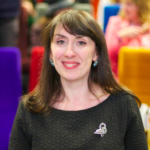
Mairi Kidd is the Director of The Saltire Society. She leads on delivery of the Society’s programmes championing the arts and culture of Scotland. She has previously worked at Creative Scotland providing strategic leadership for literature, languages a …
FEATURED PUBLISHER:
Vagabond Voices

Vagabond Voices is an independent publisher based in Glasgow, committed to introducing new titles from Scottish authors and translating fiction from other languages. We also publish poetry and polemics. Our carefully selected list aims to reflect liter …