


EXPLORE ISSUES

‘As a child I had wondered, of course, why I was so different. Why I hadn’t inherited the boldness, the temper, the sheer brawliness of my mother’s boisterous family. Or the dark good looks and humour of my father’s side.’
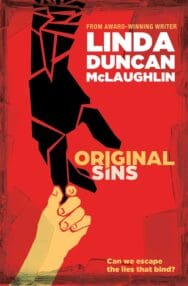
When Joanne, a troubled woman, discovers her birth father was a serial killer, she’s forced to confront a terrible question: what if the darkness in her own soul is a direct inheritance from him? This is an intimate and chilling psychological thriller. In this extract we find Joanne at her adoptive mother’s funeral feeling like an outsider.
Original Sins
By Linda Duncan McLaughlin
Published by Into Books
I hide out in the crematorium loo, shaking, searching my bag for non-existent hankies and fishing awkwardly for the end of the loo-roll in the dispenser. Who designs these things? I can’t believe what I’ve just done. I know what they’ll be thinking: Always was an odd yin, right enough, but still, her own mother’s funeral… And there’s still the purvey to get through. I hear the door open and know it will be one of the aunts.
‘Joanne? Are you in here, love?’
It’s Mina. Best of them.
‘Yeah, I’m here.’
‘Thought you might be,’ she sighs. ‘I’m sorry you got upset there, pet, but listen – we need to get down to the hotel, and nobody’ll be able to move till we go. Your Aunt Annette’s getting a wee bit… Well, you know what she’s like.’
‘I’m just coming, Auntie Mina,’ I manage. ‘I’ll be out in a minute.’
‘Okay, love. I’ll wait for you outside.’ The door clicks shut.
I sit a moment longer, clutching my fistful of loo-roll scraps, listening to the silence. There will be a show of sympathy, of understanding, for what has just happened. But later the cabal will convene, condemning me for flouting the rules, for committing the worst possible crime, of drawing attention. This wasnae about her, they’ll say, it was about her mammy.
And they will be right. This is about my mammy – but not the one who’s just translated into smoke and ashes, wisping into the ether. This is not about Alice, the only mammy I’ve ever known, Mum, who took me in and brought me up as her own. This is about my real mammy, the one who gave me away when I was barely two months old.
When they find out that I’ve decided to try to find that one, the shit is most definitely going to hit the fan. I promised Mum that I would never try to trace my birth mother, and they all know that. But Mum is dead now and, all the way through her painful dying, at the back of my mind was the knowledge that at last I would be free to betray that promise. Even though the guilt of that betrayal will probably stay with me forever.
But I need to – have to – know who I am. Who I come from. If I don’t do it now I never will. And if that costs me all of the family I have left, then that’s the price I have to pay.
And that actually is quite funny, isn’t it?
*
The funeral purvey is everything I expected. The hotel is overwarm, over-chintzy, and someone has over-ordered the buffet: platters of sandwiches and sausage rolls and bright cakes are piled high on the tables. My one insistence had been on an open bar, and people are already well-furnished with pints and wineglasses and are chatting animatedly. The room hums with a rush of post-funeral relief.
At first, people tip-toe around me, unsure whether to speak to me or not. Mina sits me down at a table buttressed with cousins, and there is an awkward pause as we all look at each other. In recent years I’ve given up trying to keep track of exactly how many cousins I have; I don’t even know the names of some of the newer additions. And of course, technically, I’m not related to them at all.
Do I sound less than familial? Perhaps. And it isn’t necessarily just because I’m adopted – I know plenty of adopted people who have relationships with their families every bit as close as any blood tie could be. Not finding out till I was fourteen was a little traumatic, maybe, but hey, I was adopted in the 60s; they did things differently then, didn’t they? Mum and Dad thought they were doing the right thing, not telling me. They’d always intended to, they said, but somehow the right moment had never arrived; by the time it did, accidentally, I was just about old enough to handle it.
As a child I had wondered, of course, why I was so different. Why I hadn’t inherited the boldness, the temper, the sheer brawliness of my mother’s boisterous family. Or the dark good looks and humour of my father’s side. I was totally unlike my cousins: not in the least physically brave, hopeless at ball games, uninterested in their feuds and constantly-changing alliances. While they romped through urban jungles, I found my adventures in books; when I did well at school, they were both contemptuous and faintly intimidated. I was an alien, unable to join their tribe; finding out there was a perfectly good explanation for that was, in some ways, a relief. And as their juvenile teasing morphed into a darker bullying I built a wall of don’t-care bricks against it until it was strong enough to repel any attempt at attack.
I was a burr under their saddle, however. And the older I grew, the more spiky my defences, the more of an irritation I became. Staying on at school was bad enough, but going to university, and sponging off my parents, and thinking myself better than them, and moving to England (of all places), and landing a cushy, under-worked, over-paid job in some soft southern college? It just served to compound my crimes – and I didn’t care, in fact I welcomed the growing distance. And while they looked askance at my weird taste in clothes and music, I failed to hide my lack of interest in telly soaps and Z-list celebrities. A pity? Perhaps. Could try harder? Almost certainly. I did regret the lack of love between us, now that I was older and more forgiving – but it was equally too late to try mending those fences now.
Original Sins by Linda Duncan McLaughlin is published by Into Books, priced £11.99.
RELATED BOOKS
ALSO IN THIS ISSUE
 The Wise Witch of Orkney by Anna Caig
‘Elspet turns her thoughts to what lies ahead but her foresight fails her; this is a situation beyon …
ALSO ON BOOKS FROM SCOTLAND
-

‘They had spoken perhaps ten sentences each and it had already begun. Moira’s resentments, her preju …
-

Ayont the Thistle by Jim Mackintosh, Alan Riach and James Robertson
‘Nane ae this then but – ma hert daen its hing/ an yon wee smile ae yours in the saft smir ae the ga …
-

David Robinson Reviews: This Door of the Seas
‘He sees what he wants to. And it makes a kind of sense too – especially to colonists from Scotland, …
-
The Broons and Oor Wullie Celebrate their 90th Birthdays!
‘Whatever the future may hold, we can be sure that The Broons and Oor Wullie will always be a part o …
-
Pretty Valuable Things by A. J. Leslie
Harper considered Charles for a few moments, lit a cigarette, then said ‘we are treating it as murde …
-
Shadow of Madness: A Q & A with D. V. Bishop
‘Yet a great novel of historical fiction also has us escape the here and now by immersing us in the …
FEATURED AUTHOR:
James Crawford

James Crawford is a writer and broadcaster, and Editor-at-Large at Birlinn Ltd. Born in the Shetlands in 1978, he studied History and Philosophy of Law at the University of Edinburgh, winning the Lord President Cooper Memorial Prize. James’s first majo …
FEATURED PUBLISHER:
Charco Press

Edinburgh-based Charco Press, founded by Samuel McDowell and Carolina Orloff, aims to change the current literary scene to make room for a kind of literature that has been overlooked’ and ‘expose the UK reader to new and exciting voices. Charco Press i …