


EXPLORE ISSUES



‘He’s not my GP so I can’t say this for sure, but based on this book – wise, informed, well-written, wide-ranging – he strikes me as being the very model of what one should be.’
David Robinson speaks to Gavin Francis about his latest book, The Unfragile Mind, and his experiences as a GP that have informed his writing.
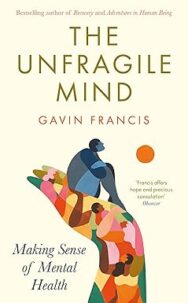
The Unfragile Mind
By Gavin Francis
Published by The Wellcome Collection
Go into the clinics of most American psychiatrists, and somewhere on their shelves you’ll usually find a chunky copy of DSM-5. In its revised edition, the 1,120 pages of the fifth edition of the American Psychiatric Association’s Diagnostically and Statistical Manual is supposed to define the latest frontiers of our knowledge about mental illness and how to treat it. In Europe, its equivalent is the sixth chapter of the online database, ICD-11.
At a time when between a quarter and a fifth of young people now suffer from a mental disorder and one in four adults are prescribed psychiatric medication, you might expect both of these manuals to be the very cornerstones of our collective fight against mental illness. Yet to Gavin Francis, the award-winning writer and Edinburgh GP, their rigid categorisation of mental illness isn’t particularly helpful. One day, he writes, it will seem ‘as overconfident as the old phrenology charts which claimed that human faculties could be gauged by the shape of the skull’.
His latest book – The Unfragile Mind: Making Sense of Mental Health – is, he tells me, ‘a call to reconsider some of the ways we think about mental ill health and do so with a bit more curiosity and humility. At the moment, a lot of people claim that we know that these conditions are facts of nature, whereas what we increasingly find, when we look into many of them, is that they’re aspects of culture, and vary hugely between cultures.’
Many people might not realise just how much of GPs’ time touches on patients’ mental health – Francis reckons between a third and a half of his appointments. In them, however, he seldom uses the diagnostic manuals. For one thing, he notices that they increasingly suggest that one syndrome might have a high risk of another when a) this might actually not be the case and b) would thus contravene the ‘Do No Harm’ principle of medical ethics. ‘Instead,’ he says, ‘I am much more likely to talk about my patients’ feelings and their suffering than their diagnoses.’
This doesn’t mean that he dismisses the mental health diagnostic manuals altogether: they might, he admits, have some value for research and in specialised hospitals, but less so ‘in the unfiltered, mild to moderate end of the spectrum of human unhappiness’ of the GP’s clinic. ‘Lots of psychiatrists,’ he adds, ‘share my concern that by widening the conversation about mental wellbeing so broadly, many people are starting to think of themselves with pathological categories of illness rather than difficulties in thinking or difficulties in the way they feel. This is making mental health services so stretched that when you have a severe, even life-threatening, mental health condition, it is harder to get seen.
‘There’s a wonderful memoir by a psychiatrist here in Lothian called Rebecca Lawrence. Her book is called An Improbable Psychiatrist. She has a severe mental health condition that waxes and wanes but it hasn’t stopped her in her career. She writes about this issue too: that sometimes there’s so much talk about mental health that patients really struggling with it become difficult to hear. It’s a real issue for me as a GP, trying to get patients seen in the system who are, for example, troubled with severe schizophrenia or schizoaffective disorder or bipolar disorder and for whom I can’t get proper support.’
Because of the numbers involved, much attention will inevitably be focussed on what Francis has to say about ADHD and autism, which he writes about in the last of his book’s 12 chapters. In it, he notes that referrals for adult ADHD psychiatric assessment in Edinburgh have recently gone from 3 to 25 per cent within five years due to metanosis, ‘a phenomenon in which one becomes aware later on in life that one’s characteristics might be accorded a clinical diagnosis’. In the US, 7 million children have now been diagnosed with ADHD, up from 2 million in the 1990s. These are huge numbers, as are those (some 3 per cent of the UK’s population) now affected by autism – so huge, in fact, that Francis writes that autism ‘has moved from being something best understood as a disorder into the territory of a common manifestation of the way in which humans think, feel and exist’.
‘Obviously,’ he explains, ‘there are extreme ends of the spectrum whereby you would see that this becomes a disorder. But in nature, there’s no cut-off line. Wouldn’t it be nice if our culture could be a bit more accepting of difference?’
Because we still know so little about the electrical, chemical and neurological processes by which our brains handle experience and emotions, Francis argues, we shouldn’t be so quick on the draw with our mental health diagnoses. ‘I’m simply asking that we approach that with a bit more humility, rather than pretending we understand it. Because, let’s face it, in 30 years’ time, the theory will be completely different.’ Surprisingly (to me anyway), he adopts a similarly sceptical attitude to claims that any one particular therapy is inherently more effective than any other. ‘It doesn’t seem to matter,’ he writes, ‘whether someone engages in family systems theory or Gestalt, psychoanalysis or CBT, or whether they access counselling through a specialist counsellor or a psychiatrist, a mental health nurse or a GP.’ Whatever the system, he adds, ‘it’s the connection with the therapist that matters, and how much that person demonstrates genuine engagement with your problems that is going to help you get better.’
The key word here is, I think, humility: with Francis, it is a necessary part of the job of being a GP, with its ‘uncommon privilege of seeing through the facades we hide behind’. It is also something he noticed in his best mentors, learnt himself on his extensive travels, or found in the work of others, like intercultural psychiatrist Dinesh Bhugra, who has pointed out that in many countries what we would recognise as symptoms of depression would not be medicalised at all.
I ask how, given each consultation at his clinic is only meant to last 15 minutes, he manages to reach the emotional depths required, and there’s a certain humility there too (‘It’s something I’m working on and will work on my whole life’). ‘Some people are very straight to the point and want to open up straight away,’ he says. ‘With others, it takes many appointments to gain their trust. Some people are really open to new approaches, others come in with a very fixed idea of what they think they need, what they want to get out of our consultation. I don’t have the luxury of choosing: I see everybody.
‘So some people might come in with a very particular idea of depression as a lack of serotonin in the brain, and they’re really keen on getting antidepressants from me. (In his book, he describes the once-popular theory that depression is caused by a deficiency of serotonin as a modern equivalent of the medieval theory of the body’s humours). I’ll chat to them, explore their ideas, concerns and expectations, and I’ll end up prescribing them some and they’ll benefit from it.
‘Someone else might say that they’ve just realised that their relentless, chronic low mood probably dates back to a period in their teens when they were kicked out of the house by their mother, and that was 50 years ago, but they’ve realised that they’ve lost the ability to trust people and that is the source of the problem. And with someone like that, I probably wouldn’t be suggesting straight away that we reach for a prescription, although it’s possible, but I would be starting to explore that and talk about what that means for them and whether they can use that insight to rebuild a sense of trust in people around them and look again at what they love, what makes them happy in life, what makes them feel as if they’re flourishing.
‘With someone who comes to me with, for example, worries that they have a bipolar illness because their moods are all over the place, I’ll ask them what they mean by that, and about what the pressures in their life in terms of secure place to live, secure happy relationships, whether they’re economically stable or precarious, whether they’ve got satisfying work or boring work that they hate – all these kinds of things are going to have an influence on whether they feel settled and at ease in their mind.’
In none of those cases, though, will Francis reach for a diagnostic manual. He’s not my GP so I can’t say this for sure, but based on this book – wise, informed, well-written, wide-ranging – he strikes me as being the very model of what one should be. ‘He is the best physician, who is the most ingenious inspirer of Hope,’ Coleridge once wrote, and ingeniously inspiring hope about a bleak subject is exactly what this book does.
The Unfragile Mind, by Gavin Francis, is published by The Wellcome Collection, price £18.99
RELATED BOOKS

ALSO ON BOOKS FROM SCOTLAND
-


Lessons From Scottish Schools: A Q & A with Lindsay Paterson
Ten years will not be enough to restore Scotland to where it was in the past…
-

Saltwater: A Midsummer Ghost Story by Elaine Thomson
‘The very thought of those grey faces made my skin grow cold.’
-

‘An Odious Campaign’ by Rob McInroy – Why a 1936 By-Election Still Resonates
‘This enraged the locals and he came close to being run out of town on several occasions.’
-

‘‘That’s right, Bobby,’ he growled. ‘I haven’t seen you in – well, since you decided to kill me.’ ‘
-

David Robinson Reviews: Solitary Agents by David Goodman
‘This is very much an up-to-the-minute story of spycraft, positively revelling in all the things tha …
-

The Savage Landscape by Cal Flyn
‘It is their resistance to the intrusions of the outside world − culturally, economically, environme …
FEATURED AUTHOR:
Sue Lawrence

Sue Lawrence is one of the UK’s leading cookery writers. After winning BBC’s MasterChef in 1991, she became a food writer and journalist, regularly contributing to Scotland on Sunday, the Sunday Times and other leading magazines. Raised in Dundee, she …
FEATURED PUBLISHER:
The Islands Book Trust

Since 2003, IBT has published over 100 books or booklets on the history and culture (in English and Gaelic) of Scottish islands. In an earlier period we were publishing over 10 books pa. Our website shows the publications currently in print. Our most r …