


Still looking for the best Christmas books for kids? Barrington Stoke have just released this charming story for those who find the festive season a bit overwhelming. Author, Nicola Davies tells us more about the motivation behind her new book.
The Dog That Saved Christmas
By Nicola Davies, illustrated by Mike Byrne
Published by Barrington Stoke
A Christmas for Everyone with Nicola Davies
Christmas can be a bit mad can’t it? The Christmas tree gets stuck in the door, the fairy lights blow a fuse, you forget to buy a present for old Uncle Whats-His-Name. Just when you think you have a bit of peace and quiet the carol singers are shrieking out of tune at the front door!
I love Christmas trees and fairy lights, Christmas carols and the mad chaos of my family all getting together but, even for me, it can all be a bit tiring. Children who rely on routine for their happiness and well being, also really struggle at Christmas because nothing is normal. Their school, their street, their home is taken over by this thing we call Christmas, and they find it really disturbing. Jake the hero of my story The Dog That Saved Christmas is one of those children. He dreads Christmas and just wants it to be over as soon as possible!
Some years I feel just like Jake. I would rather give Christmas a miss; all that rushing about buying presents and food, all the adverts on telly and in the shops telling you to buy Christmas this and Christmas that. Some years it drives me nuts and I can’t wait to get back to my nice safe predictable ordinary life. But for Jake and other children like him, who have Aspergers spectrum disorders, the chaos of Christmas is more than an irritation – it makes them feel afraid and insecure, angry and upset. Of course this can make family life tricky – part of the family is getting excited about Christmas, but another part hates everything about it.
For children like Jake, Christmas is just the extreme version of some of the problems they struggle with every day. Their reaction to what’s going on around them can seem strange, so I wanted to write a story that tried to show what it was like from their perspective. As I was thinking and researching the story, I found out about how trained companion dogs can help children like Jake feel happier and calmer even when the world about them is doing something a bit bonkers, like Christmas.
We all assume that Christmas is something that everyone looks forward to but for many people Christmas is a really difficult time. People who live alone are reminded of how lonely they are; families who have lost loved ones miss them even more and people who are struggling to make ends meet just feel left out of the whole jamboree. It’s easy to forget that Christmas isn’t really about buying things but about being together, being kind and making sure that everyone has a Christmas that suits them – even if that means perfect toast fingers instead of turkey!
The Dog That Saved Christmas by Nicola Davies and illustrated by Mike Byrne is published by Barrington Stoke, priced £6.99
Another Christmas recommendation: A Boy Called Christmas by Matt Haig and illustrated by Chris Mould, published by Canongate Books, priced £6.99
We have advent calendars filled with chocolate, cheese and even gin. But for the kids, what about a book that is also an advent calendar? Author Nick Simons tells us more about Elma the Elf.
Elma the Elf and the Tinsel-tastic Sled Zeppelin
By Nick Simons & Camilla Victoria Storm
Published by Cranachan
Q&A Session with Nick Simons
1) Your first book Elma the Elf and the Tinsel-Tastic Sled Zeppelin was recently published. A unique idea behind the book in that it is an ‘advent’ book with 24 chapters for the child and the caregiver to read in the days leading up to Christmas. How did that idea come about?
It all started when a song and a Christmas decoration crashed into each other a few Christmasses ago. This snowball turned into an avalanche of ideas, eventually developing into the book which is now out. Once we figured out that the story was more of a globe-spanning epic adventure than a simple short tale, it made complete sense to turn it into an advent calendar. Here in Norway, the “julekalender” story is a big tradition. What could be more “hyggelig” (norwegian for hygge) than bringing a Scandi-Yule tradition to the UK?
2) What are you hoping that readers will take from reading the book in this way?
Lots of things! Christmas is still a deeply shared and traditional experience, so our dream is that our readers and listeners curl up as families every day in the run-up and dive into and swim around in this world. The days and weeks counting down to Christmas are magic enough in themselves, but building a tradition of episodic storytelling could be a lovely way of bringing people together. Thinking about what Christmas really means. Hopefully having a warm, fuzzy, cinnamon-flavoured Christmas feeling in their tummies from December 1st onwards.
3) Elma is the main character of the book and is, frankly, a little bit scatty and unorthodox. Where did you come from? Is she based on anyone in particular?
We have a firm belief in strong female role models who don’t have to be princesses or wear pink clothes. Elma is like the famous girl in the old Lego advert – ready to think, create, design and build. So there’s a bit of STEM in there too. We wanted her to be funny, spiky, rough around the edges… with impulsive instincts causing her to self-inflict the worst thing that could happen to a factory elf. There are some people who have asked whether aspects of her personality and inspiration for dialogue was based a little bit on Camilla, Elma’s co-storyteller and illustrator… but we couldn’t possibly comment on that.
4) Santa’s reindeer are a major part of the story, so much so that you even held the book launch at the Cairngorm Reindeer Centre in Glenmore, Aviemore. How did that come about and how was it?
Is it possible to have a Christmas story set in Santa’s factory without reindeer? We don’t think so. And Comet is a firm favourite character of ours. It was the brainwave of our genius publishing team to approach the reindeer centre, and it couldn’t have been more appropriate. We donned our best elvish clothes and pointy ears, brought our ukuleles and played some laplandish christmas music, and read to a never-ending stream of lovely kids. It was magic.
5) As with many Christmas titles, Elma the Elf and the Tinsel-Tastic Sled Zeppelin has the receiving and giving of gifts as one of its central themes. You both live in Norway so do you have any traditions in your own families relating to gifting?
Personally, and a theme of the book, is that gifts are about quality, meaning and love, and not quantity or size. Elvish-made presents are a symbol of that. But personally, and slightly contradictory, we also both believe there can be never be enough ukuleles. So that’s always a good gift, along with lovely family gatherings.
6) If you could only receive one gift at Christmas, what would it be?
A ukulele…? Lego…? A time turner…? The collected works of Frank Zappa, Genesis and the Punch Brothers on vinyl? Unlimited crunchy cranberry porridge toppings? Enough coffee for a lifetime?
7) What do you think is the perfect gift for a booklover?
This brilliant new book which just came out, called Elma the Elf and the Tinsel-tastic Sled Zeppelin, of course!
8) And finally, what does the future hold for Elma?
We don’t think it’s too much of a spoiler to tell you that Elma made it through the book with no worse injuries than a few bungee-based bumps and bruises. So Elma and Comet will most certainly be back for more adventures of creating, cahooting, inventing and mischief.
Elma the Elf and the Tinsel-tastic Sled Zeppelin by Nick Simons & Camilla Victoria Storm is published by Cranachan, priced £6.99
Another Christmas recommendation: The Little Inventor’s Handbook, published by HarperCollins, priced £9.99
BooksfromScotland have a bit of a soft spot for The Bay City Rollers. Shang-A-Lang is compulsory at family parties, and though most Scots favour The Proclaimers’ 500 Miles as our alternative national anthem, Shang-A-Lang has to be a contender too. In his memoir, I Ran With The Gang, written before his untimely death earlier this year, Alan Longmuir remembers the making of that classic pop anthem.
Extract taken from I Ran With The Gang: My Life In and Out of The Bay City Rollers
By Alan Longmuir with Martin Knight
Published by Luath Press
At the recording session for Remember Mark 11, we were introduced to the follow-up single from Martin and Coulter, Shang-A-Lang, and we re-recorded Saturday Night while we were at it. I don’t think anybody was considering re-releasing it, but I guess vague plans for an album were forming and the producers wanted to keep things consistent vocalist wise. Shang- A-Lang was a fantastic song. I knew straight away that it was a hit, possibly a number one. For me, it had everything: a buoyant, fun pop song with a great beat and chorus that people couldn’t help but hum or whistle. It also touched on gangs, juke boxes, blue suede shoes, dancing and rocking. It could have come out of the Brill Building, the New York song-writing factory, that ten years earlier had produced Up on the Roof, Will You Still Love Me Tomorrow, Spanish Harlem and scores of others. Bill Martin has said that was his intention.
There have been several reasons put forward as to what Shang-A-Lang actually means. Bill has said he wanted to emulate the clanging noises of Glasgow’s shipyards, but Judy Garland had beaten him to it by using ‘clang clang’ in a song. He also said that Shang-A-Lang was a substitute swear word that he had used as a kid. For example, when his mother told him off, he told her ‘Aw, Shang-A-Lang’ instead of something like a phrase ending in ‘off’. Who knows? It may have been because he found something that rhymed with gang. Perhaps it didn’t go unnoticed by Bill and Phil that Mr Glitter did well with his rousing Do You Wanna Be in My Gang?
Bill Martin has also said he was referencing the Glasgow gangs, too. We knew all about gangs from Scotland. It was part of Scottish street life back then. Glasgow razor gangs, real or imagined, had been sending the tabloid press into apoplexy since the war. Indeed, some people thought we were a street gang. Yes, during our formative years graffiti declaring ‘B C R’ started appearing on walls around Edinburgh and some people believed this was the graffiti tag of a fearsome street gang. It was in reality Tam sending some young zoomer out at night with a spray can. It was an unsubtle way of spreading the word about us like he did with the David Cassidy fan club list he ‘found’ years later. You can imagine it. Two Edinburgh laddies in the park:
‘Are you in the bcr?’
‘What’s the bcr?’
‘What’s the bcr! They’re a gang, pal. Right nasty gang. They come oot at night dressed in short trousers and yellow and black stripy socks. If they catch you, they throttle you with a silk scarf until yer eyes explode…’
Some years later, when we were more famous, Tam sent us out, by then all in our tartan, with soapy water and brushes to clean off the graffiti or, at least, pretend we were. Of course, he rang the press to make sure they recorded it all for the newspapers the next day.
Shang-A-Lang, the song, has stood the test of time. In fact, a very prominent person when collecting his MBE recently from Buckingham Palace called for it to be made the Scottish national anthem. He described the incumbent one, Flower of Scotland, as a dirge. That person was Bill Martin.
Shang smashed the charts. This time there was no waiting around or biting of fingernails. The song was a hit. It might even have flown to the number one spot had it not been for The Rubettes with their song Sugar Baby Love. The Rubettes were the opposite of us: they had been made up of session musicians, brought together by John Richardson. The band Showaddywaddy had turned down Sugar Baby Love initially, and the Rubettes recorded, and then were brought together by, that song. They went on to enjoy a long and successful career. John Richardson is now a Hare Krishna devotee and goes by the name of Jayadev.
To give a flavour of the charts at the time, behind us was Sparks with This Town Ain’t Big Enough For The Both Of Us and, just slipping down the from top twenty, ABBA with their breakthrough Eurovision Song Contest winner, hit Waterloo. We’d soon meet ABBA and they seemed a decent and happy pair of couples. Like us, they had suffered from being considered to be musically lacking for many years. If you had friends coming around to dinner you’d stuff your ABBA lps behind a cushion. They were the by-word for naff but a decade or two later they were allowed out of the closet and the public opinion shifted. ABBA were brilliant and supremely talented. Dancing Queen and Take a Chance on Me are classic songs. The fickleness of taste.
I Ran With The Gang: My Life In and Out of The Bay City Rollers by Alan Longmuir with Martin Knight is published by Luath Press, priced £14.99
Another Christmas recommendation: Made in Scotland: My Grand Adventures in a Wee Country by Billy Connolly, published by BBC Books, priced £20.00
The Christmas holiday is the ideal time for reflection, and it could be said that the essay is the perfect genre to aid that reflection. This month, David Robinson looks at St Andrews-based essayist, Chris Arthur, and wonders what the essay can do for us in these turbulent times.
Hummingbirds Between the Pages
By Chris Arthur
Published by Mad Creek Books
Of all the literary genres, there’s one that is in a bit of a hole. About ten years ago, you’d occasionally come across poets worrying in private whether the next generation had gone missing, and short story writers wondering out loud whether the same thing had happened to their publishers. You don’t hear that quite so much nowadays. But spare a thought, as the year runs out, for the one kind of writer whose publishing habitat has all but vanished and who has become as rare as a snow leopard. I am talking, of course, about the essayist.
I know only one writer in all Scotland who chooses to publish nothing but essays. Because British publishers routinely assume essays are box office poison, our home-grown essayists often have to find a publisher in America, where a whole variety of university magazines still make room for them. Even there, though, essays masquerading as creative non-fiction, memoir, even meditation, all get the writerly foot in the editorial door a lot more readily anything that stays true to the dreaded e-word.
That at least is what Chris Arthur, the St Andrews-based essayist, says in the introduction to his new book, Hummingbirds Between the Pages, and maybe you could even add the odd bit of nature writing to that list. In one sense, then, his entire oeuvre – eight essay collections in such an uncommercial genre – is the very definition of a lonely furrow. In another, it’s the very opposite: unpredictable, meandering, tinged with wonder.
The title essay, for example, was inspired by something Arthur discovered in Annie Dillard’s An American Childhood. Writing about eighteenth-century settlers in Pennsylvania, she noted how they would press hummingbirds between the pages of heavy books, as if they were wildflowers, before posting them to relatives in Ulster or Scotland. Look, they were saying to those they’d left behind, you won’t have seen anything as perfect as this.
Robert Atwan, who founded the renowned Best American Essays annual anthology in 1986 and has been its series editor ever since, ranks Chris Arthur as “among the very best essayists in the English language today” and even though he doesn’t have a British publisher, he has won a shoal of awards in the US. When Atwan helped Joyce Carol Oates pick the ten best American essays since the Second World War (Baldwin, Mailer, Didion, Foster Wallace, Sontag et al) he said he made the task a lot easier by excluding non-Americans “so that such outstanding English-language essayists as Chris Arthur … are missing”.
So precisely what are they – or we, assuming you haven’t yet read Arthur – missing?
Let’s start with what his essays aren’t. Confusingly, because it’s the same word, they’re nothing to do with what you or I might, once upon a time, have written for homework. Even at university, essays were usually intended to be answered in predictable ways that had everything to do with proving that you had assimilated facts and interpretations and nothing to do with originality and self-expression.
That, though, is how the true essay started, with Montaigne sitting down in his tower and trying – essayer, to try – to put down his own thoughts – in his own words, “to follow a movement so wondering as that of our mind, to penetrate the opaque depths of its innermost folds, to pick out and immobilise the innumerable fluttering that agitate it.” Some of those flutterings could easily be that of hummingbird wings in the opening essay of Arthur’s book in which he recalls the thrill, as an eight-year-old, of watching hummingbirds dart around him in the walk-through jungle aviary in London Zoo. The essays in his collection are, he says, all rooted in similar feelings – “all of them have stopped me in my tracks, glinting with the suggestion of meanings beyond the commonplace”.
Somewhere in the best of them there’ll be that same kind of wingbeat switch from, say, Arthur’s boyhood memory of that day at London zoo to mentioning the Scots-Irish of 18th century Pennsylvania. Then the essay will dart off again, perhaps into poetry, or Buddhism – Arthur took a PhD in religious studies – or maybe back into a slice of memoir about growing up in Northern Ireland. The point is: a good essay is always on the move, always searching out links and currents of thought, because if it doesn’t it’s dead on arrival in the reader’s mind – a series of dull factoids, not “a contour map of consciousness” or a Rough Guide to the essayist’s inner life.
In June, Arthur was one of the guest speakers at an international conference on the essay organised by Kirsty Gunn and Gail Low of Dundee University’s English Department. Held at Hospitalfield, Arbroath, it attracted an impressive roster of essayists, including Philip Lopate, Gabriel Josipovici, Dan Gunn and Kim Kremer (publisher of Notting Hill Editions, who – uniquely – publish nothing but essays) and its aims were ambitious to match. Essentially, they boiled down to this: has the type of essay Arthur writes – individualistic, hard-thought – got any place within the academy or any future in journalism? What are its core values and how is it being developed? Can it be taught in schools – and if so, how?
These are all massive questions, each worthy of a full-length essay in reply. But it’s the last question that interests me the most – because the essays I most enjoy reading are by minds like Arthur’s (or, come to that, Richard Holloway’s or Kathleen Jamie’s) fuller and more wide-ranging than my own. And because such wisdom often comes with age, the heretical thought arises: can the essay ever attract the brightest minds of a younger generation? Can Arthur’s type of free-thinking essay really find its way into the university curriculum, alongside if not replacing the conventional type?
I don’t know the answer to that, but least the Dundee conference was a step in the right direction. Because in an age of empty popularism, when secularism has already squeezed out the reflective sermon and the Internet already bleached out so much long-form journalism, we need the contrariety, individuality, confidence and connectivity of the well-written essay more than ever.
Hummingbirds Between the Pages by Chris Arthur is published by Mad Creek Books, priced £21.75
Love this? You may love Waiting for the Last Bus: Reflections on Life & Death by Richard Holloway, published by Canongate Books, priced £14.99
It’s likely that we will have lots of films of derring-do to look forward to over the Christmas holidays. The Great Escape is a dead cert, surely? Still, if you prefer your adventures off screen, then BooksfromScotland can highly recommend the rebooted Richard Hannay thrillers by Robert J Harris. Here’s an excerpt from the latest, Castle Macnab.
Extract taken from Castle Macnab
By Robert J Harris
Published by Polygon
THE HUNGRY RIVER
How the ex-ruler of Germany came to be wandering among the peaks and glens of Denroy was a mystery of colossal proportions.
As the perceived instigator of the Great War, Wilhelm was the most hated man in Europe, perhaps in the world. To avoid being brought to trial for the atrocities committed in his name, he had been forced into permanent exile in Holland, forbidden to venture more than twenty-five miles from his estate at Doorn. It was as much as his life was worth to leave that refuge. Yet here he was – and by his own account he had not come alone.
A covert side-glance at my companion reassured me that he had not recognised me in turn – and why should he? At the time of our encounter, I was merely one more cog in a complex military machine. The Kaiser of Germany had more weighty matters on his mind than the face of a chance acquaintance at a period when the outcome of the war still hung in the balance.
At the time he had not struck me as a madman or a barbaric despot, as he was so often depicted. On the contrary, he seemed to me a man a shade too ordinary for his exalted position, who lacked the powers of intellect or wisdom needed to steer his country on a sane course.
Instead, through his own arrogance and ambition, he had uncaged a savage beast upon the world and he feared its rampage as much as anyone. My reflection then had been that I would not swap places with him for all the blessings of Heaven.
Whatever had brought him to Scotland, it was clearly a secret venture unsanctioned by conventional channels of diplomacy. I sensed a game being played for high stakes, and against all odds fate had placed me in a unique position to find out what it was.
I would have to tread carefully to avoid putting the Kaiser on his guard. I schooled my face to an easy smile and resumed our conversation. ‘So, Herr Hesselmann, are you in Scotland on business or to do a spot of hunting and fishing?’
‘For pleasure and relaxation, of course.’ He sounded quite genuine. ‘Shooting would be a pleasure, though it is years since I held a rifle. Now, however, I am hunting for those missing colleagues of mine. You say you have seen no one?’
‘Not a soul,’ I affirmed.
I noted that his English was quite perfect and barely accented. That was only to be expected, I supposed, given that his mother was an English princess, the daughter of Queen Victoria, and the young Wilhelm had been a frequent visitor to his grandmother’s court.
I decided to risk probing further. ‘Have you been long in Denroy?’
‘We arrived yesterday evening. We dined at eight and after drinks retired to bed. I confess I overslept this morning, as did my aide. I expect your Scottish air is responsible. When we rose we found the two who had accompanied us had disappeared, taking their car with them.’
‘Your missing friends are Swiss also?’
He blinked twice before replying. ‘They are indeed countrymen of mine. I sent my aide to the east to look for them while I explored to the west. Perhaps by the time we find our way back to the cottage they will have returned.’
To our left the glen dropped steeply to where the Shean river tumbled impetuously over a string-course of boulders. On the other side a jagged scar ran down the sheer hillside as though it had been defaced by a blunt and angry dagger. Down this defile a shimmering waterfall dashed headlong from the heights, racing for the torrent below like a frenzy of crazed hares.
‘I do enjoy your Scottish countryside,’ said my companion. Then he added in the tone of a guilty confession, ‘But what I am most looking forward to are some good Scottish scones. I had a Scottish housekeeper once who used to bake them fresh for me with jam and cream.’
Suddenly there was a disturbance among the tree-clad slopes ahead. Glancing upward, I saw a flock of startled rooks explode into the air just before three men hove into view on the road from the east.
The Kaiser gave a reflexive start at the sight then commanded himself. I realised how wary he must be of being recognised, but the great majority of people only knew him from old photographs in the newspapers. In those pictures his hair was darker, his moustache stiff and twisted upward, and he was always in a uniform bedecked with medals. No one who had not met him could possibly identify this modestly attired businessman with the imperious Prussian of old.
As the newcomers drew nearer, I saw they were dressed like huntsmen and all carried rifles. The foremost wore a patch over his right eye and a bitter scowl twisted the mouth beneath his bristling black moustache. At his heels came a large, flat-faced man with grizzled brown hair and a close-cropped beard beside whom walked a lad with a tangle of brown curls. He resembled the man at his side so closely, they were undoubtedly father and son.
Something in their purposeful stride sent a tingle of alarm down my spine. I stopped and placed my hand gently on the Kaiser’s arm to restrain him. He turned on me with an affronted glare and snorted peevishly. I realised he was not accustomed to anyone’s laying hands on him and immediately released my grip.
‘Those aren’t your friends?’ I enquired.
‘Indeed not,’ he replied. ‘I have never seen these men before.’
The leader of the strangers unslung the rifle from his shoulder and levelled it at us. ‘Gentlemen, you are trespassing on private land.’
‘As far as I am aware, this is no one’s property,’ I retorted.
The one-eyed man ignored my objection. ‘I must ask you to identify yourselves.’
‘My name is Richard Hannay,’ I told him. My sense of danger was growing, but I could see no alternative to holding our ground.
‘And I am Herr Hesselmann,’ the Kaiser informed him stiffly.
The glances passing between the three men told me they recognised the name.
‘And you are together?’ One Eye pressed.
‘Mr Hannay was kind enough to alter direction,’ said Wilhelm, ‘so that he might help me find my way.’
‘That won’t be necessary now.’ The lead huntsman shooed me off with a wave of his rifle. ‘You can carry on to wherever you were going, Mr Hannay. We’ll escort Herr Hesselmann to his destination.’
The Kaiser took a step back, sensing that something was amiss. He drew himself up with dignity and addressed the newcomers haughtily. ‘I do not believe that will be necessary. Your assistance is not required.’
‘I must insist.’ One Eye signalled his associates and they advanced on us with their guns at the ready. It was clear to me now that they knew exactly who Wilhelm was and that they intended him no good.
Snatching the alpenstock from the Kaiser’s fingers, I yelled, ‘Run!’
Perhaps for the first time in his life the former emperor proved as quick to obey an order as he was to give one and bounded off up the westward road.
One Eye grabbed the young man by the shoulder and propelled him forward. ‘After him!’
Castle Macnab by Robert J Harris is published by Polygon, priced £12.99
Another Christmas recommendation: The Return of John Macnab by Andrew Greig is published by riverrun, priced £9.99
To those currently working in publishing, we’re sure when you’re elbow deep in metadata spreadsheets, you might wish you worked in the industry at a simpler time. To get a greater glimpse into those days of gentleman publishing, BooksfromScotland recommends Dear Mr Murray, a collection of letters from the John Murray archive. You’ll find amongst these pages complaints from Jane Austen about a print delay, Lord Byron discussing his eventful love life, and Adrian Conan Doyle challenging a literary critic to a duel. Maybe metadata spreadsheets are less stressful after all!
Extract taken from Dear Mr Murray: Letters to a Gentleman Publisher
Edited by David McClay
Published by John Murray
The largely self-taught Scottish poet James Hogg, known as ‘the Ettrick Shepherd’, struggled to make a living as a shepherd and enjoyed only limited commercial success as a writer. Despite gaining admirers among literary circles, his lack of manners and argumentative nature often caused him difficulties. As a result he was always short of money and hoped that his friendships with John Murray II, Walter Scott and Lord Byron would boost his literary career.
Hogg, however, often caused offence to his fellow poets: with Byron by making crude and inappropriate jokes over his marriage and with Scott and Byron over their reluctance to contribute to his proposed poetical magazine. Hogg and Murray first met in Edinburgh in the autumn of 1814, with Murray encouraged to publish him upon his reciting part of his poem Pilgrims of the Sun (1815). Between the agreement to publish and the work appearing in print Hogg, desperate for money and news of Byron, wrote to Murray.
James Hogg to John Murray II, Edinburgh, 26 December 1814
Dear Murray
What the deuce have you made of my excellent poem that you are never publishing it while I am starving for want of money and cannot even afford a Christmas goose to my friends? I think I may say of you as the countryman said to his friend who asked him when his wife had her accouchement ‘Troth, man’ said he ‘she’s aye gaun aboot yet and I think she’ll be gaun to keep this ane till hirsel a thegither’. However I daresay that like the said wife you have your reasons for it but of all things a bookseller’s reasons suit worst with a poets board – I should be glad to know if you got safely across the Tweed and what number of the little family group you lost by the way betwixt Edin. and London and how everything in the literary world is going on with you since that time – Why do you never write to me? Have you ever seen Moore or talked to him about our projected reporting? What in the world is become of that unlucky perverse callan Lord Byron? I have not heard from him these two months and more. I have really been afraid for some time past that he was dead or perhaps even married and was truly very concerned about the lad – But I was informed the other day by a gentleman of the utmost respectability that he was very busy writing godly psalms to be sung in congregations and families and when I heard that I said, ‘If that be the case there’s no man sure of his life’ – I do not know where to find him else I would write him a scolding letter – I have nothing in the world to say to you only be sure to let me hear from you and tell me how you are like to come on with the copies of the Queen’s Wake which I sent you. It has been a losing business and you must get me as much for it as you can afford. I hope you will soon find occasion for sending me an offer for a fifth edition. I am interrupted so farewell for the present.
God bless you
James Hogg
Dear Mr Murray: Letters to a Gentleman Publisher is edited by David McClay, published by John Murray, and priced £16.99
Another Christmas recommendation: Letters of Note, edited by Shaun Usher, published by Canongate Books, priced £16.99
‘Tis the season to coorie in, and to coorie in in style, we should all have a look at Gabriella Bennett’s The Art of Coorie. It’s full of fabulous suggestions for making the best out of Scotland’s larder, our natural world, our traditions, our textiles – all the things that give us that warm, fuzzy feeling, despite our infamous weather! Here, especially for the festive season, are The Art of Coorie‘s tips on Christmas wrapping.
Extract taken from The Art of Coorie: How to Live Happy the Scottish Way
By Gabriella Bennett
Published by Black and White Publishing
TEN TIPS FOR COORIE GIFT WRAPPING
Jane Adams of Author Interiors
1 We like to repurpose old newspapers found under flooring we have lifted up or in cupboards and drawers in homes we are developing or decorating, especially for our book lover friends. For friends who like something more contemporary, we like offcuts or leftover wallpaper to make an unusual and luxurious gift wrap.
2 You can get quirky with your gift tags – such as a holly leaf with your loved one’s name written on it in metallic felt-tip pen. Use blackboard paint on one side of the cardboard and then write their name in chalk on it.
3 We love to bring the outside in with our Christmas decorating and wrapping, especially as Scotland has so many rich tastes, textures and scents. Posies of holly, ivy berries, and pine cones look stunning tied to presents. Dried fruits like grapefruit or orange look beautiful attached to a ribbon bow.
4 We make homemade marmalade as a Christmas tradition as a nod to the Dundee area where we live. If you have any oranges left over from making marmalade or fruit cake – cut them into slices and stick them in the oven at a low temperature so they dehydrate. For a more contemporary look, do the same with figs as they have a great texture and shape when dehydrated.
5 Try bleaching pine cones for a cool-toned vibe. Wearing gloves, bleach the cones, leaving them for less time if you prefer ashy grey or longer for white. Bleaching leaves to make leaf skeletons is another lovely addition to wrapping. You can also spray paint holly leaves and pine cones in metallic tones.
6 Think about inner wrapping as well – some tissue paper and maybe a few slices of dried blood oranges and grapefruit.
7 Consider how the gift will be received as that will affect how you dress it up. Adding a Christmas biscuit to a parcel is lovely, but not ideal if being sent in the post.
8 It’s about creating scents and feelings of Christmas. Think about the texture of your wrapping, how you want it to look and how you want it to smell.
9 Set aside time for wrapping. It’s all about stimulating an emotional response to Christmas. We live in a world where we are always pushed for time, so it’s lovely to set aside time to do something fun and thoughtful for others. Sit in front of the fire on the floor with all your materials set out. Have a hot toddy and slice of shortbread or tablet waiting at the side as you listen to your favourite Christmas songs.
10 Darker mornings and longer, colder nights draw out from November onwards and there is less inclination to go outside. Make use of the feeling to hibernate and make shared experiences such as the ceremony of gift wrapping as you cosy up inside during these winter months.
The Art of Coorie: How to Live Happy the Scottish Way by Gabriella Bennett is published by Black and White Publishing, priced £14.99
Another Christmas recommendation: The Story of Scottish Design by Philip Long and Joanna Norman, published by Thames & Hudson, priced £24.95
Our second book brought to us from an independent record company comes from Scottish Fiction’s Beerjacket. Silver Cords is a beautifully-produced collection of music and short stories that anyone would be chuffed to find in their Christmas stocking. BooksfromScotland are lucky to share with you now the first single from the collection along with its corresponding short story.
Extract taken from Silver Cords
By Beerjacket
Published by Scottish Fiction
Cord
You put the heart-shaped knot
In my stretched-straight silver cord
Like a rope that leads to heaven
Our breath’s in pockets caught
Of our threadbare lived-in coats
It is the hope that lifts the living.
You’re the first word on my tongue
Till the last breath in my lung
Ours the years that make me young.
Shoots of life have shot
Through the houses that we bought
We left our shadows on them
Boots the hallways blot
But they’re proof that we have walked
The roof stops water falling.
You’re the first word on my tongue
Till the last breath in my lung
Ours the years that make me young.
You
Web winder
Fortune is not free
Only in dreams
Only in my dreams
Then I am not me
I’m you
Thread finder
It is as you believe
Only in dreams
Only in my dreams
Then I am not me
Eyes closed fast can see.
Peter Kelly – guitar, mandolin, vocal, footstomp
Julia Doogan – harmony vocal
Stuart MacLeod – tambourine
Picture us like paper dolls. Vulnerable but in it together.
Joined in purpose, everything that matters and all that matters.
The connections we have to each other are the stitches that join the seams of the world.
Maybe there is one connection in your life that stitches together your own world, the only real world there is.
No one will ever go to every corner and meet everyone in it, so what’s real? Only the immediate world of your family and friends.
And there will be one person in that immediate world whose breath is the wind, whose smile is the sun.
Shoots of Life
My wife powers our marriage and, for that matter, every tiny piece of engineering that makes our world together work. Children’s meals and clothes, bills, repairs to the house: everything.
Without her as the conductor, my orchestra would play flat and out of time, probably performing several different tunes at once before smashing their instruments over each others’ heads. She ensures that all parts of our lives synchronise in a harmonious and beautiful symphony.
Each moment she lives is a monument to her organisation and control. I see her at work, plotting and planning to resolve minor and major disasters before they find a means to occur. It is as if she has a clairvoyant ability which enables her to foresee the future and then tweak it to make it right.
This is not a claim I could make for myself. My part is always as the director of calamity, or at the very least, a strong supporting lead adding to the drama of every situation. She is calm in the face of challenge while I’m the storm that interrupts the picnic.
But we are two corresponding jigsaw pieces. Without the bonds that make the stories of our lives, we might as well be random atoms chaotically appearing and disappearing in space and time like briefly twinkling Christmas lights, disappointing fireworks or increasingly ominous birthday candles.
I’ve always believed that as people, the threads that tie us together don’t just connect us to each other, they connect us to ourselves and define the ‘selves’ that we claim as ours. The decisions we make are seldom made alone and we are seldom alone, even on our own.
We aren’t who we are, we’re who we are together.
Nothing in life is accidental. Everything falls perfectly into place, even when things seem wrong and perhaps especially then. There’s a comfort in accepting that everything good or bad is meant to be, just as it happens. Everything is connected and everything has a purpose, even the things that appear not to work properly. Maybe their purpose is to not work properly. Maybe the things that don’t work properly exist to allow the things that do to fix them.
She had assigned me the task of clearing out the old cobwebs that dressed the windows of the shed like tinsel.
I’ve always respected and feared spiders. They carry themselves with an authority. They dominate any environment they inhabit with their silver cords, trails of their prey streaked across their intricate cages of silk.
I was armed with a brush and, at first, I was quite comfortable to sweep my way through the maps and mazes the spiders had left behind them. For a moment, I imagined my own house being cast away in this manner and felt guilty, but then powerful again in the next instant. On inspecting the dizzying complexity of the patterns, I pictured myself as a spider knitting an infinite world of webs and trapping enemies to be ingested piece by piece.
Littered around the windowsill were the crumpled bodies of spiders whose numbers had come up. Strange, I thought, that something as apparently flimsy as a web could hold firm whilst a creature as feared as a spider would so easily succumb to mortality. All knotted in on themselves, they looked like they were trying to hide from the shame of their defeat. I know that feeling.
Just then, there was life. Movement. A spider shocked me as it glided suddenly into view and froze. I thought of myself multiplied in the spider’s vision as it angled to see me more clearly. I was secretly ashamed for feeling fear in the face of this tiny creature. What did I imagine it could do to me? The shock in my chest subsided but now I felt reluctant to continue sweeping away the cobwebs in its presence. You might think it ridiculous but I was flooded by guilt at the idea of destroying the networks of web created by this spider and its ancestors as it watched.
As if rushing to protect the web from the thoughts in my head, life burst through the spider and it suddenly shot across the cord towards the centre of the web. My shame turned to horror as I registered the unfortunate victim suspended in the middle with its arms and legs paralysed and pinned.
It was me.
It was me and it was not me. Every detail reflected me exactly in a tiny replica. The proportions of my body and the trapped creature were the same but in absolute miniature. Looking upon its face was like gazing into a mirror through the wrong end of a telescope. I saw its arms and legs strain against the hold of the web and the exasperation creep over its face as it realised the futility of fighting against its inevitable fate. It knew it would die here in the terrible grip of a spider.
Grotesque images invaded every corner of my imagination as I pictured myself held captive in its chelicerae before disappearing into its shocking mouth, head first, feet kicking ridiculously. The panic forced my hand as I smashed at the web in helpless desperation to free myself from the enemy. I vibrated with animal fury, striking out over and over.
Finally I stopped frozen in a gasp as I looked down at my web-covered fingers, outstretched like they were afraid to be seen together in their guilt.
I could see no sign of my enemy, presumably thrown into a far corner of the shed, definitely no longer a threat. But I couldn’t see my small self either. My eyes scattered around the windowsill, scanning for movement amongst the dust and dead spiders. There was no sign of him. My memory was a freeze-frame of the panicked expression on the face of the little me. What had I done? In my rage, what had I done?
Sickened by my actions and disturbed by the thought of myself – my small self – lost somewhere, tiny and vulnerable, I returned to the house. She could tell right away that something was wrong and I am a hopeless liar, even when lying is the right thing to do.
“What’s the matter with you, Steven?” she asked. “Did you hurt yourself?”
“No, I’m fine,” I replied, a little too abruptly. “Are you okay?”
“You’re acting weird,” she said. Now I don’t know about you but when someone says I’m acting weird, I find it impossible to act normally and overcompensate or try to laugh it off. I picked up a letter from the kitchen work surface and examined it without the composure to actually take in any of the words. I was acting weird.
Eventually, she gave up on enquiring further, probably deciding that she didn’t care much about my strange mood as there were other, more important matters in need of attention. She left me alone in the kitchen, still holding the letter, still unable to read a word of it. The face of the little me was frozen there inside my head, an image of utter terror.
Now when I rescue spiders from my house, I talk to them on the way out the door. It’s okay, I say, I’m not like the others.
https://scottishfiction.bandcamp.com/album/silver-cords
Silver Cords by Beerjacket is published by Scottish Fiction, priced £15.00
Another Christmas recommendation: Book of Scotlands by Momus, published by Luath Press, priced £8.99
A very interesting development at the tail end of 2018 is that Scottish record companies are now getting in on the publishing act, so we’ll be featuring them both in this issue. First up are the lovely people from Last Night From Glasgow, who have collaborated with Stephen Watt – poet-in-residence at Dumbarton FC, Hampden Collection poet-in-chief and recently appointed Makar of the Writers’ Federation – on a collection laid out like one of BooksfromScotland’s favourite gifts to receive, a lovingly created mix-tape: one side is dedicated to Stephen’s own poetry, the other side contains poems from some of Stephen’s musical heroes. Here is Stephen Watt on putting MCSTAPE together.
MCSTAPE
By Stephen Watt
Published by Last Night From Glasgow
The solitary joyride which all poets manoeuvre often undertakes a journey originating from pain or loss which leads them to expel demons through print or microphone. After this, one can finally loosen up and begin to savour the things which matter to them: Love, magic, science, stilt-walking…..
When I first began performing, I put immense pressure on myself to try and memorise my writing. It wasn’t something I was especially remarkable at doing. Slams made me anxious. Other poets would laugh off their mishaps, but I would crumple. All the confidence I had fabricated would slip away into a frustrated, floundering muddle on stage. My friend David – who would be there at my first ever performance in Café Rio in 2010 and later become my Best Man in 2017 – remarked “You’re poets, not rock stars. Holding a book in front of you looks great on camera – it shows exactly what you are”. Exactly what you are. It was at this point when I relaxed, accepting my status as a bard. But still something nipped at the back of my mind. Rock star I ain’t – but that connection to music has been there all my life, and so has the DIY punk-ethic.
A book of poems written about all those incredible gigs I’ve attended, heroes I’ve worshipped, record stores I’ve dwindled in, and venues I’ve pogoed in would bring an energy of its own. Scotland loves its live music and has a rich history to tap into. I already had my poem “Wet Midweek Barras Gigs” as a starting point in 2014, but what publisher would take on such a notion? And what would make my poems so special compared to any other young(ish) writer with their own stories to tell?
Stephen Watt – Wet Midweek Barras Gigs
In 2016, a crowdfunded record label called ‘Last Night From Glasgow’ (LNFG) was formed. They were entirely not-for-profit, with all money raised going back into the bands and artists on their label. It was an entirely selfless, avant-garde, positive breath of fresh air. One friend, Murray Easton, was a founding member and it was as a reviewer for the punk site Louder Than War when I first attended a LNFG gig in Mono Music Café. Here was a foundation of true music lovers who wanted to support emerging talent, with a small but honourable 200 membership base.
Through Murray, primary discussions with LNFG were positive. Co-founder Ian Smith’s approving outlook on the idea was assured when the prospect of collaborating with musicians associated with Scottish music was proposed. I’m the antithesis of a rock star, but music is my lifeblood. I would take it upon myself to hunt down contacts, e-mails, social media pages, and seek people who were interested. There would be many who were unable to get involved, of course, due to other commitments or others who were simply out of reach. But what became fascinating was the number of musicians I was dragging out of their comfort zones. “I can’t write poetry” or “I’ve not written poetry since school” was often the response. My opinion was that I was not looking to find the country’s almightiest wordsmiths in music but rather find creative types willing to take an experience of their own, be brave, and lend fresh voices beyond my opinions – after all, Scotland’s music community spirit is a glorious gift and one which has appeared recently in the support for Vic Galloway’s “Rip It Up” pop exhibition and films such as “Big Gold Dream” and “Teenage Superstars”. We show a lack of ego. A show of supporting our friends and peers. And several of those bands’ members stepped forward – Altered Images, The Bluebells, BMX Bandits, The Soup Dragons.
And then it became obvious that I shouldn’t only seek musicians but also actors, authors. If time permitted, the book could have added a further hundred names and poems but it was cleverly conjured up by LNFG to produce 33 (RPM) poems by me, add in another 12 contributors making it 45 (RPM) poems – and then bring in musicians and members on the label to produce a truly contemporary, innovative body of work. This wasn’t a literary market we were gunning for – it was a music market. We included a hidden track/poem in the book. We produced a double-cover, minus blurbs you would usually find on a book sleeve – recording vocals on to tape and then setting them on fire, hammering them, exploding them. The ‘Screamadelica’-influenced cover was no accident. LNFGb1 would shortly become known as ‘MIXTAPE’ until I felt the Scottish slant wasn’t obvious enough, and we turned it into ‘MCSTAPE’. The launch would be in a well-known Glasgow music basement, the 13th Note bar and café. I would read my poetry before bands at events organised by the record label. We chased music outlets, radio stations, magazines. “It shows exactly what you are”, echoed at the back of my mind.
At the time of the book being complete, I had another idea. As my greatest hero John Cooper-Clarke was a renowned punk poet and much of my favourite music originated from that genre, I contacted the Joe Strummer Foundation with the concept of producing a short poetry collection celebrating the Clash frontman’s anniversary, welcoming punk-lit from poets, musicians and authors – similar to the MCSTAPE concept. Soon, I had followed the same blueprint for contacting suitable contributors; people like John Robb, Jah Wobble, Pauline Black, and Cooper-Clarke himself. The collection “Ashes To Activists” is earmarked for publication on Joe’s 16th anniversary, 22 December 2018, in a PDF format – free to all who download from the website.
It was never about money. It’s always about passion.
It’s about taking something you love then making it happen.
Hopefully, it shows exactly what I am.
http://shop.lastnightfromglasgow.com/product/mcstape-stephen-watt-stephen-watt-special-guests
MCSTAPE by Stephen Watt is published by Last Night From Glasgow, priced £7.50
Another Christmas recommendation: Neu Reekie! Untitled One, published by Polygon, priced £12.99
The festive season is a time for friends and family, but, let’s be honest, it’s also about indulgence. It’s a time to unashamedly treat yourself, and if there’s better way to feel a little bit luxurious than sipping on a cool glass of champagne, then please let BooksfromScotland know! But for those who want to know a little more about what they’re imbibing, let drinks specialist Davy Zyv show you the way.
101 Champagnes & Other Sparkling Wines to Try Before You Die
By Davy Zyv
Published by Birlinn
Champagne is delicious. This is very important. It’s scrumptious and magnificent. We love its flavour, we love its fizziness. We love the sense of drama and celebration it brings to any occasion. It’s the perfect drink to share with friends and family over the festive season.
I’ve been hooked on wine since I was 12 and taking my first sips of rose from my mum’s glass at my grandfather’s house near Beziers. I remember thinking why, if this is made from grapes, why does it smell and taste of raspberries? That stuck with me – how do you metamorphise those flavours? It was the first time I realised I had a discerning palate. I wasn’t academic at school and left at 16 to enrol on a chef’s course. A wine expert came to talk to us and explained the role of wine in food. That was a turning point: I was so excited that I left the kitchen behind to study wine. At Villeneuve’s basement shop in Edinburgh’s Broughton Street I sold countless bottles of sparkling wine to customers wanting to celebrate life’s milestones. But it wasn’t until I started as a sommelier at the double Michelin starred Le Gavroche in London that I had the chance to taste some of the most exquisite and expensive champagnes, and a passion for life really started. The clientele was discerning and could easily spend thousands on lunch, so I had to be at the top of my game. They were always surprised to hear me speak because they were expecting a French or Italian accent, and instead heard a Scottish one. More recently I have been wine development manager for the world’s second largest wine retailer, and now Champagne and Italian wine buyer for the world’s most famous vintner. Earlier this year I was sworn into the ancient Ordre des Couteaux du Champagne as a Chevalier.
I spend a lot of the year travelling, meeting wine producers and hear great stories, particularly about champagne. The region, sitting on vital trade routes, has had a turbulent history from Napoleonic War to the First and Second World Wars . There was heavy looting of Champagne’s cellars by the Nazis and at one point there was danger that the German thirst for champagne they would drink the region dry . When writing my book, I wanted to tell some of those stories, introduce new people to its flavour, to explain why it’s so expensive, how it can complement food – but also to recommend other sparkling wines. We have never had so much choice in finding our favourite fizzer. Many champagne makers have taken their trade all around the world, finding new methods, grapes and climates to produce fine examples from Australia, California and South America. And the English sparkling wine business is booming. Many wines are now beating champagnes in blind tastings and awards.
The UK is historically one of the largest markets for champagne and sparkling wine in the world. We love bubbles. For the book I write about my 51 favourite champagnes, many are significant to champagne’s success. The other 50 are sparkling wines which I have discovered in the course of my 13 years in the wine industry, and have painstakingly tasted each and every bottle.
The vast majority of champagne is bought in the eight weeks before Christmas, and now is the time to look out for offers in the supermarkets. I have two tips for champagne season, not on when you drink fizz, but how. If you have decent champagne on Champagne Day or at Christmas, don’t serve it too cold. This hides the flavour, so you will enjoy it better if you let it sit on the table for 10 minutes before serving. Finally, every bottle of champagne is at least two years old, and some are closer to 10. Making champagne is one of the most complex, labour-intensive and time-consuming methods of making wine there is. It would be a shame to undo all that time and hard work by not serving it correctly. Please, do not drink good champagne out of flutes. The shape of these glasses actually restricts your enjoyment of the champagne, hiding all those delicious flavours which take so long to produce. Best keep to normal white wine glasses. Cheers!
Three champagnes and sparkling wines for the festive season
Billecart-Salmon Brut Reserve
This family-run producer is a fraction of the size of many other famous houses. What they lack in size, they deliver on quality and value. The current owners are sixth generation, and they taste every morning with their grandfather Jean Roland-Billecart, now in his 90s, but still the boss in the blending room. Harmonic fizzy luminosity, very moreish.
Aldi Exquisite Collection Cremant du Jura
Aldi buy wine with German efficiency, using their economies of scale to customers’ benefit; the value is stonking. There are some serious stars in their range, and this cremant from Jura is one of them. It’s 100% chardonnay and made in the same way as many great champagnes. But you can buy three bottles for the price of one bottle of champagne.
Champagne Comte de Senneval
Champagne at £10 a bottle? Thank you Lidl for passing on value to customers who may not have afforded champagne before now. Made for Lidl by cousin company to Lanson champagne houses, this comes from good stock. A soft, quite floral style of champers which your Christmas dinner guests will knock back with abandon
101 Champagnes & Other Sparkling Wines to Try Before You Die by Davy Zyv is published by Birlinn, priced £14.99
Another Christmas recommendation: Gin Galore by Sean Murphy, published by Black and White, priced £12.99
The National Museum of Scotland’s current exhibition, Embroidered Stories is on now and runs until 21st April 2019. As ever, they have produced a beautiful book to coincide with the exhibition, which is a fascinating social history as well as a stunning collection of needlework.
Extract taken from Embroidered Stories: Scottish Samplers
By Helen Wyld
Published by NMS Enterprises Ltd – Publishing
Agnes Spence
Monifieth, Angus, c.1826
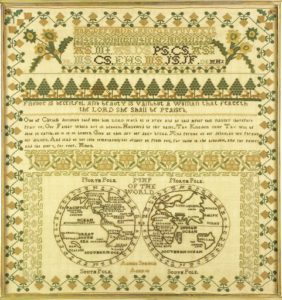 Double hemisphere world maps were often included in atlases, and one of these was probably the basis for Agnes Spence’s work. Samplers representing the whole world, like this one, were less common than maps of the nation or county where the maker lived. Note the host of names for the Caribbean islands, reflecting their strategic and economic importance to the British Empire. Australia at this time was named New Holland, and ‘Van Diemans Land’ refers to the island of Tasmania; both were also British colonies in the 1820s.
Agnes’ parents, Andrew Spence and Marjory Isles, were married on 22 November 1807 in Monifieth parish, Angus. Agnes was baptised on 27 June 1816, one of nine siblings. Her father’s occupation is listed as a wood merchant in the 1841 Census. A tombstone in Dundee records that Agnes died in 1832,
aged just fifteen.
Caption: Sampler and details of double hemisphere map
Agnes Spence, c.1826, silk on wool, 496 x 466mm
© Private Collection of Leslie B. Durst
Katharine and Margret Sheriff
Athelstaneford, East Lothian, c.1770
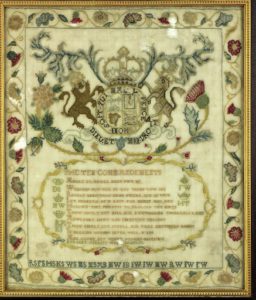
 Katharine and Margret Sheriff were sisters, born in the village of Athelstaneford, East Lothian, in 1753 and 1755 respectively. They made near-identical samplers featuring the Ten Commandments and an unorthodox version of the coat of arms of Great Britain.
The rose and thistle springing from a single stalk symbolise the union of the crowns of England and Scotland. The position of the lion supporter on the left indicates that this was a form of the arms as used in England (in Scotland the unicorn appears on the left). This could mean the arms were copied from a coin minted in England.
Unusually the shield itself is incorrect: it does not show the House of Hanover, which should be included from the accession of George I (1714) to the death of William IV (1837). Instead we simply find the arms of France (three fleurs-de-lys), Scotland (a lion rampant), Ireland (a harp) and England (three lions passant) in the four quarters. This arrangement is itself irregular as, more typically, France and England would appear together in the first quarter.
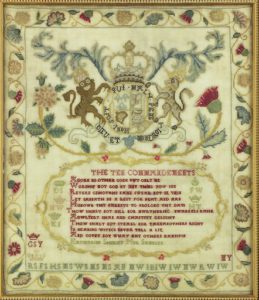 The omission of the arms of Hanover could be read as a statement of support for the exiled Stuarts, though by 1770 this seems highly unlikely. Perhaps the girls were copying an old coat of arms; or perhaps they just simplified the image to make it easier to stitch – the Hanoverian quarter would have required a far greater level of detail.
Katharine and Margret had six brothers and sisters, but Katharine is the only one whose later life can be traced. In 1775 she married Robert Scott, a minister in nearby Haddington, and the couple had five children.
 Caption: The coat of arms of Great Britain
As used in England under George III, with England and Scotland in the first quarter, France in the second, Ireland in the third, and Hanover in the fourth. Taken from William Maitland, The History of Edinburgh, 1753.
© National Museums Scotland
Caption: Samplers of Katherine and Margret Sheriff
Katharine Sheriff, c.1770, silk on wool, 361 x 312mm
Margret Sheriff, c.1770, silk on wool, 361 x 312mm
© Private Collection of Leslie B. Durst
Embroidered Stories: Scottish Samplers by Helen Wyld is published by The National Museums of Scotland, priced £9.99
Another Christmas recommendation: Scottish Plant Lore: an Illustrated Flora by Dr Gregory Kenicer, published by RBGE, priced £25.00
Books for kids always go down a treat on Christmas day, especially as there is always such a bounty to choose from. Our friends at Floris have an excellent range of books that celebrate the festive season and Ali Begg, their Sales & Marketing Assistant, writes for BooksfromScotland on his favourite selection.
The nights keep drawing in, there’s a nip to the air, and it’s hard to believe that December has arrived. At this time of year, nothing feels better than a cosy evening spent snuggled up with a great book, and the great Icelandic tradition of Jolabokaflod feels like the distillation of all that is wonderful about books and reading in the winter months.
We’re big fans of this season of book-gifting here at Floris Books, not least because it gives us the opportunity to wax lyrical about the work of some of our wonderful Nordic authors and illustrators. So, in the spirit of the season, please enjoy this round-up of some of our favourite books from across the Nordic region.
Ollie’s Ski Trip – Elsa Beskow
Swedish national treasure Elsa Beskow is the country’s best-loved children’s book illustrator. Sometimes called the ‘Beatrix Potter of Sweden’, her charming artistic style takes the reader back to an idyllic Sweden at the turn of the last century, often helped along with a splash of magic.
Beskow produced a wide array of gorgeous picture books, but the suitably wintery Ollie’s Ski Trip, first published in 1907, is a favourite at this time of year. It sees six-year-old Ollie being given his first pair of real skis, and dashing out as soon as the snow begins to fall. He heads off into the woods and meets sparkling Jack Frost, who shoos away damp Mrs Thaw. Jack Frost takes him on an adventure to the palace of King Winter, and Ollie has a wonderful time in a huge snowball fight! But will Mrs Thaw return too soon and melt all the snow?
Tomten and the Fox – Astrid Lindgren
Illustrated by Eva Eriksson
Astrid Lindgren is undoubtedly Sweden’s most famous children’s author; her books have sold over 145 million copies worldwide and have been translated in to over 90 different languages. Best known for her books about Pippi Longstocking, she also wrote a number of well-loved picture books, including this story of a mischievous fox and a wise, kindly old tomten (a traditional Swedish gnome character).
It’s a cold winter’s night and a hungry fox is creeping through the snow.
He sees a hen house and hopes to grab a couple of chickens, but he’s forgotten about the old tomten who guards the farm… This classic Swedish tale is brought to life by acclaimed illustrator Eva Eriksson, who is based near Stockholm and won the Astrid Lindgren Prize in 2001.
Otto and the Secret Light of Christmas – Nora Surojegin
Illustrated by Pirkko-Liisa Surojegin
Moving from Sweden to Finland, this charming story book was created by mother and daughter duo Nora and Pirkko-Liisa Surojegin, whose detailed, delicate illustrations and gentle, episodic storytelling capture the true spirit of Christmas.
One day Otto, an elfin adventurer, finds a postcard on the seashore showing pictures of beautiful sparkling lights in the night sky with the words, ‘The light of Christmas!’ If this ‘Christmas’ can brighten even the gloomiest Finnish winter, Otto decides he must find it. So he heads north, trudging through dark forests and skiing towards the fells of Lapland, in search of the secret light of Christmas. Will he ever find the mysterious light he’s looking for, and will Christmas brighten Otto’s winter?
The House of Lost and Found – Martin Widmark
Illustrated by Emilia Dziubak
Martin Widmark is a bestselling children’s author in Sweden, where he has published over 100 different titles, including this moving story of loss and hope. Full of uplifting sentiment and atmospheric illustrations from the award-winning Emilia Dziubak, this book will bring cheer to even the darkest and coldest of wintery nights.
Niles is old, and lives alone in a house full of dust and memories. One day, a little boy appears on his doorstep and asks him to take care of his potted plant. At first, Niles is grumpy at the prospect but, as the plant begins to grow under his care, he finds the seeds of hope begin to grow within himself once more…
An Illustrated Treasury of Hans Christian Andersen’s Fairy Tales
Illustrated by Anastasiya Archipova
Last, but certainly not least, it’s nearly impossible to think about Scandinavian children’s books without thinking of Danish author Hans Christian Andersen, whose fairy tales have delighted children and adults alike for nearly two centuries.
This treasury collects Andersen’s best-loved tales and includes The Little Mermaid, The Snow Queen, Thumbelina, The Princess and the Pea and The Emperor’s New Clothes. Beautifully adorned with illustrations from Moscow-based artist Anastasiya Archipova, it makes a perfect addition to any bookshelf.
Find our full collection of Nordic children’s books on our website.
Follow our Floris advent calendar on Instagram @florisbooks.
Most countries have their own Christmas traditions. Here, Christopher Norris tells us about the Icelandic tradition of Jólabókaflóðið, a tradition book lovers from across the world should surely adopt at this time of year.
Christmas is a time for giving, all over the world, often featuring a mash-up of custom with origins in different countries. People in many cultures celebrate by exchanging presents with family and friends, and these gifts often include books. Scotland and Iceland share many national traits, including genetic heritage (60% of Icelandic women are of Scots’ descent) and a common love of literature and the sharing of books at Christmas. A Book Week Scotland poll conducted in November 2017 found that a whopping 69% of Scots said they would purchase books or book tokens to give to family and friends at Christmas.
In one sense, this is no surprise: books always make for great presents. Books are cheap, portable and easy to wrap; they come ready to use (no batteries needed); they come in all shapes, sizes, genres and flavours, to suit everyone’s interests and enthusiasms; they can teach, entertain and expand our imaginations; they are robust, stack easily, and have no breakable moving parts; you can never have too many of them and they can last a lifetime. Books have features that can knock more expensive, faddish and exotic gifts into a cocked hat.
There are plenty of books to choose from, not least by Scottish authors or about topics of interest to Scots. In 2017, the International Publishers Association released a report showing that the UK published more books per head than anywhere else in the world (2,710 titles per million people, in 2015). Iceland was not far behind, with 2,628 titles per million, but the Nordic nation has the most well read citizens anywhere on the planet: half the population reads more than eight books per year. Amazingly, one in ten people in Iceland writes a published book, making sense of the national proverb ‘everyone has a book in their stomach’.
Scotland and Icelands’ shared love of books is no accident. Both nations have rich oral traditions, with storytellers entertaining and teaching their audiences on long winter nights; and complementary literary cultures, ranging from sagas of the exploits of medieval kings, through epic poetry, to our modern flourish of tales to suit every taste – including a mutual passion for crime fiction, perhaps a reflection of common cultural roots. Scottish giants of the genre, such as Ian Rankin and Val McDermid, are matched by the talents of Yrsa Sigurðardóttir and Ragnar Jónasson, both best-selling Icelandic authors with many titles translated into English. As a result of this common cultural heritage, UNESCO have designated both Edinburgh and Reykjavík as ‘Cities of Literature’.
In a November 2017 press release from Literature Alliance Scotland, Kristín Viðarsdóttir, Head of International Cooperation at Reykjavík City of Literature, said: ‘Our literatures have crossed paths through the ages as have our people and our languages. We can trace our connection to the very settlement of Iceland, as many of our ancestors came here from the British Isles.’
For over 70 years, Icelanders have celebrated their passion for books with a unique tradition called Jólabókaflóðið – Christmas book flood, in English, and pronounced Jola-boka-flod (with the ‘J’ sounding like the ‘Y’ in ‘yoghurt). The word Jól is Old Norse for ‘Yule’, which is same as the Scots language word for the festive season.
The Jólabókaflóðið tradition began during World War II once Iceland had gained its independence from Denmark in 1944. Paper was one of the few commodities not rationed during the war, so Icelanders shared their love of books even more as other types of gifts were in short supply. This increase in giving books as presents reinforced Iceland’s culture as a nation of bookaholics.
Every year since, the Icelandic book trade has published a printed catalogue – called Bókatíðindi (‘Book Bulletin’, in English) – that is sent to every household in the country in mid-November during the Reykjavik Book Fair. People use the catalogue to order books to give friends and family for Christmas.
During the festive season, gifts are opened on 24 December and, by tradition, everyone reads the books they have been given straight away, often while drinking hot chocolate or alcohol-free Christmas ale called jólabland.
Whilst it might be a stretch to persuade everyone in Scotland to forgo the pub or Midnight Mass on Christmas Eve – especially in a land where a post-Reformation ban on celebrating the festive season led to Christmas Day only being declared a public holiday in 1958 – Jólabókaflóðið reminds us that the long hours of seasonal ennui when ‘there’s nothing on the telly’, we’re fed up of being cooped up with our extended families, and we’re bloated from all the endless turkey dinners, give us the perfect opportunity to find the time and place to lose ourselves in a book, especially one we have just received as a gift. We might even enjoy the experience so much that we would make a resolution to carry on reading for pleasure well into the New Year, once the Hogmanay parties, processions and renditions of ‘Auld Lang Syne’ have died away.
In the old days of Celtic Druids, the Yule season – with its remnant tradition of burning logs to conquer midwinter darkness – lasted 12 days, the period during which they believed the sun stood still, a tradition assimilated by later Viking settlers. The twelve days of Christmas and Twelfth Night remain with us from these origins, as well as the large ceremonial fires lit in northern harbour towns in Scotland to mark the turning of the year.
In Iceland, the modern festive Jól season lasts the full 12 days, personalised by Christmas folklore tales of the mischievous ‘Yule Lads’ and the ‘Christmas Cat’ – captured in a famous poem by Jóhannes úr Kötlum, later set to music by the pop icon, Björk (YouTube video).
Wouldn’t it be great to allow ourselves the chance to read for pleasure over the whole Yule season, from Christmas Eve to Epiphany and beyond? As for me, my festive wish list for Jolabokaflod from the Books from Scotland catalogue (fiction | non-fiction) will include Lethal White, the latest Robert Galbraith ‘Strike’ novel; Alexander McCall Smith’s personal curation of Scottish poems, A Gathering; and a new illustrated biography of the Scottish-born scientist, inventor and engineer, Alexander Graham Bell.
As another famous Scot – Kenneth Grahame – wrote for his character, Toad, to say in The Wind in the Willows, reading books allow you to be ‘Here today, up and off to somewhere else tomorrow! Travel, change, interest, excitement! The whole world before you, and a horizon that’s always changing!’
Let’s make Jólabókaflóðið part of our festive cultural tradition here in Scotland. Merry Christmas and ‘happy reading’, wherever you travel in your books this Yuletide.
Christopher Norris is the Founder and Curator of Jolabokaflod CIC, a not-for-profit enterprise to introduce the Icelandic tradition of Jolabokaflod to the UK and beyond: @Jolabokaflod | #Jolabokaflod
With thanks to AUTHOR Interiors for the photograph, taken from The Art of Coorie: How to Live Happy the Scottish Way by Gabriella Bennett
BooksfromScotland is carrying on our #BookWeekScotland celebrations and continuing to look at Scotland’s Rebel women. Rosemary Goring has just released Scotland: Her Story, The Nation’s History by the Women Who Lived It, a brilliant collection of letters, autobiography and other first hand accounts telling Scotland’s story from our women’s perspectives. There are brillliant stories from queens, countesses, miners, mothers and musicians that will enlighten and inspire all readers. Every film producer in the land should probably get themselves a copy! Here, our two women, Madeleine Smith and Mary Brooksbank, find themselves in court for very different reasons . . .
Extracts taken from Scotland: Her Story, The Nation’s History by the Women Who Lived It
By Rosemary Goring
Published by Birlinn
Letter to a doomed youth
Madeleine Smith, 3 July 1856
Written eight months before she is thought to have poisoned him, this letter from the middle-class Glaswegian Madeleine Smith to her lover Pierre Emile L’Angelier, an apprentice gardener, shows her excitable, dramatic and possibly erratic personality. When she became engaged to a wealthy suitor, William Harper Monnich, thereby crushing Emile’s long-held expectations, she asked him to return her letters. Knowing they were incriminating, he tried to blackmail her into marrying him. All her pleading would not budge him, and not long afterwards, he was found dead. Madeleine’s letters, discovered in the dead man’s room, and her purchase of arsenic in the weeks before his death, led
to her trial in 1857. It caused a sensation. Many refused to believe a well-brought-up young woman could have killed a man in such a sinister and premeditated fashion. Others were transfixed by the scandalous revelations of premarital sex. The charges were found not proven, that peculiarly Scottish verdict which lies between Guilty and Not Guilty. Smith went on to marry twice, have two children, and live a quiet life in England and New York until her death in 1928.
Helensburgh
Wednesday Night
My own ever beloved Emile
I trust to Heaven you got home safe – I was not heard by anyone – So I am safe – Were you dearest any the worse of being out in the night air – Emile perhaps I did wrong in taking you into my room – but are you not my own husband – It can be no sin dearest – But I wont do it again – I was so glad to see you darling – would I could be ever with you to keep you company – You stayed so short I got nothing said to you – I had thought of so many things to ask you about – But I hope love your next visit will be longer – Emile my husband I have been thinking of all you said to me last night – Now in the first place – I promise you I shall safe as much of my pin money as I can – I shall put it to many useful things – I shall spend the money I safe on things I shall require when I am your wife. Will this please you – In the second place – I shall not go about as of old with B/- I shall go out before the afternoon – And in the next place – I shall not go to any Public Balls without getting your consent – will this please you my dear little husband – I shall try and do all I can to please you and keep your mind free and do be happy – And darling if you continue to love me I shall please you in many things – Emile if you go away and go into the French army – you know you will never return to Scotland – and of course I am your wife and I can never be the wife of any other one – So my mind is made up if you go – I shall go where no one shall see me more – I shall be dead to the World. But dearest love I trust we shall get on so that you wont go. I shall behave well for your dear sake – Yes My own My sweet Emile I shall make you happy. You shall some day I hope say you have a faithful and loving wife, And my prayer shall be that you shall never regret taking me for your wife – One of my annoyances is that I may not suit you – or that I am not half good enough to be your wife – Emile I often think we do not [know] each other much that is – we do not know the temper or character of each other – We have never seen each other but under peculiar circumstances so we shall have all that to study after our marriage. But I dont think dear love it shall be difficult to do – What do you say pet . . .
I shall now say Good Night – It is later than when you left me last night – Adieu my love my good dear husband – I adore you more and more each time I see you – You were looking in my eyes very very well last night – I forgot to tell you last night that I have had great pain in getting my first Wisdom tooth. So after I get them all you will expect something like wisdom from me. Adium sweet love my fond embrace – A dear sweet Kiss from your devoted and your truly loving your affectionate wife your own dearest true
Mini
A marked woman
Mary Brooksbank, c. 1922 or 1923
Born in Aberdeen in 1897, in what she described as ‘one of the worst slums in the city’, Mary Brooksbank (nee Soutar) became a fervent Communist, and served three sentences in prison as a result. This was something of a family tradition, her father being an ardent trade unionist. She was also a gifted songwriter, best known for ‘Oh, Dear Me’ (putting the words to the tune of ‘The Jute Mill Song’). After her family moved south, she started in a jute mill in Dundee when she was almost fourteen, and for the rest of her life agitated for better conditions for workers. In an interview with Hamish Henderson in 1968 she recalled: ‘My mother put me into service for a period; tried to make me genteel you know. She gave me a lovely outfit but it didna suit me; it was the worst thing she could have did because I saw right away the contrast between their homes and ours, you know, thon’s o’ the gentry and ours.’ She was expelled from the Communist Party after expressing her condemnation of Stalin’s inhumane policies. Michael Marra and Rod Paterson wrote a song in her honour, called ‘The Bawbee Birlin’. Here, she describes life in a mill shortly after the First World War.
The life of the women workers of Dundee, right up to the thirties, was, to put it bluntly, a living hell of hard work and poverty. It was a common sight to see women, after a long 10-hour day in the mill, running to the steam washhouses with the family washing. They worked up to the last few days before having their bairns . . . Infant and maternal mortality in Dundee was the highest in the country, worse even than Lancashire. Children of 12 were given badges enabling them to sell papers in the street. Even the police had their Bootless Bairns Fund, for bootless bairns were a common enough sight in those days. So were low wages, unemployment, profiteering in food, lack of proper medical attention, bad housing conditions, and, of course, the ever-prevalent ignorance, superstition and fear.
The women in particular had much to be afraid of. Fear of losing their jobs, fear of losing their health, fear of losing their bairns, fear of offending, even unwittingly, gaffers, priests, factors, and all those whom they had been taught were placed by God in authority over them.
Unemployment continued to grow. How could it be otherwise? The imposition of the Versailles Treaty on a defeated Germany virtually made slaves of the German people, compelling them to produce the goods which we had formerly made. The British and American industrialists reaped a rich harvest by way of reparations but had to subsidise their own unemployed wage slaves. In the meantime, mass demonstrations were taking place. One in particular comes to mind. It was during the first Armistice Day, that day when two minutes’ silence is held in memory of our ‘glorious dead’. Yes, ‘these bundles of bloody rags’, mentioned by Churchill. With our banners of protest mentioning the numbers of unemployed, the homeless, the widowed and orphaned, we marched. One of our unemployed ex-servicemen had a banner depicting a soldier rising, looking up at these numbers, and saying, ‘If this is what I fought for, thank Christ I’m dead!’
A local minister, the Rev. Harcourt Davidson (noted for his drinking habits), stopped our demonstration, then the police, who had been waiting, commenced arresting our leaders. We were charged with breach of the peace. I got 40 days’ imprisonment, Jock Thomson, our chairman, got 60 days, and some 20 others got fines and lesser sentences. Every day we spent in gaol there were mass demonstrations outside. We could hear the people singing and shouting to cheer us up . . .
I was soon to learn that original thinking, like original sin, brought its own punishment. I found that, because of my activities, I could not get a job, and if I did, I could not keep it long.
I recall a great rally held in the Caird Hall, and sponsored by all the religious denominations in the city, against Bolshevism. One of the posters, a gigantic affair, showed a worker being led blindfold into a chasm. Over the brink was a black cloud labelled ‘Communism’. Evidently plenty of money was behind this political rally, for there was no mistaking its purpose, hidden under the cloak of religion. No sooner did the chairman start to speak than there were interruptions from all over the hall. During a lull, I asked the chairman why the reverend gentlemen had made no protest at the mass slaughter between 1914 and 1918? I was immediately seized and hustled out to a waiting van.
Next day in court I pleaded guilty. The sheriff, Malcolm, asked why I had protested the previous evening. I pointed out that this had been advertised as a religious meeting, but was in fact political. He agreed, saying, ‘International politics, Mrs Brooksbank!’ He then fined me three guineas.
I soon realised that I was becoming a ‘marked’ woman. Once, while addressing a meeting outside the High School gate, in answer to a question I said that until the working class took possession of the –— means of production and became rulers of the country, we would always have unemployment, so long as we had production for profit. That night I was taken from my home by the police and kept in custody without being informed with what I was being charged.
Our organisation got a solicitor, a young man called Carmichael, a partner of Grafton Lawson. Next day I was told that I was charged with sedition. I was taken downstairs into a room where a sheriff’s clerk read a long rigmarole. Then I was taken into court. Carmichael came over and in a very paternal tone of voice asked me to plead guilty. He told me that it would go hard with me if I didn’t, as sedition was a very serious offence.
He said he was sorry to see me mixed up with all these riff-raff, I was very young, etc., etc. I asked him if he was being paid to represent me, or my accusers, whereupon he became very annoyed. When the Court proceedings opened, I promptly pleaded ‘Not Guilty!’ Carmichael addressed the sheriff, saying that this young woman had received a poor education and did not realise the seriousness of what she was saying. I interrupted, asking if I could enter the witness box. The sheriff replied, ‘Certainly’.
I said I admitted that what I said was only what a former Labour Prime Minister had once said, but in different terms. I protested that I was not asking the 500 or so people at the meeting to take over the administration of the country. Came the verdict: ‘Not Proven!’
Scotland: Her Story, The Nation’s History by the Women Who Lived It by Rosemary Goring is published by Birlinn, priced £20.00
This week is #BookWeekScotland, and this year’s theme is REBEL. We’ve already uploaded our Rebel issue, which you can read here. And all this week, BooksfromScotland will be highlighting even more Scottish books with a bit o’ rebel in ’em! Let’s kick of with some poetry, and Gerda Stevenson’s brilliant collection, Quines.
Poems taken from Quines: Poems in Tribute to Women of Scotland
By Gerda Stevenson
Published by Luath Press
The Dwaum
Isabella MacDuff, Countess of Buchan, 1286–c.1313, Fife; in defiance of her husband, she crowned Robert the Bruce as King of Scots at Scone in 1306, during the Wars of Scottish Independence;
captured by Edward I of England, and imprisoned for four years in a cage hung on the walls of Berwick Castle.
1
Strange, the wey ye get yaised tae a thing –
the wund whuppin its braith through the baurs,
sun slingin its spears, hail hurlin its flanes,
year ower year. I dinna feel the cauld ony mair
in ma tatterwallop goon; the day, I sweir
I hae a norrie that ma limbs are growin hair,
saft, lik the down o a doo – mibbe I’ll hae wings
by morn, an flichter awa…
2
Aftentimes I dwaum, aye the samin dwaum:
I’m layin my hauns on the saucrit Stane
tae gaither its pooer, layin them, again an again,
Comyn’s stowen meir on the cobbles ootby,
her braith a reek in the nicht, she’s champin at the bit.
Syne we’re heidit North fae Lunnon Toon,
her hooves dirlin ablow an eldritch mune.
It’s dawin fair whan we win the Border,
tho by Scone, we’re droukit wi dounfaw an swelt;
an he’s there, pacin the palace grun – furrit an back,
back an furrit – Bruce, waitin fur ma hauns alane.
The dwaum, the dwaum, the samin dwaum,
I lay my luif, first ane then t’ither, on the saucrit Stane,
oor braw Stane that Edward daured tae rieve;
ma clan alane can croon oor nation’s king.
I hae the pooer; on his pow I place the gowden ring.
3
Cages are lang-kent tae me;
lang, lang afore noo, fae the day
I ettled tae flee the bield, a lowp
in ma spang, howp in ma hert,
a hale rowth o time aheid o me;
but claucht an hapshackled
in a union biled in hell, aa wrang,
a line leal tae Edward, thirled
tae yon auld Comyn carl, agin ma will.
He hoasts an he hirples,
The weary day lang,
Maids, when ye’re young,
Niver wed an auld man…
I hae a hoast in ma lungs the day –
berkin like a dug – an unco hirple an aa,
sae I’m telt by yon wumman wha casts
the brock tae me – cauld kail an parritch
that maks ma kyte bowk.
4
A skimmer o licht on the waves ablow.
Scotland tae the North, England tae the Sooth.
The samin mune abuin us aa, that hus nae care
fur stane or nation, croon or king. I’m hingin heich
amang the sterns; am I dwaumin? The baurs
o ma cavie hae fell awa, the down on ma limbs
gies a fissle, a reeshle, ma feathers prick,
ma wings are spreid oot wide, they lift me,
slaw and strang intae the glisterin nicht.
Scotland Celebrates 3-0 at Easter Road
Ethel Hay (goal), Bella Osborne and Georgina Wright (backs), Rose Rayman and Isa Stevenson (half-backs), Emma Wright, Louise Cole, Lily St Clair, Maud Riweford, Carrie Balliol, and Minnie Brymner (forwards), wearing nickerbockers in the style of the Rational Dress movement, played and won the first recorded women’s international football match, Scotland v England, Saturday, 7th May, 1881, Easter Road, Edinburgh.
The wind was against us – but wasn’t it ever?
We had all to play for, and nothing to lose;
we kicked off with gusto, no matter the weather,
two thousand, the crowd, their jeers couldn’t bruise
our spirits; red stockings and belts a kindling flicker
across the turf, then flashes of fire, flames fanned
by self-belief, we were bonded as one, slicker
than our English sisters, that day; we spanned
the field, every inch covered, Ethel hardly required
in goal – but when her moment came, oh, the spring
in her fearless lunge to save – the whole team fired!
We surge forward, and hear someone sing,
a lone voice, at first, Daughters of Freedom Arise,
then more and more: Yield not the battle till ye have won! –
our striker takes possession, her mind on the prize,
Lily St Clair, talk about flair! – a meteor cast from the sun –
dancing and dodging, she blazes to the box, and bends
the ball in – a goal for Scotland! We weep and cheer,
Scotia’s Eleven makes history, sends
a message to the world: have no doubt, we are here,
scaling the heights, new horizons in our sights
and the ball is rolling for women’s rights.
The Living Mountain Addresses a £5 Banknote
Nan Shepherd, born Peterculter, 1893, died Aberdeen, 1981; novelist, poet and writer of non-fiction, lecturer in English at Aberdeen College of Education; her non-fiction work, The Living Mountain, written in 1941 but not published till 1977, describes the Cairngorms; first woman to appear on a Royal Bank of Scotland banknote, 2016.
You cavorted through my corries, capered about my braes,
careened between my coiling clouds, played
hide-and-seek on my plateau, glinted as you skipped
across my ruffled secret loch – a butterfly, I thought –
a Silver-studded Blue brought back from extinction;
till the wind dropped, and you came to rest,
snagged in moss campion – a plastic rectangle
pulsing on the tail of a breeze.
I dislike litter, especially your kind – polymer particles
that issue in blizzards from careless markets, slip
from pockets, won’t perish in rain or melt with snow;
though in your case, I’ll make an exception, because
you bear her face: the woman who never rushed
to my summits, but walked into me, took time to learn
my every line – schist, gneiss and granite – and heard
my braided voice. You’ve brought her to light again,
all I contain, nurture and sustain, held in her steady gaze.
Quines: Poems in Tribute to Women of Scotland by Gerda Stevenson is published by Luath Press, priced £9.99
https://www.luath.co.uk/poetry/quines-poems-in-tribute-to-women-of-scotland
Today we celebrate RLS Day! Each year on this day, literary Edinburgh pays homage to one of its most beloved sons with walks, talks and a whole host of other events that highlights his life and work. BooksfromScotland is happy to get in on the action, presenting this extract from a brand new study of Robert Louis Stevenson and one of his most famous novels.
Extract taken from The Scenery of Dreams: The True Story of Robert Louis Stevenson’s Kidnapped
By Lachlan Munro
Published by Deveron Press
There are few more beloved authors than Robert Louis Stevenson, both icon and enigma. There are few authors more instantly recognisable, but as the biographies pile up, the more elusive he becomes—puritan and sensualist, introvert and exhibitionist, aesthete and vagabond, invalid and adventurer—he retains a fascination that only increases with the passing years. Essayist, poet, and novelist, his autobiography is his work, and none better I think to glimpse this man-child than his meandering, dislocated, truncated masterpiece, his own personal favourite, Kidnapped. Loved by generations of readers, its popularity has barely waned, for it has all the ingredients of a great yarn: an inheritance denied, good versus evil, an adventure at sea, a swashbuckling hero, a shipwreck, an unsolved murder, a hazardous escape, then, a final redemption – of sorts.
I call his works autobiographical because the themes and characters in nearly all of Stevenson’s writings are derived from his experiences, and despite a vivid imagination, an examination of his poems and stories reveals that nearly all of the characters and incidents recur elsewhere in one form or another. He seemed incapable of writing anything that did not refer to some aspect of his early life, directly or indirectly incorporating memories, dreams, places, emotions, and the traumas of his early years, which he described thus:
My childhood was a very mixed experience, full of fever, nightmare, insomnia, painful days and interminable nights; and I can speak with less authority of Gardens than that of that other ‘land of counterpane.’ But to what end should we renew these sorrows? The sufferings of life may be handled by the very greatest in their hours of insight; it is of its pleasures that our common poems should be formed; these are the experiences that we should seek to recall or to provoke; and I say with Thoreau, ‘What right have I to complain, who have not ceased to wonder?
RLS, Letter to William Archer, 29th of March 1885.
But his sickly, cosseted, fear-filled frailty was also full of love and song from his mother, and particularly from his nurse ‘Cummy,’ who peppered his daydreams with stirring tales of religion, war, and witchcraft. These, combined with his extensive reading, and later his travels, would be the stuff from which he would draw inspiration again and again until his untimely death. In his essay The Foreigner at Home (1882) Stevenson wrote:
. . . the sense of the nature of his country and his country’s history gradually growing in the child’s mind from story and from observation. A Scottish child hears much of shipwreck, out-lying skerries, pitiless breakers, and great sea-lights, much of heathery mountains, wild clans and hunted Covenanters.
But, if his infant life was filled with adventurous imaginings, games, and escapes from his imprisoning bed, he also managed to escape growing up – his great escape, facilitated by a fragile constitution and family money, for attempts to become an artist are invariably at someone else’s expense. He escaped Victorian Edinburgh’s “blunderbuss conformity,” first by adopting a bohemian manner, developing intimate friendships, and secretly frequenting the city’s low dens, then by his foreign travels for health reasons, which he often played up. He escaped following the family tradition of becoming an engineer, and despite his Law degree, he escaped becoming a lawyer. His luminous, translucent, angular androgyny could make men fall in love with him, but he was attractive, and attracted to, older women, who could mother him, and these defined all his adult relationships. Finally, financially independent for the moment, he escaped to the other side of the world to what he hoped would be a tropical idyll. His most constant escape from reality and adulthood, however, remained his imagination, and his attempts to re-conjure his childhood in his writings. In 1884 he wrote to the poet William Cosmo Monkhouse:
After all your boyhood aspirations and youth’s immortal daydreams, you are condemned to sit down, grossly draw in your chair to the fat board, and be a beastly Burgess till you die. Can it be? Is there not some escape, some furlough from the Moral Law, some holiday jaunt contrivable into a Better Land? Shall we never shed blood? This prospect is too grey . . . To confess plainly, I had intended to spend my life (or any leisure I might have from Piracy upon the high seas) as the leader of a great horde of irregular cavalry, devastating whole valleys. I can still, looking back, see myself in many favourite attitudes; signaling for a boat from my pirate ship with a pocket handkerchief, I at the jetty and one or two of my bold blades keeping the crowd at bay; or else turning in the saddle to look back at my whole command (some five thousand strong) following me at the hand-gallop up the road out of the burning valley: this last by moonlight.
Stevenson would later dismiss this as: “an astonishing gush of nonsense,” but it is just too full of peculiar detail not to be true, and it was his attempts to recapture his vivid memories, and to consolidate his youth, that so much of his work was directly or indirectly concerned. David Daiches wrote that Stevenson, like Proust, was engaged in a ‘recherche du temps perdu,’ a recapturing of lost youth, an escape back to childhood:
Literature for him was but an extension of those childhood games of romantic make-believe that he has described so vividly in his autobiographical essays.
David Daiches ~ Robert Louis Stevenson: A Revaluation (1947).
Stevenson confirmed this in A Gossip on Romance:
Fiction is to the grown man what play is to the child; it is there that he changes the atmosphere and tenor of his life; and when the game so chimes with his fancy that he can join in it with all his heart, when it pleases him with every turn, when he loves to recall it and dwells upon its recollection with entire delight, fiction is called romance.
He taught himself to write well through imitation and practice, but his fictions were not only a form of play; Jenni Calder believed that in Treasure Island and Kidnapped Stevenson was inviting us to join him in the game, and as G. K. Chesterton shrewdly observed:
The dialogue is spirited and full of fine Scottish humours, but all these things are almost as secondary in Kidnapped and Catriona as they are in Treasure Island itself. The thing is still simply an adventure story, and especially a boy’s adventure story; such as is fitted to describe the adventures of a boy. And there are moments when it is the same boy; and his name is neither Hawkins nor Balfour, but Stevenson.
Both authors caught the reality that Stevenson retained his playful sense of inclusive adventure, but Chesterton’s description of this historical romance par excellence as simply a boy’s adventure story, is a simplification too far. Treasure Island falls into that category, but the genesis of Kidnapped was quite different, and much longer. Here, Stevenson addressed deeper issues of character, culture, history, and politics – a story in which his hero escapes attempted murder and is brutally shanghaied, and a mad boy is killed out of hand by a brutish drunk. There are bloody sword fights, a shipwreck, a government official assassinated, for which an innocent man will be hanged, all described with stark realism, but always with a pawky humour. It is an adventure story certainly, but this Peter Pan of Scottish literature had brought all his skills into play. Kidnapped was a synthesis of Stevenson’s own experiences drawn from his reading, his travels, his knowledge of Scottish history and landscape, his knowledge of dialect, and his knowledge of human nature.
It would not be an exaggeration to suggest that when reading Kidnapped, we are walking through Stevenson’s entire life.
The Scenery of Dreams: The True Story of Robert Louis Stevenson’s Kidnapped by Lachlan Munro is published by Deveron Press, priced £14.99
David Keenan’s debut novel This is Memorial Device was one of BooksfromScotland’s favourite reads of 2017, so we are thrilled that he has followed it up so quickly with another cracking book, For The Good Times, which will be released in January 2019. It’s a novel that follows Sammy and his three friends as they come of age in 1970s Belfast, where the usual concerns—music, clothes, girls, comic books, drinking—clash with the criminal and terrorist violence around them. We hope you enjoy this exclusive pre-publication taster.
Extract taken from For The Good Times
By David Keenan
Published by Faber
Longhairs came late to Belfast. It was 1972 before I ever clapped eyes on a hippy, but there he was right enough, sitting on the ground at a bus stop on the Lisburn Road in the blazing sunshine, with his bare feet and an acoustic guitar round his neck with a piece of string; I could barely believe my lamps.
So as some longhairs turn up at the wedding, some hippy bastards, and they stand out like plums. Tommy starts to making jokes. Look at these fucking women, he says, and he’s doing this comedy walk, mincing up and down. I’m sure I recognise one of them but I can’t place him. At this point I don’t know any of the boys with the long hair. Then this guy who I nearly almost recognise comes over with some of his longhair pals and he walks up to Tommy. Are you Tommy Kentigern? he says to him. Tommy says to him, who wants to know, fucking Bob Marley? and he turns round to us and he’s all laughing and winking. The guy is just looking at him. What are you talking about? he says to him. Bob Marley is a Rastafarian. I don’t give a fuck what you are, Tommy says to him. Tommy’s confused, Pat says, he means Bob Dylan. Don’t fucking correct me, Tommy says to Pat, and he turns on him. I mean fucking Bob Marley, he says. What songs does Bob Marley sing? the guy asks him and there was something in the way he says it, something arrogant in his voice, that made me recognise him for who he was. Ah fuck, I says to myself, it’s only fucking Mackle McConaughey, this guy’s a commandant in the IRA. A killer, a hero, a serious guy. I put my hand on Tommy’s shoulder. Tommy, I says to him, take it easy. Take it easy, he says to me, what the fuck is wrong with you? Then he turns back to Mack. Bob Marley sings the song about the wind, he says to him, don’t fucking try to cheat me. It’s Bob Dylan what sings the song about the fucking wind, Mack says to him, cool as you like. Look, I says to the both of them, who gives a fuck about Bob Marley and Bob Dylan. Excuse me if I’m wrong, I says, but you’re Mackle McConaughey, are you not? One of his longhair pals steps up to me. Who the fuck are you? he says. I’m Samuel McMahon, I says to him. Sure, I thought it was yourself, McConaughey says to me. Suddenly he’s all friendly, like. How’s your ma? he says to me. Ah, she’s grand, I says to him.
You’re Mackle McConaughey? Tommy says. Now he can’t believe his lamps. I’m sorry for calling you Bob Marley, he says. That was unforgivable. Sure, I probably did mean Bob Dylan. Fuck it, Mack says, let’s get the green in, and he and his boys head to the bar. I’m starting to breathe again. Tommy gives me a look and under his breath he says to me, is the fucking Ra really coming to this? But we all end up getting half-blocked and at one point Mack actually gets up onstage with the band and sings ‘Blowin’ in the Wind’.
Now Tommy knew nothing about the rock n roll. None of us did. I mean, we all went to see Bill Haley when he played Belfast. That was just an excuse to rip out the seats. But that night I looked at Mack, who had his arm around Tommy by this point, the pair of them completely blocked and talking into each other’s faces, and I thought to myself, the times they are a-fucking changin’ alright.
For The Good Times by David Keenan is published by Faber, priced £12.99
Stuart Cosgrove’s Harlem 69 is the final instalment in the author’s critically acclaimed trilogy on the story of soul music and the US civil rights movement, which began with Detroit 67 and followed by Memphis 68, which won the Penderyn Prize as ‘Music Book of the Year’ in 2018. Taking a look at the Black Panther show trials, the heroin pandemic that spread across the district, and the music that went on to inspire future generations of Black music makers, Harlem 69 is essential reading and will make you head out to your nearest record store. But, if you’re tightening your purse strings, then don’t worry: Stuart Cosgrove has put together his top ten playlist inspired by his latest book. Enjoy.
Harlem 69: The Future of Soul
By Stuart Cosgrove
Published by Polygon
- Nina Simone ‘Young Gifted and Black’ a sung at the Harlem Culture Festival 1969 as a tribute to Nina Simone’s dearly departed friend, the radical playwright Lorraine Hansberry.
- Donny Hathaway’s ‘The Ghetto’ a pioneering soul song written by Donny Hathaway in his apartment in Washington DC in the aftermath of Martin Luther King’s assassination. It became synonymous with streets of Harlem
- ‘Cashing In’ by The Voices of East Harlem. An underground northern soul classic by a Harlem community choir the song is about money, bad faith and love.
- ‘The Revolution Will Not Be Televised’ – In 1969 a young jazz poet, Gil Scot Heron was already a newly published writer, desperate to record his first album.
https://www.youtube.com/watch?v=qGaoXAwl9kw
- Damn Sam, Miracle Man and the Soul Congregation were an underground Harlem band that have since become one of the most respected street funk bands ever.
- Bobby Womack’s ‘Across 110th Street’ is one of Harlem’s great landmark songs. Street life, survivalism and sidewalk poetry.
- ‘Freddie’s Dead’ by Curtis Mayfield – the tragic tale of a Harlem drug peddlar who meets his final deal, the standout track in the epic ‘Superfly’ soundtrack.
- Frank Foster’s ‘Harlem Rumble’ a tense streetwise instrumental sounds like a chase sequence in a great ghetto theme movie
- ‘Spanish Harlem’ Aretha Franklin’s tribute to Harlem’s Eastside, the Hispanic capital of the USA.
https://www.youtube.com/watch?v=gFNqwQ8vdAY
- In Harlem in 1969, Afeni Shakur a female leader of the Black Panthers was on trial falsely accused of plotting a bombing campaign. Out on bail her son was conceived and eventually born after she had been acquitted – her son was Tupac Shakur – the hip-hop master of Thug Life.
Harlem 69: The Future of Soul by Stuart Cosgrove is published by Polygon, priced £16.99
David Robinson reflects on the poet’s role in difficult times as he talks to Alexander McCall Smith about his recently published poetry collection.
A Gathering: A Personal Anthology of Scottish Poems
Edited by Alexander McCall Smith
Published by Polygon
The other day, I found myself reading John MacLeod’s book River of Fire (Birlinn, 2010) about the Clydebank Blitz. To remind you of its scale, in two nights in March 1941, German bombers caused damage so extensive that of the town’s 12,000 dwellings, only seven were undamaged. Four thousand were completely destroyed, and 4,500 were uninhabitable for months. More to the point, 528 people were dead, 617 seriously injured, and the next morning thousands of the 35,000 newly homeless stumbled along the Dumbarton Road towards Glasgow.
We were in the middle of a war. Democracy and national survival were at stake. Like everyone else, Scotland’s poets had a decision to make. What were they going to do? Were they going to fight fascism or not? What would I have done – and what would you?
My point here isn’t to question the morality of pacifism in 1941 (that’s a completely different discussion) but to imagine the strength of character it would have taken to go against so many of your compatriots at a time like that. In March 1941, the US and the USSR were still not involved in the war, Japan was taking control of much of China and the Far East, the Germans had the Brits on the run in Africa, had overrun Europe, and Hitler had just ordered a big expansion of Auschwitz. The overwhelming majority of Scots were not deterred by any of that but wanted to fight on.
But look at the poets. Norman MacCaig was a conscientious objector; so was Edwin Morgan. Hugh MacDiarmid was conscripted to work in a Scotstoun munitions factory but wrote virulently anti-English poetry in private, and Douglas Young was imprisoned for refusing conscription. In other words, even when Scotland was at its most united – as it surely must have been when its towns and cities were being bombed, and Britain was isolated and faced a credible threat of invasion – many of its leading poets went against the popular flow. They made it clear that they didn’t want to fight. At such a time and place, rebelliousness like that takes guts.
This thought crossed my mind only because at the same time as reading MacLeod’s River of Fire, I was also reading A Gathering, Alexander McCall Smith’s personal anthology of Scottish poems, which has just been published by Polygon. How Scotland’s poets reacted to the Second World War isn’t mentioned in the book in anything other than the brief biographical notes at the end. But it did make me wonder whether McCall Smith thought Scottish poets were a particularly rebellious bunch. So – on National Poetry Day, as it happens – I asked him.
‘Auden talked about the effects of society on the poet,’ he pointed out. ‘He said that ‘Ireland hurt Yeats into poetry’. And you can say that about many poets, that they are hurt into poetry because they contemplate the world and they see its contradictions and its difficulties.’
In Scotland’s case, he added, there is another factor. ‘Until the re-emergence of the Scottish Parliament it seemed to many people that Scotland had a somewhat distant legislature and Scotland may have found difficulties in expressing herself through such an institution. You find that very strongly in the 20th century Scottish Poetry Renaissance led by MacDiarmid who is a classic example of that. He was a rebel against virtually everybody.’
A Gathering takes the Second World War as a cut-off point: it doesn’t include anyone born after it. This, says McCall Smith, was ‘just a matter of setting limits to make the anthology do-able, and not a matter of my own personal taste’. Another reason, one suspects, might well be that the famously polite bestselling author might not have wanted to make invidious choices among contemporary poets.
Of the poets included in the book, he met MacCaig, MacDiarmid and Hamish Henderson. The latter seems to have made the greatest impression. ‘He was tall, rather ungainly man,’ he writes, ‘a bit like a well-built scarecrow, as he often wore a hat that no self-respecting scarecrow would consider wearing. He smiled at people with gentle, wry smile, exposing teeth that seemed to go in all sorts of directions. He was sitting on a table, singing, unaccompanied, that great poem he wrote, ‘The 51st Highland Division’s Farewell to Sicily’. That simple tune, so easy to remember, never leaves you once you have heard it. It breaks the heart.’
That last phrase is, of course, an echo of what MacDiarmid said ‘the little white rose of Scotland’ does too – almost as if McCall Smith is acting as a retrospective peacemaker between the two flyting poetic rebels who can, as Tim Neat wrote in his Guardian obituary of Henderson ‘be seen to stand as the twin piers of revolutionary thought in modern Scotland: MacDiarmid the small ascetic, atheistic Presbyterian, Henderson the Falstaffian Episcopalian libertarian.’
Of the two, my own sympathies are with Henderson. His rebelliousness took many forms: not only turning down the OBE offered him by the Thatcher government but in writing poems and songs that consistently show him thinking internationally, far beyond his tribe (as well as lovingly within it). ‘Seven Good Germans’, for example, is full of empathy for dead enemy soldiers left behind in the North African desert. And in ‘Elegies for the Dead in Cyrenaica’ he adds ‘that we should not disfigure ourselves/With villainy of hatred’. In the middle of war, it’s easy enough to succumb to disfiguring hatred: it takes a certain rebelliousness of mind not to.
Auden has long been McCall Smith’s favourite poet – he has even written a book about him – not just because of his technical mastery and his ability to make us change the way we see things, but because ‘he understands the notion of civilisation, and that makes him invaluable in these dark times’. The Scottish writer who comes closest in this regard, he says, is Ruthven (pronounced ‘Riven’) Todd (1914-78) whose poem ‘In September 1937’, included in the anthology, is a particular favourite.
‘It’s a poem of absolute beauty,’ McCall Smith says. ‘In it, he is thinking about a previous year in which he was back on Mull, stacking peat, where ‘the hills /Were brown lions, crouched to meet the autumn gales’. The poem is haunted by a growing sense of crisis – and I think that poetry of that sort resonates with us today because there is a slight whiff of the 1930s about our own age.’
Auden called his 1947 ‘baroque eclogue’ The Age of Anxiety. Few read it these days, but the title endures. It fits our decade just as it did the 1940s or that ‘long, dishonest decade’ that preceded it. In these anxious, hate-filled times, writing and thinking beyond our own social media silos is a necessary rebellion, and I hope we can still rely on our poets to provide it.
A Gathering: A Personal Anthology of Scottish Poems, edited by Alexander McCall Smith, is published by Polygon, priced £14.99.
Every adventure has to begin with a dream, and in For Every One, Jason Reynolds has written a beautiful and inspirational clarion call to dreamers everywhere.
Extract taken from For Every One
by Jason Reynolds
Published by 404 Ink and Knights Of
THIS LETTER ISN’T
for any specific
kind of dream.
It isn’t intended
for a certain genre,
medium,
trade, or
denomination.
It is only intended
FOR THE COURAGEOUS.
Maybe you are a dancer
moving to the sound of your own future;
or a musician
banging strumming bowing plucking
blowing into,
creating soundtracks
for dream trains chugging along
through thick night;
or a painter
spilling and splattering confessions
across the face of stretched canvas;
or an actor
praying at the altar
of your alter ego;
or a photographer,
finger on the button
like a quick-draw cowboy,
shooting
not to kill anyone
but to preserve forever;
or maybe even
a writer
for some strange reason,
writing expert books,
pages of good intention
and rah-rah and fantasy
and sometimes truth,
or maybe even letters to people
you don’t know but
do know you love.
Or maybe you aren’t
an artist at all.
DREAMS AREN’T
RESERVED FOR
THE CREATIVES.
Maybe you’re an athlete,
a gladiator hoping for
a shot at the lion.
Maybe you’re eighteen
and plan to make your first million
by twenty-five
(it’s not impossible).
Or maybe you’re eighteen
and plan to make it to twenty-one
(it’s not impossible, nor is
twenty-two twenty-three twenty-four).
At twenty-five I moved back in with my
mother
and found out
she loved to teach
little kids,
and bake,
and help the needy –
her passion made plain,
her dream made real
after forty years
of forty hours a week
behind a desk.
You might be fifty
and think it’s too late.
JUMP ANYWAY.
Dreams don’t have timelines,
deadlines,
and aren’t always in
straight lines.
JUMP ANYWAY.
OR MAYBE
your dream is to have a family,
to wear corny T-shirts
and hold up signs
and be the cameraman
at the little one’s
games.
To kiss your child
on head and heart,
selflessly fertilizing
his or her passion.
Stay awake with them
when the dream
is crying
like a colicky infant;
help them feed it
and before sleep
do your best to
smother
that tiny ember
of doubt and fear
that glows
beneath the brush.
THIS LETTER
IS FOR
US ALL.
The awkward angels
with crooked halos and
second-hand wings.
The irresponsible
and curious
fire-bellied babies.
The deformed, with
hearts on the outside
and ears on the inside.
The squares who
use nine-to-five cubes
as planning sessions
for the real work.
For the rebel children,
the wild ones
the long-shots
the bad-mouthed
the side-eyed
the terribly terribly
terribly envied
secretly
by the safe.
For those who bear the cross –
the two perpendicular
planks of passion –
who find life is best
when nailed to it.
For the jumpers.
For the jumpers.
For the jumpers.
THIS LETTER
IS FOR US ALL,
to remind us
that we are many.
That we are right
for trying.
That purpose is real.
That making it is possible.
For Every One by Jason Reynolds is published by 404 Ink and Knights Of, priced £5.00
ALSO ON BOOKS FROM SCOTLAND
-

David Robinson Reviews: The Loch of the Bees
‘The past’s current flows through the characters in his fiction so strongly that it almost becomes t …
-

The Nightkeeper’s Apprentice by Jude Reid
‘She’d never seen anything like it. The whole sky was lit up in ribbons of colour – blue, green, yel …
-

David Robinson Interviews: Gavin Francis
‘He’s not my GP so I can’t say this for sure, but based on this book – wise, informed, well-written, …
-
The Cromarty Library Circle by Shona MacLean
‘No one in the room could have been unaware of what it was that Dr Fraser alluded to. The horrors pe …
-

In Search of Gems by Kenneth Steven
‘It still amazes me that these magnificent shells grow in a river. Never mind whether they have pear …
-

Winterbourne by Elisabeth Wolf
‘The Coopers stared at each other for a second, two seconds. ‘It’s a sign—’ said Cooper.’
FEATURED AUTHOR:
Adam Oyebanji

Adam Oyebanji is an SF/Crime novelist whose work blends thrilling plots with thought-provoking ideas, often exploring themes of identity, belonging, and the occasional whodunnit. His work has been praised for its originality, rich world-building, and s …
FEATURED PUBLISHER:
McNidder & Grace

McNidder & Grace is an award-winning independent publisher specialising in biographies and memoirs, music literature, art, travel, history, sport, and crime fiction. McNidder & Grace carry the stories and voices of a wide range of authors and g …