


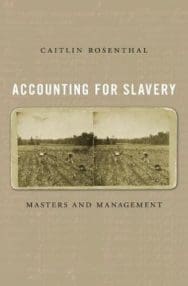
ABOUT THIS BOOK
PUBLISHER: Harvard University Press
FORMAT: Hardback
ISBN: 9780674972094
RRP: £27.95
PAGES: 312
PUBLICATION DATE:
August 31, 2018
BUY THIS BOOK
As an Amazon Associate and Bookshop.org affiliate we earn from qualifying purchases.
Accounting for Slavery: Masters and Management
Caitlin Rosenthal
Accounting for Slavery is a unique contribution to the decades-long effort to understand New World slavery’s complex relationship with capitalism. Through careful analysis of plantation records, Caitlin Rosenthal explores the development of quantitative management practices on West Indian and Southern plantations. She shows how planter-capitalists built sophisticated organizational structures and even practiced an early form of scientific management. They subjected enslaved people to experiments, such as allocating and reallocating labor from crop to crop, planning meals and lodging, and carefully recording daily productivity. The incentive strategies they crafted offered rewards but also threatened brutal punishment.The traditional story of modern management focuses on the factories of England and New England, but Rosenthal demonstrates that investors in West Indian and Southern plantations used complex accounting practices, sometimes before their Northern counterparts. For example, some planters depreciated their human capital decades before the practice was a widely used accounting technique. Contrary to narratives that depict slavery as a barrier to innovation, Accounting for Slavery explains how elite planters turned their power over enslaved people into a productivity advantage. The brutality of slavery was readily compatible with the development of new quantitative techniques for workforce organization.By showing the many ways that business innovation can be a byproduct of bondage, Rosenthal further erodes the false boundary between capitalism and slavery and illuminates deep parallels between the outlooks of eighteenth- and nineteenth-century slaveholders and the ethical dilemmas facing twenty-first-century businesses.
Reviews of Accounting for Slavery: Masters and Management
By paying close attention to slaveholders' methods of keeping accounts, Caitlin Rosenthal shows how and why they tried to reduce human beings to marks on a ledger. Anyone concerned with the sometimes dark history of management, data, and modern accounting practices needs to read this brilliant, carefully argued book.–W. Caleb McDaniel, Rice University Full of insights into the history of Atlantic slavery, Accounting for Slavery will force its readers to look with fresh eyes at the many freedoms and unfreedoms of the modern American workplace. This is an original book, which uniquely draws from and speaks to many disciplines, while written compellingly for a wide audience.–Jonathan Levy, University of Chicago
ALSO ON BOOKS FROM SCOTLAND
-

David Robinson Reviews: The Loch of the Bees
‘The past’s current flows through the characters in his fiction so strongly that it almost becomes t …
-

The Nightkeeper’s Apprentice by Jude Reid
‘She’d never seen anything like it. The whole sky was lit up in ribbons of colour – blue, green, yel …
-

David Robinson Interviews: Gavin Francis
‘He’s not my GP so I can’t say this for sure, but based on this book – wise, informed, well-written, …
-

The Cromarty Library Circle by Shona MacLean
‘No one in the room could have been unaware of what it was that Dr Fraser alluded to. The horrors pe …
-

In Search of Gems by Kenneth Steven
‘It still amazes me that these magnificent shells grow in a river. Never mind whether they have pear …
-

Winterbourne by Elisabeth Wolf
‘The Coopers stared at each other for a second, two seconds. ‘It’s a sign—’ said Cooper.’
FEATURED AUTHOR:
Nan Shepherd

Anna (Nan) Shepherd was born in 1893 and died in 1981. Closely attached to Aberdeen and her native Deeside, she graduated from her home university in 1915 and for the next forty-one years worked as a lecturer in English. An enthusiastic gardener and hi …
FEATURED PUBLISHER:
Lexus

Lexus started up in 1980, some years before the car. The company was founded by a group of bilingual lexicographers who had learned their trade in the bilingual dictionary department of Collins Publishers. At first Lexus was a packager and created a wi …