


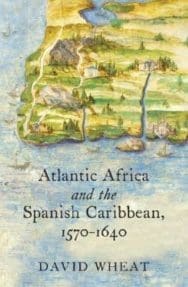
ABOUT THIS BOOK
PUBLISHER: The University of North Carolina Press
FORMAT: Paperback
ISBN: 9781469647654
RRP: £29.95
PAGES: 352
PUBLICATION DATE:
August 30, 2018
BUY THIS BOOK
As an Amazon Associate and Bookshop.org affiliate we earn from qualifying purchases.
Atlantic Africa and the Spanish Caribbean, 1570-1640
David Wheat
This work resituates the Spanish Caribbean as an extension of the Luso-African Atlantic world from the late sixteenth to the mid-seventeenth century, when the union of the Spanish and Portuguese crowns facilitated a surge in the transatlantic slave trade. After the catastrophic decline of Amerindian populations on the islands, two major African provenance zones, first Upper Guinea and then Angola, contributed forced migrant populations with distinct experiences to the Caribbean. They played a dynamic role in the social formation of early Spanish colonial society in the fortified port cities of Cartagena de Indias, Havana, Santo Domingo, and Panama City and their semirural hinterlands.David Wheat is the first scholar to establish this early phase of the “”Africanization”” of the Spanish Caribbean two centuries before the rise of large-scale sugar plantations. With African migrants and their descendants comprising demographic majorities in core areas of Spanish settlement, Luso-Africans, Afro-Iberians, Latinized Africans, and free people of color acted more as colonists or settlers than as plantation slaves. These ethnically mixed and economically diversified societies constituted a region of overlapping Iberian and African worlds, while they made possible Spain’s colonization of the Caribbean.
David Wheat
David Wheat is associate professor of history at Michigan State University.
ALSO ON BOOKS FROM SCOTLAND
-

David Robinson Reviews: The Loch of the Bees
‘The past’s current flows through the characters in his fiction so strongly that it almost becomes t …
-

The Nightkeeper’s Apprentice by Jude Reid
‘She’d never seen anything like it. The whole sky was lit up in ribbons of colour – blue, green, yel …
-

David Robinson Interviews: Gavin Francis
‘He’s not my GP so I can’t say this for sure, but based on this book – wise, informed, well-written, …
-
The Cromarty Library Circle by Shona MacLean
‘No one in the room could have been unaware of what it was that Dr Fraser alluded to. The horrors pe …
-

In Search of Gems by Kenneth Steven
‘It still amazes me that these magnificent shells grow in a river. Never mind whether they have pear …
-

Winterbourne by Elisabeth Wolf
‘The Coopers stared at each other for a second, two seconds. ‘It’s a sign—’ said Cooper.’
FEATURED AUTHOR:
Graeme Armstrong

Graeme Armstrong is a Times bestselling author from Airdrie, North Lanarkshire. His teenage years were spent within Scotland’s ‘young team’ gang culture. Alongside overcoming struggles with drug addiction, alcohol abuse and violence, he went on to read …
FEATURED PUBLISHER:
Arkbound

Arkbound is a publishing social enterprise based in Glasgow. Their aim is to support authors from disadvantaged and diverse backgrounds to get their voices heard, especially for writing that covers important social and environmental themes. They are on …