


ABOUT THIS BOOK
PUBLISHER: Boydell & Brewer Ltd
FORMAT: Hardback
ISBN: 9781783273164
RRP: £75.00
PAGES: 324
PUBLICATION DATE:
June 15, 2018
BUY THIS BOOK
As an Amazon Associate and Bookshop.org affiliate we earn from qualifying purchases.
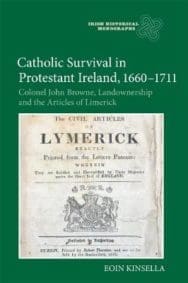
Catholic Survival in Protestant Ireland, 1660-1711: Colonel John Browne, Landownership and the Articles of Limerick
Eoin Kinsella
Traditional accounts of early modern Ireland have traced the seemingly inevitable decline of the Catholic landed interest following the Cromwellian and Williamite wars of the seventeenth century, portraying the Irish Catholic community as leaderless and politically moribund in the decades after the surrender of Limerick in 1691. This book demonstrates, however, that the picture was considerably more complex. By taking advantage of the upheavals in Irish landownership of the 1650s, many Catholics not only survived, but thrived. Having emerged as leaders of the Irish Catholic interest during the 1680s, these landowners refused to go into exile following the surrender of the Jacobites. They do not fit neatly into the archetype of the dispossessed and discontented Irish Catholic, offering instead an alternative perspective on Irish Jacobitism. Using the career of Colonel John Browne of Westport House as a focal point, this book casts new light on a wide range of subjects, including Catholic opposition to the repeal of the Restoration land settlement, the Irish Jacobite civil and military administration, estate management in late seventeenth-century Ireland, and the creation of lobbying networks in Dublin and London by Irish Catholics. The book also provides a detailed examination of the Williamite peace settlement in Ireland, and highlights the deeply interconnected nature of Irish society in the late seventeenth century. EOIN KINSELLA completed his doctorate at University College Dublin
ALSO ON BOOKS FROM SCOTLAND
-

David Robinson Reviews: The Loch of the Bees
‘The past’s current flows through the characters in his fiction so strongly that it almost becomes t …
-

The Nightkeeper’s Apprentice by Jude Reid
‘She’d never seen anything like it. The whole sky was lit up in ribbons of colour – blue, green, yel …
-

David Robinson Interviews: Gavin Francis
‘He’s not my GP so I can’t say this for sure, but based on this book – wise, informed, well-written, …
-
The Cromarty Library Circle by Shona MacLean
‘No one in the room could have been unaware of what it was that Dr Fraser alluded to. The horrors pe …
-

In Search of Gems by Kenneth Steven
‘It still amazes me that these magnificent shells grow in a river. Never mind whether they have pear …
-
Winterbourne by Elisabeth Wolf
‘The Coopers stared at each other for a second, two seconds. ‘It’s a sign—’ said Cooper.’
FEATURED AUTHOR:
Peter May

Peter May is a novelist, originally from Glasgow but now living and working in France. He started out as a journalist, studying at the Edinburgh College of Commerce, and winning the Fraser Award aged just 21 for his writing. He was named Scotland’s You …
FEATURED PUBLISHER:
Polaris Publishing

Established in 2011 and based in Edinburgh, Polaris Publishing Ltd are immensely proud to publish award-winning works by world-class authors. We are committed to unearthing exciting voices and publishing important, thoughtful and gripping stories with …