


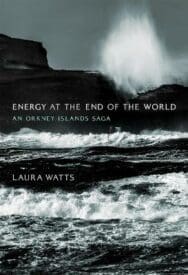
ABOUT THIS BOOK
PUBLISHER: MIT Press Ltd
FORMAT: Hardback
ISBN: 9780262038898
RRP: £27.00
PAGES: 440
PUBLICATION DATE:
January 15, 2019
BUY THIS BOOK
As an Amazon Associate and Bookshop.org affiliate we earn from qualifying purchases.
Energy at the End of the World: An Orkney Islands Saga
Laura Watts
Making local energy futures, from marine energy to hydrogen fuel, at the edge of the world.The islands of Orkney, off the northern coast of Scotland, are closer to the Arctic Circle than to London. Surrounded by fierce seas and shrouded by clouds and mist, the islands seem to mark the edge of the known world. And yet they are a center for energy technology innovation, from marine energy to hydrogen fuel networks, attracting the interest of venture capitalists and local communities. In this book, Laura Watts tells a story of making energy futures at the edge of the world.Orkney, Watts tells us, has been making technology for six thousand years, from arrowheads and stone circles to wave and tide energy prototypes. Artifacts and traces of all the ages-Stone, Bronze, Iron, Viking, Silicon-are visible everywhere. The islanders turned to energy innovation when forced to contend with an energy infrastructure they had outgrown. Today, Orkney is home to the European Marine Energy Centre, established in 2003. There are about forty open-sea marine energy test facilities in the world, many of which draw on Orkney expertise. The islands generate more renewable energy than they use, are growing hydrogen fuel and electric car networks, and have hundreds of locally owned micro wind turbines and a decade-old smart grid. Mixing storytelling and ethnography, empiricism and lyricism, Watts tells an Orkney energy saga-an account of how the islands are creating their own low-carbon future in the face of the seemingly impossible. The Orkney Islands, Watts shows, are playing a long game, making energy futures for another six thousand years.
Laura Watts
Laura Watts is a poet, writer, ethnographer of futures, and Interdisciplinary Senior Lecturer in Energy and Society in the School of Geosciences at the University of Edinburgh. As a science and technology studies scholar she has explored the effect of “edge” landscapes on how the future is imagined and made. She is coauthor of Ebban an’ Flowan, the world’s first poetic primer for marine renewable energy, and in 2017 she won the International Cultural Innovation Prize with the Reconstrained Design Group for a community-built energy storage device designed from scrap.
ALSO ON BOOKS FROM SCOTLAND
-

David Robinson Reviews: The Loch of the Bees
‘The past’s current flows through the characters in his fiction so strongly that it almost becomes t …
-
The Nightkeeper’s Apprentice by Jude Reid
‘She’d never seen anything like it. The whole sky was lit up in ribbons of colour – blue, green, yel …
-

David Robinson Interviews: Gavin Francis
‘He’s not my GP so I can’t say this for sure, but based on this book – wise, informed, well-written, …
-
The Cromarty Library Circle by Shona MacLean
‘No one in the room could have been unaware of what it was that Dr Fraser alluded to. The horrors pe …
-

In Search of Gems by Kenneth Steven
‘It still amazes me that these magnificent shells grow in a river. Never mind whether they have pear …
-

Winterbourne by Elisabeth Wolf
‘The Coopers stared at each other for a second, two seconds. ‘It’s a sign—’ said Cooper.’
FEATURED AUTHOR:
Olga Wojtas

Olga Wojtas is an unconventional – and very witty – writer of postmodern crime fiction whose surrealist humour has been compared to the likes of PG Wodehouse, Jasper Fforde and the Marx Brothers. Her debut novel, Miss Blaine’s Prefect and the Golden Sa …
FEATURED PUBLISHER:
404 Ink

404 Ink is an alternative book publisher based in Edinburgh. Established in mid 2016 we sought to provide an alternative literary programme for the Scottish reader market and beyond by publishing unusual fiction, non-fiction, poetry and comics in Engli …