


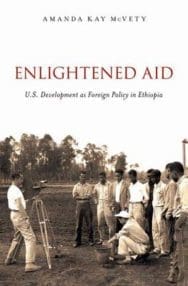
ABOUT THIS BOOK
PUBLISHER: Oxford University Press Inc
FORMAT: Hardback
ISBN: 9780199796915
RRP: £53.00
PAGES: 312
PUBLICATION DATE:
April 19, 2012
BUY THIS BOOK
As an Amazon Associate and Bookshop.org affiliate we earn from qualifying purchases.
Enlightened Aid: U.S. Development as Foreign Policy in Ethiopia
Amanda Kay McVety
Enlightened Aid is a unique history of foreign aid. It begins with the modern concept of progress in the Scottish Enlightenment, follows its development in nineteenth and early twentieth-century economics and anthropology, describes its transformation from a concept into a tool of foreign policy, and ends with the current debate about aid’s utility. In his 1949 inaugural address, Harry Truman vowed to make the development of the underdeveloped world a central part of the United States government’s national security agenda. This commitment became policy the following year with the creation of Point Four-America’s first aid program to the developing world. Point Four technicians shared technology, know-how, and capital with thirty-four nations around the world. They taught classes on public health and irrigation, distributed chickens and vaccines, and helped build schools and water treatment facilities. They did all of it in the name of development, believing that economic progress would lead to social and political progress, which, in turn, would ensure that Point Four recipient nations would become prosperous democratic participants in the global community of nations.Point Four was a weapon in the fight against poverty, but it was also a weapon in the fight against the Soviet Union. Eisenhower reluctantly embraced it and Kennedy made it a central part of his international policy agenda, turning Truman’s program into the United States Agency for International Development. Point Four had proven itself to be a useful tool of diplomacy, and subsequent administrations claimed it for themselves. None seemed overly worried that it had not also proven itself to be a particularly useful tool of development. Using Ethiopia as a case study, Enlightened Aid: U.S. Development as Foreign Policy in Ethiopia examines the struggle between foreign aid-for-diplomacy and foreign aid-for-development. Point Four’s creators believed that aid could be both at the same time. The history of U.S. aid to Ethiopia suggests otherwise.
Reviews of Enlightened Aid: U.S. Development as Foreign Policy in Ethiopia
""Setting Ethiopia's tragedy in the context of the Cold War and two centuries of economic thought, Enlightened Aid is a definitive and revealing requiem for development."" –The Journal of American History""This broadly-conceived and highly original study makes an important contribution to the growing literature on the pre-Cold War history of developmentalism, whose origins are traced back to the thinkers of the Scottish Enlightenment in the eighteenth century. Spanning eight decades of American interventions in Ethiopia, Enlightened Aid provides an often surprising account of a paradigmatic example of American foreign aid, and its underlying hubristic rationales, which have been inexplicably neglected by historians and other social scientists."" –Michael Adas, Abraham E. Voorhees Professor of History, Rutgers University at New Brunswick ""Amanda Kay McVety's ambitious book situates American development aid to Ethiopia in the broadest context, shedding light on the evolving meanings of development, on American programs in the early Cold War, and on the emergence of the peculiar developmentalist state of Ethiopia. Ranging from David Hume to Walt Rostow, from Haile Selassie to Jeffrey Sachs, Enlightened Aid is a welcome contribution to histories of development, expanding the geographic and chronological boundaries of the field."" –David C. Engerman, Associate Professor of History, Brandeis University
Amanda Kay McVety
Assistant Professor of History, Miami University
ALSO ON BOOKS FROM SCOTLAND
-


The Scottish Colourists: Art & Life by Alice Strang
‘Together the quartet embodied a new spirit in Scottish art and they are celebrated as Scotland’s le …
-

David Robinson Reviews: Our Noble Selves by Kate Atkinson
‘As I suggested at the start, there’s a whole heap of plot in Our Noble Selves – spies, murders, and …
-

‘They had spoken perhaps ten sentences each and it had already begun. Moira’s resentments, her preju …
-

Ayont the Thistle by Jim Mackintosh, Alan Riach and James Robertson
‘Nane ae this then but – ma hert daen its hing/ an yon wee smile ae yours in the saft smir ae the ga …
-

David Robinson Reviews: This Door of the Seas
‘He sees what he wants to. And it makes a kind of sense too – especially to colonists from Scotland, …
-

The Broons and Oor Wullie Celebrate their 90th Birthdays!
‘Whatever the future may hold, we can be sure that The Broons and Oor Wullie will always be a part o …
FEATURED AUTHOR:
Alan Parks

Alan Parks has worked in the music industry for over twenty years. His debut novel Bloody January was shortlisted for the Grand Prix de Littérature Policière. He won the McIlvanney Prize in 2022 for the fifth entry in the Harry McCoy series, May God Fo …
FEATURED PUBLISHER:
The Islands Book Trust
Since 2003, IBT has published over 100 books or booklets on the history and culture (in English and Gaelic) of Scottish islands. In an earlier period we were publishing over 10 books pa. Our website shows the publications currently in print. Our most r …