



ABOUT THIS BOOK
PUBLISHER: Liverpool University Press
FORMAT: Hardback
ISBN: 9781789620818
RRP: £80.00
PAGES: 256
PUBLICATION DATE:
September 30, 2019
BUY THIS BOOK
As an Amazon Associate and Bookshop.org affiliate we earn from qualifying purchases.
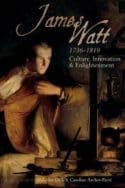
James Watt (1736-1819): Culture, Innovation and Enlightenment
Caroline Archer-Parre
Malcolm Dick
James Watt (1736-1819) was a pivotal figure of the Industrial Revolution. His career as a scientific instrument maker, inventor and engineer was developed in Scotland, his land of birth. His subsequent national and international significance as a scientist, technologist and businessman was formed in the Birmingham area. There, his partnership with Matthew Boulton and the intellectual and personal support of other members of the Lunar Society network, such as Erasmus Darwin, James Keir, William Small and Josiah Wedgwood, enabled him to translate his improvements in steam technology into efficient machines. His pumping and rotative steam engines represent a summit of technological achievement in the late-eighteenth and early-nineteenth centuries.This is the traditional picture of James Watt. After his death, his surviving son, James Watt junior projected his father’s image through commissioning sculptures, medals, paintings and biographies which celebrated his reputation as a `great man’ of the Industrial Revolution. In popular historical understanding Watt has also become a hero of modernity, but the context in which he operated and the roles of others in shaping his ideas have been downplayed. This book explores new aspects of his work and evaluates him in his locational, family, social and intellectual contexts.
Reviews of James Watt (1736-1819): Culture, Innovation and Enlightenment
Reviews'High quality chapters, convincingly argued and clearly written, offering new insights into Watt's life and work..'Professor Christine MacLeod, University of Bristol
Caroline Archer-Parre
Caroline Archer-Parre is Professor of Typography at Birmingham City University, Director of the Centre for Printing History & Culture and Chairman of the Baskerville Society. She is the author of The Kynoch Press, 1876-1982: the anatomy of a printing house, (British Library, 2000); Paris Underground (MBP, 2004); and Tart cards: London’s illicit advertising art (MBP, 2003). Caroline is currently Co-investigator on the AHRC-funded project, `Letterpress Printing: past, present, future’. Malcolm Dick is Director of the Centre for West Midlands History at the University of Birmingham. He directed two history projects in Birmingham between 2000 and 2004: the Millennibrum Project, which created a multi-media archive of post-1945 Birmingham history and Revolutionary Players which produced an online resource of the history of the West Midlands region. Malcolm has published books on Joseph Priestley, Matthew Boulton and the history of Birmingham and co-directs the Centre for Printing History & Culture.
OTHER BOOKS BY THE SAME AUTHOR

ALSO ON BOOKS FROM SCOTLAND
-

David Robinson Reviews: The Loch of the Bees
‘The past’s current flows through the characters in his fiction so strongly that it almost becomes t …
-

The Nightkeeper’s Apprentice by Jude Reid
‘She’d never seen anything like it. The whole sky was lit up in ribbons of colour – blue, green, yel …
-

David Robinson Interviews: Gavin Francis
‘He’s not my GP so I can’t say this for sure, but based on this book – wise, informed, well-written, …
-
The Cromarty Library Circle by Shona MacLean
‘No one in the room could have been unaware of what it was that Dr Fraser alluded to. The horrors pe …
-

In Search of Gems by Kenneth Steven
‘It still amazes me that these magnificent shells grow in a river. Never mind whether they have pear …
-

Winterbourne by Elisabeth Wolf
‘The Coopers stared at each other for a second, two seconds. ‘It’s a sign—’ said Cooper.’
FEATURED AUTHOR:
Pamela Butchart

Pamela Butchart is a teacher and the writer of many award-winning books, including The Spy Who Loved School Dinners and My Head Teacher is a Vampire Rat. She is also author of of the bestselling picture books Never Tickle a Tiger, Yikes, Stinkysaurus! …
FEATURED PUBLISHER:
Orkneyology Press
We are a bibliophile husband and wife team, Tom and Rhonda Muir of the Okney Islands. Orkneyology Press evolved from our website, Orkneyology.com. Curating remarkable stories by means of an independent press has been our ultimate goal since we began th …