


ABOUT THIS BOOK
PUBLISHER: Edward Elgar Publishing Ltd
FORMAT: Hardback
ISBN: 9781788971843
RRP: £85.00
PAGES: 296
PUBLICATION DATE:
July 27, 2018
BUY THIS BOOK
As an Amazon Associate and Bookshop.org affiliate we earn from qualifying purchases.
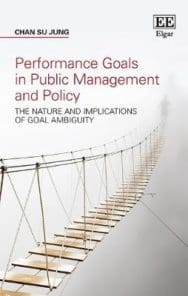
Performance Goals in Public Management and Policy: The Nature and Implications of Goal Ambiguity
Chan S. Jung
Chan Su Jung provides a thorough review of goal ambiguity in the public sector, exploring the general assertions, arguments and empirical evidence regarding performance goal ambiguity, particularly highlighting its causes, consequences, and mediation effects. The author proposes a new conceptual framework for successful analysis of goal ambiguity that can effectively relate to diverse organizational and program characteristics.Using U.S. federal programs, South Korean central government agencies, and English local authorities as examples, Jung empirically tests his framework to validate the new approach for goal ambiguity analysis. The author corroborates management capacity, third-party involvement, learning times, size, and work complexity as predictors of goal ambiguity and performance. In addition, Jung studies political insulation structures as moderators between management capacity and goal ambiguity, along with the negative effect of goal ambiguity on performance. Based on these empirical findings, the author provides clear and transferable principles to guide further theoretical and conceptual studies on the topic.An essential read for quantitative researchers and doctoral students of public management and policy, this book will guide future empirical studies on goal ambiguity and performance in the public sector.
Reviews of Performance Goals in Public Management and Policy: The Nature and Implications of Goal Ambiguity
`This book is a must read to those who are interested in public performance goals and goal ambiguity issues. The author offers not only comprehensive and superb conceptual discussions on public performance goals and goal ambiguity as independent, mediating, and dependent variables in public organizations, but also provides rigorous evidence based on empirical analyses of U.S. Federal government data as well as the data obtained from British local governments and South Korean central government. While this book itself is a refined scholarly architecture of public performance goals and goal ambiguity by carefully linking concepts, models, and empirical analyses, the author also envisions exciting future research by positing fourteen compelling research propositions and various research methods.' — M. Jae Moon, Yonsei University, South Korea
Chan S. Jung
Chan Su Jung, Samhwa Global Limited, Hong Kong SAR
ALSO ON BOOKS FROM SCOTLAND
-


David Robinson Reviews: The Loch of the Bees
‘The past’s current flows through the characters in his fiction so strongly that it almost becomes t …
-

The Nightkeeper’s Apprentice by Jude Reid
‘She’d never seen anything like it. The whole sky was lit up in ribbons of colour – blue, green, yel …
-

David Robinson Interviews: Gavin Francis
‘He’s not my GP so I can’t say this for sure, but based on this book – wise, informed, well-written, …
-

The Cromarty Library Circle by Shona MacLean
‘No one in the room could have been unaware of what it was that Dr Fraser alluded to. The horrors pe …
-

In Search of Gems by Kenneth Steven
‘It still amazes me that these magnificent shells grow in a river. Never mind whether they have pear …
-

Winterbourne by Elisabeth Wolf
‘The Coopers stared at each other for a second, two seconds. ‘It’s a sign—’ said Cooper.’
FEATURED AUTHOR:
Peter Mackay

Academic, writer and broadcaster Pàdraig MacAoidh (Peter Mackay) has been appointed as Scotland’s Makar – our national poet. First Minister John Swinney MSP formally welcomed Pàdraig to the role at Edinburgh Central Library on 2 December 2024. The Maka …
FEATURED PUBLISHER:
Little Door Books

Little Door Books was officially launched as an independent publisher in 2016. We work collaboratively with established and emerging authors and illustrators, offering them greater input in the creation of their high-quality, exciting, and ultimately b …