


ABOUT THIS BOOK
PUBLISHER: Oxford University Press
FORMAT: Hardback
ISBN: 9780198747901
RRP: £65.00
PAGES: 272
PUBLICATION DATE:
September 24, 2015
BUY THIS BOOK
As an Amazon Associate and Bookshop.org affiliate we earn from qualifying purchases.
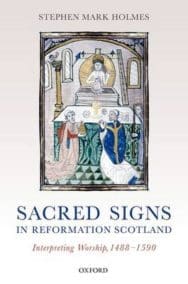
Sacred Signs in Reformation Scotland: Interpreting Worship, 1488-1590
Stephen Mark Holmes
Sacred Signs in Reformation Scotland is the first study of how public worship was interpreted in Renaissance Scotland and offers a radically new way of understanding the Scottish Reformation. It first defines the history and method of ‘liturgical interpretation’ (using the methods of medieval Biblical exegesis to explain worship), then shows why it was central to medieval and early modern Western European religious culture. The rest of the book uses Scotland as a case study for a multidisciplinary investigation of the place of liturgical interpretation in this culture. Stephen Mark Holmes uses the methods of ‘book history’ to discover the place of liturgical interpretation in education, sermons and pastoral practice and also investigates its impact on material culture, especially church buildings and furnishings. A study of books and their owners reveals networks of clergy in Scotland committed to the liturgy and Catholic reform, especially the ‘Aberdeen liturgists’.Holmes corrects current scholarship by showing that their influence lasted beyond 1560 and suggests that they created the distinctive religious culture of North-East Scotland (later a centre of Catholic recusancy, Episcopalianism and Jacobitism). The final two chapters investigate what happened to liturgical interpretation in Scottish religious culture after the Protestant Reformation of 1559-60, showing that while it declined in importance in Catholic circles, a Reformed Protestant version of liturgical interpretation was created and flourished which used exactly the same method to produce both an interpretation of the Reformed sacramental rites and an ‘anti-commentary’ on Catholic liturgy. The book demonstrates an important continuity across the Reformation divide arguing that the ‘Scottish Reformation’ is best seen as both Catholic and Protestant, with the reformers on both sides having more in common than they or subsequent historians have allowed.
Stephen Mark Holmes
Dr Steven Mark Holmes is an Honorary Fellow at the University of Edinburgh.
ALSO ON BOOKS FROM SCOTLAND
-

David Robinson Reviews: The Loch of the Bees
‘The past’s current flows through the characters in his fiction so strongly that it almost becomes t …
-

The Nightkeeper’s Apprentice by Jude Reid
‘She’d never seen anything like it. The whole sky was lit up in ribbons of colour – blue, green, yel …
-

David Robinson Interviews: Gavin Francis
‘He’s not my GP so I can’t say this for sure, but based on this book – wise, informed, well-written, …
-
The Cromarty Library Circle by Shona MacLean
‘No one in the room could have been unaware of what it was that Dr Fraser alluded to. The horrors pe …
-
In Search of Gems by Kenneth Steven
‘It still amazes me that these magnificent shells grow in a river. Never mind whether they have pear …
-

Winterbourne by Elisabeth Wolf
‘The Coopers stared at each other for a second, two seconds. ‘It’s a sign—’ said Cooper.’
FEATURED AUTHOR:
Lindz McLeod

Lindz McLeod is an award-winning queer, working-class, Scottish writer and editor who dabbles in the surreal. She was the Competition Secretary of the Edinburgh Writers’ Club from 2019-2023, and was elected as their Club President in 2023. Her work has …
FEATURED PUBLISHER:
Luna Press Publishing

Luna Press Publishing is an independent press founded in 2015. We deal with Science Fiction, Fantasy and Dark Fantasy, in both fiction and academia. We work with agents, published authors and new writers, with PhD students and researchers. We take prid …