


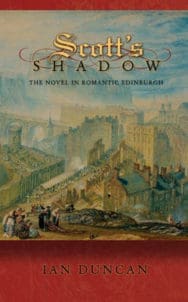
ABOUT THIS BOOK
PUBLISHER: Princeton University Press
FORMAT: Paperback
ISBN: 9780691144269
RRP: £19.95
PAGES: 416
PUBLICATION DATE:
August 2, 2016
BUY THIS BOOK
As an Amazon Associate and Bookshop.org affiliate we earn from qualifying purchases.
Scott’s Shadow: The Novel in Romantic Edinburgh
Ian Duncan
Scott’s Shadow is the first comprehensive account of the flowering of Scottish fiction between 1802 and 1832, when post-Enlightenment Edinburgh rivaled London as a center for literary and cultural innovation. Ian Duncan shows how Walter Scott became the central figure in these developments, and how he helped redefine the novel as the principal modern genre for the representation of national historical life. Duncan traces the rise of a cultural nationalist ideology and the ascendancy of Scott’s Waverley novels in the years after Waterloo. He argues that the key to Scott’s achievement and its unprecedented impact was the actualization of a realist aesthetic of fiction, one that offered a socializing model of the imagination as first theorized by Scottish philosopher and historian David Hume. This aesthetic, Duncan contends, provides a powerful novelistic alternative to the Kantian-Coleridgean account of the imagination that has been taken as normative for British Romanticism since the early twentieth century.Duncan goes on to examine in detail how other Scottish writers inspired by Scott’s innovations–James Hogg and John Galt in particular–produced in their own novels and tales rival accounts of regional, national, and imperial history. Scott’s Shadow illuminates a major but neglected episode of British Romanticism as well as a pivotal moment in the history and development of the novel.
Ian Duncan
Ian Duncan is professor of English at the University of California, Berkeley. He is the author of Modern Romance and Transformations of the Novel and the coeditor of Scotland and the Borders of Romanticism.
ALSO ON BOOKS FROM SCOTLAND
-

David Robinson Reviews: The Loch of the Bees
‘The past’s current flows through the characters in his fiction so strongly that it almost becomes t …
-

The Nightkeeper’s Apprentice by Jude Reid
‘She’d never seen anything like it. The whole sky was lit up in ribbons of colour – blue, green, yel …
-

David Robinson Interviews: Gavin Francis
‘He’s not my GP so I can’t say this for sure, but based on this book – wise, informed, well-written, …
-
The Cromarty Library Circle by Shona MacLean
‘No one in the room could have been unaware of what it was that Dr Fraser alluded to. The horrors pe …
-

In Search of Gems by Kenneth Steven
‘It still amazes me that these magnificent shells grow in a river. Never mind whether they have pear …
-

Winterbourne by Elisabeth Wolf
‘The Coopers stared at each other for a second, two seconds. ‘It’s a sign—’ said Cooper.’
FEATURED AUTHOR:
Lesley Glaister

Lesley Glaister is a fiction writer, poet, playwright and teacher of writing. She has published fourteen adult novels, the first of a YA trilogy and numerous short stories. She received both a Somerset Maugham and a Betty Trask award for Honour Thy Fat …
FEATURED PUBLISHER:
Scottish Mountaineering Press

Launched in 2020, the Scottish Mountaineering Press exists to promote and share Scotland’s natural wonders, embracing the creativity born out of an explorer spirit and celebrating the joy and endeavour in a life lived outdoors. We are a wholly-owned su …