


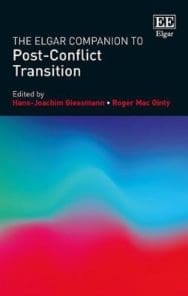
ABOUT THIS BOOK
PUBLISHER: Edward Elgar Publishing Ltd
FORMAT: Hardback
ISBN: 9781783479047
RRP: £130.00
PAGES: 392
PUBLICATION DATE:
August 31, 2018
BUY THIS BOOK
As an Amazon Associate and Bookshop.org affiliate we earn from qualifying purchases.
The Elgar Companion to Post-Conflict Transition
Hans-Joachim Giessmann
Roger Mac Ginty
Beatrix Austin
Christine Seifert
A better understanding of regime changes, and their drivers, is vital to understanding the root causes of conflict and instability. In doing so, national and international actors can develop appropriate strategies to address, curb and prevent escalations of violence when these transitions occur. This innovative book explores the motivations and impacts of regime change and political transition in the contemporary era. Systematically examining the drivers, formats and long term impacts of transitions, the contributors seek to identify patterns, commonalities, and disjunctures between them.Bringing together leading scholars and practitioners with longstanding relationships to the conflicts they have covered, this book provides systematic cross-case examinations of regime change. It examines the structural and immediate triggers of transitions both external and internal, as well as shedding light on the ways in which everyday life is changed by them – for better or worse. Providing a framework for typological and comparative analysis, this book provides ontological and epistemological perspectives on 14 case studies of regime change following civil wars, secessionist conflicts, popular revolutions, military rule and foreign intervention.This book is a vital tool for academics and students of political science, development, history, regional, peace and conflict studies. Reflecting on regime change processes spanning different regions and types of transition, The Elgar Companion to Post Conflict Transition is an accessible way to cover key debates.
Hans-Joachim Giessmann
Edited by Hans-Joachim Giessmann, Executive Director, Berghof Foundation, Germany, Roger Mac Ginty, Humanitarian and Conflict Response Institute, and Department of Politics, University of Manchester, UK, with Beatrix Austin and Christine Seifert, Berghof Foundation, Germany
ALSO ON BOOKS FROM SCOTLAND
-

David Robinson Reviews: The Loch of the Bees
‘The past’s current flows through the characters in his fiction so strongly that it almost becomes t …
-

The Nightkeeper’s Apprentice by Jude Reid
‘She’d never seen anything like it. The whole sky was lit up in ribbons of colour – blue, green, yel …
-

David Robinson Interviews: Gavin Francis
‘He’s not my GP so I can’t say this for sure, but based on this book – wise, informed, well-written, …
-
The Cromarty Library Circle by Shona MacLean
‘No one in the room could have been unaware of what it was that Dr Fraser alluded to. The horrors pe …
-

In Search of Gems by Kenneth Steven
‘It still amazes me that these magnificent shells grow in a river. Never mind whether they have pear …
-

Winterbourne by Elisabeth Wolf
‘The Coopers stared at each other for a second, two seconds. ‘It’s a sign—’ said Cooper.’
FEATURED AUTHOR:
Pamela Butchart

Pamela Butchart is a teacher and the writer of many award-winning books, including The Spy Who Loved School Dinners and My Head Teacher is a Vampire Rat. She is also author of of the bestselling picture books Never Tickle a Tiger, Yikes, Stinkysaurus! …
FEATURED PUBLISHER:
Edinburgh University Press

Connecting people and ideas to inspire creative thinking, open new perspectives and shape the world we live in. Our ambition is to create a community of authors, editors, advisors and practitioners committed to publishing world-class academic research …