


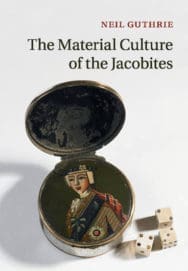
ABOUT THIS BOOK
PUBLISHER: Cambridge University Press
FORMAT: Paperback
ISBN: 9781316626238
RRP: £19.99
PAGES: 288
PUBLICATION DATE:
September 15, 2016
BUY THIS BOOK
As an Amazon Associate and Bookshop.org affiliate we earn from qualifying purchases.
The Material Culture of the Jacobites
Neil Guthrie
The Jacobites, adherents of the exiled King James II of England and VII of Scotland and his descendants, continue to command attention long after the end of realistic Jacobite hopes down to the present. Extraordinarily, the promotion of the Jacobite cause and adherence to it were recorded in a rich and highly miscellaneous store of objects, including medals, portraits, pin-cushions, glassware and dice-boxes. Interdisciplinary and highly illustrated, this book combines legal and art history to survey the extensive material culture associated with Jacobites and Jacobitism. Neil Guthrie considers the attractions and the risks of making, distributing and possessing ‘things of danger’; their imagery and inscriptions; and their place in a variety of contexts in the seventeenth and eighteenth centuries. Finally, he explores the many complex reasons underlying the long-lasting fascination with the Jacobites.
Reviews of The Material Culture of the Jacobites
'Neil Guthrie presents an impressive range of subject matter and a wealth of learning in this original, erudite, and perceptive book. He is not only well-versed in eighteenth-century history and literature, but also knows the relevant fields of law – necessary for an understanding of the limited room for manoeuvre available to Jacobites – and Latinity, the medium for so many tags, allusions and inscriptions in Jacobite literature.' Colin Kidd, University of Glasgow
Neil Guthrie
Neil Guthrie is a lawyer by profession and has published articles on Jacobite material culture, law and literary history, including ‘Johnson’s Touch-piece and the ‘Charge of Fame’: Personal and Public Aspects of the Medal in Eighteenth-Century Britain’ in The Politics of Samuel Johnson (edited by H. Erskine-Hill and J. C. D. Clark, 2012).
ALSO ON BOOKS FROM SCOTLAND
-

David Robinson Reviews: The Loch of the Bees
‘The past’s current flows through the characters in his fiction so strongly that it almost becomes t …
-

The Nightkeeper’s Apprentice by Jude Reid
‘She’d never seen anything like it. The whole sky was lit up in ribbons of colour – blue, green, yel …
-

David Robinson Interviews: Gavin Francis
‘He’s not my GP so I can’t say this for sure, but based on this book – wise, informed, well-written, …
-
The Cromarty Library Circle by Shona MacLean
‘No one in the room could have been unaware of what it was that Dr Fraser alluded to. The horrors pe …
-
In Search of Gems by Kenneth Steven
‘It still amazes me that these magnificent shells grow in a river. Never mind whether they have pear …
-
Winterbourne by Elisabeth Wolf
‘The Coopers stared at each other for a second, two seconds. ‘It’s a sign—’ said Cooper.’
FEATURED AUTHOR:
Seona Calder

Seona Calder was born and raised in Scotland. After studying art, she went on to work as an illustrator on various projects, including books on science, astronomy and animal behaviour. Seona claims that ‘living with a menagerie of animals over the year …
FEATURED PUBLISHER:
Polaris Publishing

Established in 2011 and based in Edinburgh, Polaris Publishing Ltd are immensely proud to publish award-winning works by world-class authors. We are committed to unearthing exciting voices and publishing important, thoughtful and gripping stories with …