


ABOUT THIS BOOK
PUBLISHER: Equinox Publishing Ltd
FORMAT: Electronic book text
ISBN: 9781781797129
RRP: £39.95
PAGES: 256
PUBLICATION DATE:
September 3, 2018
BUY THIS BOOK
As an Amazon Associate and Bookshop.org affiliate we earn from qualifying purchases.
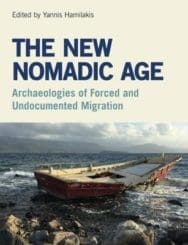
The New Nomadic Age: Archaeologies of Forced and Undocumented Migration
Yannis Hamilakis
It can be suggested that today we live in a new nomadic age, an age of global movement and migration. For the majority of people on earth, however, especially from the global south, crossing national borders and moving from the global south to the global north is risky, perilous, often lethal. Many are forced or compelled to migrate due to war, persecution, or the structural violence of poverty and deprivation. The phenomenon of forced and undocumented migration is one of the defining features of our era. And while the topic is at the centre of attention and study in many scholarly fields, the materiality of the phenomenon and its sensorial and mnemonic dimensions are barely understood and analysed. In this regard, contemporary archaeology can make an immense contribution.This book, the first archaeological anthology on the topic, takes up the challenge and explores the diverse intellectual, methodological, ethical, and political frameworks for an archaeology of forced and undocumented migration in the present. Matters of historical depth, theory, method, ethics and politics as well as heritage value and public representation are investigated and analysed, adopting a variety of perspectives. The book contains both short reflections and more substantive treatments and case studies from around the world, from the Mexico-USA border to Australia, and utilizes a diversity of narrative formats, including several photographic essays.
Yannis Hamilakis
Yannis Hamilakis is Joukowsky Family Professor of Archaeology and Professor of Modern Greek Studies at the Joukowsky Institute for Archaeology and the Ancient World, Brown University, and Co-Director of the Koutroulou Magoula Archaeology and Archaeological Ethnography Project.
ALSO ON BOOKS FROM SCOTLAND
-

David Robinson Reviews: The Loch of the Bees
‘The past’s current flows through the characters in his fiction so strongly that it almost becomes t …
-

The Nightkeeper’s Apprentice by Jude Reid
‘She’d never seen anything like it. The whole sky was lit up in ribbons of colour – blue, green, yel …
-

David Robinson Interviews: Gavin Francis
‘He’s not my GP so I can’t say this for sure, but based on this book – wise, informed, well-written, …
-
The Cromarty Library Circle by Shona MacLean
‘No one in the room could have been unaware of what it was that Dr Fraser alluded to. The horrors pe …
-

In Search of Gems by Kenneth Steven
‘It still amazes me that these magnificent shells grow in a river. Never mind whether they have pear …
-

Winterbourne by Elisabeth Wolf
‘The Coopers stared at each other for a second, two seconds. ‘It’s a sign—’ said Cooper.’
FEATURED AUTHOR:
David F. Ross

David F. Ross was born in Glasgow in 1964 and lived in various part of the city until the late 70’s, before moving to Kilmarnock where he now lives with his wife and their two children. He studied architecture at Glasgow School of Art, and in 1992 grad …
FEATURED PUBLISHER:
404 Ink

404 Ink is an alternative book publisher based in Edinburgh. Established in mid 2016 we sought to provide an alternative literary programme for the Scottish reader market and beyond by publishing unusual fiction, non-fiction, poetry and comics in Engli …