


EXPLORE ISSUES



‘Each time I’ve aimlessly scrolled on social media since finishing Face, I’ve felt a small sense of foreboding.’
Nasim Asl finds a dizzying, disturbing dystopian world in Joma West’s debut novel, Face.
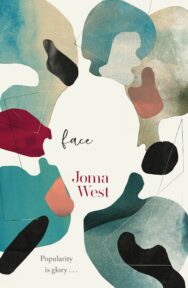
Face
By Joma West
Published by Tor
In a world where social media dominates discourse, politics, relationships and friendships, it can seem like we’re permanently on display to strangers. Many of us are constantly curating a digital image we want to project of ourselves to others. This experience is at the heart of Joma West’s debut novel Face – but magnified to a truly dystopian extent.
Face is set in an alternative, future version of society where focus on the self has reached monumental levels. Everyone has access to virtual realities, the online world and social media feeds right from their eyelids, and characters measure their every interaction and decision based on how it will interact their ‘face’ – how they’re seen and judged by others. This self-obsession has gone so far that contact between humans is considered taboo and is the most repulsive experience most characters can imagine. An interesting foil to our own existence, where the desire for touch and physical intimacy can even be seen through the sexualisation of products and commerce.
Concept-wise Face is grabbing. Yet where other novels also marketed as sci-fi or dystopian can spend a lot of time explaining exactly how these societies came to pass, West throws her readers straight into her brand-new world and leaves them to work things out on their own. It can be confusing but it’s also incredibly engaging to be constantly thinking about and trying to understand the societal norms at play. It’s a smart technique that keeps interest levels high and the reader asking questions.
We’re also used to dystopian novels where a single protagonist, akin to a chosen one, is the sole focus of the story. Typically, they are secret usurpers who meet other disruptive thinkers, then take on the world’s autocratic authorities, overthrow regimes and restore the natural order of things. There’s no change of system like that in Face. The novel follows a close-knit cast of characters, revolving around a single family and a few individuals that fly into their orbit. West’s characters live their daily lives, start and end relationships, learn new things, question themselves and the face they present to their world. It feels domestic rather than global, even though there’s still a lot at stake. Some things are never fully explained – such as the authorities who pull some characters in for questioning. We never quite learn who they are, who controls them, or what their purpose is.
The novel takes place over a good number of months, but time passes quickly – in part due to the fact we follow one character at a time. West provides her reader with a revolving cast – characters who are all intimately connected in ways that are revealed as the novel progresses. Section by section, character by character, turn by turn, we’re offered close readings of their psyche and glimpses into their internal monologue.
Reading the same scene from the perspective of multiple different characters is interesting, and the technique provides a neatness to the novel’s overall structure. However, given how close some characters are, by the time the same scene is replayed for the fourth time through different eyes it feels repetitive. I appreciate the wider point this makes about the ennui and claustrophobia felt when trapped in a world where you’re physically and emotionally separated from everyone else – indeed, characters have the ability to constantly film the world as they see it through their eyes and view the footage – but I found myself skimming some repeated interactions. I wanted to see more of who these characters were and what they did when they were alone, when their face was not on display.
Despite this, West is successful in creating a cast of characters each with distinct voices, personalities, and motives, even if they’re mostly unlikeable. It’s helpful this characterisation is so strong; each section of the book feels like another layer of paper is being removed in pass the parcel, and some truths of this society are slowly revealed. I kept reading because I wanted to unwrap the characters and see their real face. More is revealed as the book progresses and we see new pairings interact. The emotional depth increases as the story continues and while normal, everyday life is at the heart of Face, more jeopardy emerges as we meet more characters, though it never reaches breath-catching levels.
It’s disturbing that in the world West creates, where people are so focused on how others judge them, that class becomes divisive in the extreme – there’s an underclass of people known as Menials, who are essentially bred to be slaves, castrated and brainwashed to have no desire, personality or independence. It’s uncomfortable to read the extent of the dehumanisation at play, and some of the book’s most interesting passages feature exchanges between the Menial whose narrative weaves through the entire novel (Jake) and the virtual counsellor he speaks to regularly. The echoes of human rights abuses across history echo loudly, and as more horrors are revealed the reader is left unsettled by the knowledge that in a world so obsessed with judgement, compassion for others is almost non-existent.
Face is a moving and engaging study of humanity, and where its limits may lie, but I think the power and the punch of what could be a necessary warning for our times is weakened by the novel’s structure. The repetition of scenes took space away from action. Each time I felt we were about to get into the juicy, dramatic and captivating part of the story, West reversed course. I was left wanting more. Perhaps it was the lack of action that meant I wasn’t hanging onto every word. I wasn’t struck by a fierce flash of obsession as I was reading – partly because I had no idea where the plot was ultimately going – but what West has done incredibly successfully is write a book I’ve not stopped thinking about. Each time I’ve aimlessly scrolled on social media since finishing Face, I’ve felt a small sense of foreboding, felt a slight shudder, and asked myself perhaps the novel’s most pertinent question – ‘what if’?
Face by Joma West is published by Tor, priced £20.99.
RELATED BOOKS

ALSO ON BOOKS FROM SCOTLAND
-


David Robinson Interviews: Gavin Francis
‘He’s not my GP so I can’t say this for sure, but based on this book – wise, informed, well-written, …
-
The Cromarty Library Circle by Shona MacLean
‘No one in the room could have been unaware of what it was that Dr Fraser alluded to. The horrors pe …
-

In Search of Gems by Kenneth Steven
‘It still amazes me that these magnificent shells grow in a river. Never mind whether they have pear …
-

Winterbourne by Elisabeth Wolf
‘The Coopers stared at each other for a second, two seconds. ‘It’s a sign—’ said Cooper.’
-
David Robinson Reviews: From Scotland with Love by Fred Bridgland
‘There are so many unsung heroes in Fred’s book that I almost lose count.’
-
Winter Round Up of New Scots and Gaelic Books
‘what would happen if someone really scrieved in thir ane langwij / didn’t turn on their mouth lit i …
FEATURED AUTHOR:
Lindsay Littleson

Lindsay Littleson is a primary school teacher in Renfrewshire, Scotland. Since taking up writing for children in early 2014 she has published a short story with Walker Books, in addition to winning the Kelpies Prize with her first children’s novel, The …
FEATURED PUBLISHER:
Tippermuir Books Ltd

Tippermuir Books Ltd is a book publisher based in Perth. Established in 2009, Tippermuir seeks to add to the cultural life of Scotland by publishing interesting and worthy books in English and Scots. Our strength is our smallness and love of the writte …