


EXPLORE ISSUES



‘Read it, and you start to realise how clumsy any chronological saunter through Faber’s work would have been, and how themes of alienation, connection and compassion leach through all of it, from short stories to novellas and doorstop novels.’
In this review of Rodge Glass’s book on Michel Faber, David Robinson reflects on Faber’s literary journey, the fallibility of (a reader’s) memory, and the nuances that define a writer’s work.
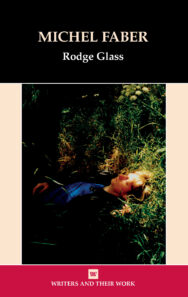
Michel Faber (Writers and Their Work)
By Rodge Glass
Published by Liverpool University Press
Most writers would, I think, be horrified if they realised how much their readers forget about their novels once they have finished them – and how soon. All that time sweating blood over choosing the precisely right adjective or metaphor, shading in the odd nuance of character or building up an exquisite moral dilemma – only for most of it to evaporate from our minds almost as soon as we’ve reached the final full stop.
At least I’m like that in my general reading (reviewing and book prize judging is a completely different matter) and I suspect most people are too. As soon as a fortnight after I’ve finished it, all the finer details of a novel’s plot and individuated examples of writerly style or dialogue are already starting to disappear.
What remains is hard to describe and I’ve never really thought about it until this week, though it’s precisely the kind of thing Durham University’s ReaderBank research project at this year’s Edinburgh International Book Festival would be interested in. Yet to me, how a novel sinks into my mind, its details gradually dissolving into a general impression, has some parallels with what happens when we meet someone for the first time. A week later, I mightn’t be able to remember the colour of their eyes, but I will certainly know whether or not I liked them. As with people, so with books: we don’t mentally mark them out of ten or try to sum them up in a single adjective. Wordlessly, though, that impression forms all the same: don’t waste more of your time with this one, that one seems trustworthy; this one is perceptive, that one a show-off, and so on.
All of which is by way of explaining why I am the perfect reader for Rodge Glass’s book on Michel Faber in the excellent Writers and their Work series. Because while I have read nearly everything Faber has published, I have forgotten nearly everything about his books apart from the impression they left behind. And because I don’t re-read (a discussion for another day) and Faber hasn’t written a new adult novel since 2015 and doesn’t intend to, without Glass’s book to remind me, all the substantial pleasures of Faber’s fiction would gradually fade from my mind.
Faber’s own fiction suggests a simile for this process: the gradual fading of memories of life on Earth for the missionary Peter on the planet Oasis in The Book of Strange New Things. True, those first impressions of reading Faber more than a decade ago are still somewhere in my mind, sending out signals (with Faber, these go something like: this guy is smart, original, unpretentious, clear-sighted, always worth reading); these get weaker through time, and in any case, Glass’s book makes me realise, they were woefully incomplete anyway. Everyone’s were.
What do I mean by that? Well, thanks to Glass, I now know that back in 1987, nearly three decades before he published The Book of Strange New Things, Faber wrote a novel called A Photograph of Jesus. Generously, he showed it to Glass along with all the rest of his unpublished fiction. It is, says Glass, a fully-formed and eminently publishable novel. Set in 1980s Australia, where he was then living, and soaked in then-contemporary references, A Photograph of Jesus is about a depressive computer nerd who a strange sect called the New Wave Christians of the Seventh Seal are convinced will soon ‘become’ Christ. As they follow him around, he turns into a celebrity at the centre of a media frenzy.
Why did Faber – who remained unpublished for a whole decade until Canongate published his first collection of short stories in 1997 – not submit the novel for publication? The reason, says Glass, isn’t that Faber didn’t think it was well enough written. But he had been wanting – subtly, unstridently – to examine the nature of faith, and in this regard he felt his novel had failed. No amount of rewriting could stop it being anything other than a thin satire. Where was the one thing Glass identifies as at the heart of Faber’s fiction – compassion? Nowhere: so into the metaphorical bottom drawer of his word processor it went.
Now look at The Book of Strange New Things. As Glass points out, this is a study of faith at an altogether deeper level. It is positively drenched in compassion, a sad book about love and absences made even more heartbreaking when you realise that Faber wrote it while Eva Youren, not just his beloved wife but massively important in his writing career, was dying of cancer. Look at how calmly and carefully he steers the novel’s story away from everything the reader expects. If you’re going to bow out as a writer of fiction, how could you improve on it?
Without Glass’s book, I wouldn’t have known anything of A Photograph of Jesus. But then again, I wouldn’t have known so much else. The path to publication of Some Rain Must Fall, for example, when Faber was agentless and completely unknown (Judy Moir, then a freelance editor, plays a heroic role here). The behind-the-scenes tussle over his 2000 breakthrough novel Under The Skin, which one highly respected editorial reader was convinced would ruin Faber’s reputation. How the novel had started out as a short story about a couple who abduct a baby monkey, shave off its fur and have it surgically modified to resemble a human being. How that, in turn, had its roots in Faber’s experience of seeing surgery while working as a nurse in Australia and thinking about the impulse towards plastic surgery.
Now granted, you can read Under The Skin and be enjoyably shocked out of your pants by what Isserley gets up to on the A9 without knowing any of this, but who isn’t fascinated by the shadowplay between life and fiction? Who doesn’t want to know more about the fraught business of creating something out of nothing? And while, on a larger scale, I might have sensed something of the long ‘through lines’ of thought underpinning Faber’s fiction, I altogether lack the clarity with which Glass traces them here.
My one fear on starting a book like this is that I would feel the same kind of bewilderment Faber has written about feeling on reading academic commentaries on his work ‘because academics speak a language that I haven’t learnt, and are liable to reference Jacques Derrida and other theorists I neither read nor understand’. Mercifully, while Glass is indeed an academic (as well as being a novelist he is senior lecturer in creative writing at Strathclyde and convenor of its MLitt course), at least here he doesn’t write like one. Instead, what you see in these pages is, with careful scholarship and attentiveness – and thanks, no doubt, to a lengthy email correspondence with Faber himself – one mind working out the expansively imaginative dimensions of another. Look under D in the index, and Derrida doesn’t even warrant a single appearance.
I want to end with Glass’s beginning. In his opening paragraph, he wonders at how anyone could possibly introduce a writer such as Faber, ‘whose work over the last 25 years so resists categorisation? Who for decades before that did not seek out publication at all, and whose every other creation aims to be meaningfully different from his others?’ That’s the joy of this book. It delivers. It tracks the work of an unworldly writer fully engaged with being, in as many directions as possible, the best that he can be.
Read it, and you start to realise how clumsy any chronological saunter through Faber’s work would have been, and how themes of alienation, connection and compassion leach through all of it, from short stories to novellas and doorstop novels. Read it, and not only are all the details you have forgotten about Michel Faber’s fiction suddenly brought back into focus, but now, for the first time, you are seeing them all at once. What a beautiful work of art his mind is.
Michel Faber by Rodge Glass is published by Liverpool University Press, priced £33.
RELATED BOOKS

ALSO ON BOOKS FROM SCOTLAND
-

David Robinson Reviews: Our Noble Selves by Kate Atkinson
‘As I suggested at the start, there’s a whole heap of plot in Our Noble Selves – spies, murders, and …
-
‘They had spoken perhaps ten sentences each and it had already begun. Moira’s resentments, her preju …
-

Ayont the Thistle by Jim Mackintosh, Alan Riach and James Robertson
‘Nane ae this then but – ma hert daen its hing/ an yon wee smile ae yours in the saft smir ae the ga …
-

David Robinson Reviews: This Door of the Seas
‘He sees what he wants to. And it makes a kind of sense too – especially to colonists from Scotland, …
-

The Broons and Oor Wullie Celebrate their 90th Birthdays!
‘Whatever the future may hold, we can be sure that The Broons and Oor Wullie will always be a part o …
-

Pretty Valuable Things by A. J. Leslie
Harper considered Charles for a few moments, lit a cigarette, then said ‘we are treating it as murde …
FEATURED AUTHOR:
Evelyn Clarke

It was a dark and stormy night (well, it was actually an unusually warm evening in Edinburgh, Scotland) when Number One Sunday Times bestselling author V.E. Schwab, known for The Invisible Life of Addie LaRue and Bury Our Bones in the Midnight Soil, pr …
FEATURED PUBLISHER:
Sunono Publishing Ltd

Sunono is an Arabic publisher established in the UK. We publish our books in Arabic and in English. We publish children’s books with the approach to extend our work to introduce adult books and novels. In 2020 and 2021 we won the Sharjah Translation Gr …