


EXPLORE ISSUES


‘But the world is made of hybrids. Purity is an illusion. We are born of two parents. Even the orange is the offspring of different parents: the mandarin and the pomelo.’
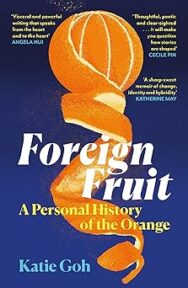
In this unique, subversive and intimate hybrid memoir, Katie Goh explores the orange as a means of understanding the world, and herself within it. She covers violence, colonialism, resilience, art and beauty in a book that will make you rethink about the everyday and history’s grand narratives. In this extract, we look at Asia’s influence on art and style in early modern Europe.
Foreign Fruit: A Personal History of the Orange
By Katie Goh
Published by Canongate
Jingdezhen porcelain makers begin catering for the newly wealthy European market. They make shaving mugs and mustard pots and sell them to VOC merchants. But while the Dutch want functional ceramics, they also want their porcelain to look Chinese. One account sent from Batavia, the VOC’s capital in Indonesia, to Taiwan in 1635 lists Europe’s favoured motifs: ‘Chinese persons on foot and on horseback, water, landscapes, pleasure-houses, their boats, birds and animals, all this is well liked in Europe.’ The market for Chinese-looking porcelain is captured in many of Kalf’s paintings, such as his Still Life with a Chinese Bowl, Nautilus Cup and Other Objects (1662), which features a relief of Chinese figures in traditional dress affixed to a blue-and-white sugar bowl beside peeled citrus.
Europe does eventually master its own porcelain. Augustus II the Strong, elector of Saxony and king of Poland, desires porcelain with such a burning greed that by his death in 1733, he owns a thirty-five-thousand-piece collection, the largest in Europe. The ruler is a rampant spender on the luxurious, the exotic, and the desirable, so much so that he diagnoses himself with ‘porcelain sickness’, that is not unlike a hunger for citrus. In a letter, he writes: ‘Are you not aware that the same is true for oranges as for porcelain, that once one has the sickness of one or the other, one can never get enough of the things and wishes to have more and more.’12 In 1701, Augustus imprisons the German alchemist Johann Friedrich Böttger, who boasted that he had discovered how to spin gold. Unable to make good on his lie, Böttger instead works on a recipe for the porcelain-sick ruler with the scientist Ehrenfried Walther von Tschirnhaus. After four years they finally succeed, and in 1710 they establish a porcelain manufactory in Meissen, which continues to produce porcelain today.
Vienna in Austria, Plymouth in England, and Delft in Holland all begin producing their own porcelain. This is not authentic Jingdezhen porcelain but a cheaper, thinner earthenware that resembles the imported items. European ceramists interpret Chinese visual culture for themselves, reproducing popular motifs such as dragons, plants, birds, and people, but severed from their original cultural significance.
In the eighteenth century, reinterpretation of East Asian designs by Europeans becomes its own decorative style, called chinoiserie, which expands to encompass furniture, wallpaper, paintings, and architecture. Like the painted sinaasappels in a still life, silks, lacquered furniture, and porcelain in European households are fashionable for what they signify – the exotic. Chinoiserie is a European interpretation – an appropriation of Chinese aesthetics made palatable for western tastes. It is a hybrid aesthetic, a crude creation of China through a European gaze. This reinterpretation of other cultures is not one-way. In Beijing, the Emperor Qianlong commissions Jesuit artists to design eighteenth-century baroque-style European pavilions in Yuanming Yuan, the city’s Summer Palace.
Authenticity is prized high in culture. We want ‘authentic’ food, ‘authentic’ travel, and ‘authentic’ experiences. ‘Authentic’ may as well be synonymous with ‘real.’ But authenticity is a nebulous quality. As the Silk Roads taught us, societies have been exchanging food, ideas, religions, and genetics for thousands of years. I wonder when an inauthentic creation becomes a style in its own right. When does Dutch porcelain with its Chinese motifs assimilate into the history of art, not as a cheap version of East Asian ceramics but as its own hybrid visual identity?
Immigration is the hybridising of multiple cultures, as is the mixing of families of different races, nations, and religions. My father using the leftover trimmings of a roast dinner in his Malaysian curries is perfectly inauthentic and perfectly delicious. Immigrants who open restaurants of their national cuisines often transform their cooking to cater to western palates. Chinese, Indian, and Thai takeout restaurants may not be authentic, but in their inauthenticity, something new and hybrid and delightful is created.
Being mixed race is, of course, being a hybrid of two cultures. The language of mixed identity, from the more innocuous – half of this and half of that – to the more insidious – the one-drop rule – is loaded with accusations of inauthenticity. I could fill the rest of this book with the offhand comments that have been levelled at my racial identity, but all of them had the same effect: of segmenting me into halves and quarters until my sense of self was almost entirely cut away. During the pandemic’s surge of anti-Asian violence, these voices from the past returned as a whisper in my mind that questioned if I was even Asian enough to have the right to feel this much sorrow.
Looking back now, I see that my childhood obsession with authenticity – and my frustration when I failed to capture what I thought was authenticity in art – was about trying to feel real. Growing up, I felt out of step in a world that was rigidly organised into categories of difference. I was not Asian or White but Other; not Straight or Gay but Other; not British or Irish but Other; not Protestant or Catholic but Other. This third, hybrid identity had no borders and no models to guide me. Now I know and love so many people who live along the spectrum of Other, between what our society considers fixed identities. But I felt alone as a child, and I thought that if I couldn’t pin myself to one identity, then I did not exist. I felt half finished, half authentic, and half of something else – which really meant that I totalled nothing.
But the world is made of hybrids. Purity is an illusion. We are born of two parents. Even the orange is the offspring of different parents: the mandarin and the pomelo. Art has always taken its inspiration from numerous wells of ideas. A still life is a construction half of imagination, half of reality. A contemporary ceramist shapes their porcelain after both Chinese and Dutch models. History is too various to offer a single narrative. Life is composed of shards of glass, all slotted together to make a mosaic. No one is born complete.
Foreign Fruit: A Personal History of the Orange by Katie Goh is published by Canongate, priced £16.99.
RELATED BOOKS

ALSO ON BOOKS FROM SCOTLAND
-

David Robinson Reviews: The Loch of the Bees
‘The past’s current flows through the characters in his fiction so strongly that it almost becomes t …
-

The Nightkeeper’s Apprentice by Jude Reid
‘She’d never seen anything like it. The whole sky was lit up in ribbons of colour – blue, green, yel …
-

David Robinson Interviews: Gavin Francis
‘He’s not my GP so I can’t say this for sure, but based on this book – wise, informed, well-written, …
-
The Cromarty Library Circle by Shona MacLean
‘No one in the room could have been unaware of what it was that Dr Fraser alluded to. The horrors pe …
-
In Search of Gems by Kenneth Steven
‘It still amazes me that these magnificent shells grow in a river. Never mind whether they have pear …
-

Winterbourne by Elisabeth Wolf
‘The Coopers stared at each other for a second, two seconds. ‘It’s a sign—’ said Cooper.’
FEATURED AUTHOR:
Mason Cross

Mason Cross is the author of the Carter Blake thriller series. The first book, The Killing Season, was published by Orion in 2014, followed by The Samaritan, The Time to Kill (titled Winterlong in the USA), and Don’t Look For Me. Mason Cross’s short cr …
FEATURED PUBLISHER:
Sunono Publishing Ltd

Sunono is an Arabic publisher established in the UK. We publish our books in Arabic and in English. We publish children’s books with the approach to extend our work to introduce adult books and novels. In 2020 and 2021 we won the Sharjah Translation Gr …