


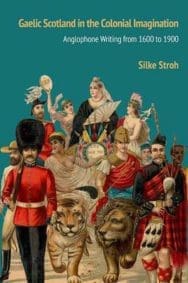
ABOUT THIS BOOK
PUBLISHER: Northwestern University Press
FORMAT: Hardback
ISBN: 9780810134034
RRP: £96.95
PAGES: 304
PUBLICATION DATE:
December 30, 2016
BUY THIS BOOK
As an Amazon Associate and Bookshop.org affiliate we earn from qualifying purchases.
Gaelic Scotland in the Colonial Imagination: Anglophone Writing from 1600 to 1900
Silke Stroh
Can Scotland be considered an English colony? Is its experience and literature comparable to that of overseas postcolonial countries? Or are such comparisons no more than patriotic victimology to mask Scottish complicity in the British Empire and justify nationalism? These questions have been heatedly debated in recent years, in the aftermath of the 2014 referendum on independence and amid a continuing campaign for more autonomy. Gaelic Scotland in the Colonial Imagination offers a general introduction to the emerging field of postcolonial Scottish studies, assessing both its potential and limitations in order to promote further interdisciplinary dialogue. Accessible to readers from various backgrounds, the book combines overviews of theoretical, social, and cultural contexts with detailed case studies of literary and nonliterary texts. The main focus is on internal divisions between the Anglophone Lowlands and traditionally Gaelic Highlands, which also play a crucial role in Scottish-English relations.Silke Stroh shows how the image of Scotland’s Gaelic margins changed under the influence of two simultaneous developments: the emergence of the modern nation-state and the rise of overseas colonialism.
Reviews of Gaelic Scotland in the Colonial Imagination: Anglophone Writing from 1600 to 1900
Stroh engages with the contested question of whether postcolonial theory can be fruitfully applied to Scottish literary expressions and cultural encounters by outlining the fundamental concepts and applying them to the most fundamental fault-line in Scottish history, that between the Lowlands and Highlands. In revisiting familiar texts, such as Martin Martin s surveys of the Western Isles and Walter Scott sWaverley, and introducing onesless familiar today, she demonstrates convincingly and comprehensibly that the hallmarks of colonial discourse Othering, civilizing missions, internalized stigmatization, and so on abound in the ways in which anglophone authors represented their Gaelic subjects. Michael Newton, author of Warriors of the Word and Seanchaidh na Coille / Memory-Keeper of the Forest"
Silke Stroh
Silke Stroh is an assistant professor of English, postcolonial, and media studies at the University of Muenster, Germany.
OTHER BOOKS BY THE SAME AUTHOR

ALSO ON BOOKS FROM SCOTLAND
-

David Robinson Reviews: The Loch of the Bees
‘The past’s current flows through the characters in his fiction so strongly that it almost becomes t …
-

The Nightkeeper’s Apprentice by Jude Reid
‘She’d never seen anything like it. The whole sky was lit up in ribbons of colour – blue, green, yel …
-

David Robinson Interviews: Gavin Francis
‘He’s not my GP so I can’t say this for sure, but based on this book – wise, informed, well-written, …
-
The Cromarty Library Circle by Shona MacLean
‘No one in the room could have been unaware of what it was that Dr Fraser alluded to. The horrors pe …
-

In Search of Gems by Kenneth Steven
‘It still amazes me that these magnificent shells grow in a river. Never mind whether they have pear …
-

Winterbourne by Elisabeth Wolf
‘The Coopers stared at each other for a second, two seconds. ‘It’s a sign—’ said Cooper.’
FEATURED AUTHOR:
Doug Johnstone

Doug Johnstone is a novelist based in Edinburgh. In 2021,The Big Chill, the second in his Skelfs series, was longlisted for the Theakston’s Old Peculier Crime Novel of the Year. In 2020, A Dark Matter, the first in the series, was shortlisted for the M …
FEATURED PUBLISHER:
Frontline Noir

Frontline Noir, founded in 2008, is a publisher of current affairs and recent history titles covering controversial topics and events, often written by people who were participants or otherwise affected. Our aim is to ensure such subjects are given a h …