


Edinburgh’s August festivals may be over, but that doesn’t mean our revels are now ended. Anytime is the right time to spoil yourself! Food writer Ghillie Basan knows exactly how use Scotland’s larder for pure, sensual indulgence, and her latest book, Spirit & Spice, takes the reader on a most delicious culinary journey. Here she shares her thoughts on pairing whisky and food.
Extract taken from Spirit & Spice
By Ghillie Basan
Published by Kitchen Press

Spices can elevate whisky beyond the realms of taste, comfort and tradition to being downright sexy. The descriptive tasting notes on the bottles and in whisky manuals are a testament to their seduction, such as ‘crisp aroma of fresh linen’, ‘enticing flavours of the Orient’ or maybe ‘comforting like soft pillows’ or ‘silky and lingering’. A hint of spice can flirt on the nose and palate with mystique and warmth, a touch of playfulness against the luxurious background of oak casks infused with sweet sherry, bourbon, rum or cognac or the smokiness of the maverick peat. Whisky can offer opportunities to quietly savour and dream: for a moment the aromas and flavours transport your palate and your mind to a different place or time, but it is often the spice notes that carry your thoughts and take you on that journey. Such is the power of the spirit in all its intriguing complexity.
Many a Scot will tell you that all you need is a ‘wee dram’ to keep you warm, to brighten your spirits, to cure your cold, or to keep you going. Some will even swear that their daily dram has taken them fit and healthy into old age. A dram a day will keep the doctor away. In his retirement, my father became one of these Scots. Every evening, he would nurse a dram, or two, and when he felt a twinge of discomfort from an ulcer, or perhaps from his developing cancer, he would soothe the alcohol burn by adding a splash of milk. Even when he was dying, he would enjoy a milky dram in his bed. When he could no longer speak, we had a ‘thumbs up thumbs down’ system for eating and drinking and his thumb would always rise at the offer of a wee dram. The last taste to pass his lips before he slipped away shortly after his 91st birthday was the salty machair of his beloved smoky Caol Ila.
There was always a bottle of whisky in our house when I was growing up, but until my late twenties I had only really ever had it splashed into my porridge, in a hot toddy with honey and milk, or combined with ginger wine in a Whisky Mac – my favourite hip-flask tipple for skiing in the biting blizzards at Glenshee. The memory of my father enjoying his dram, with or without milk, is firmly etched on my mind from the age of four, but I don’t recall my mother or any of her female friends ever touching a drop; they drank wine or sherry instead. Even the designs on the bottles and boxes depicted men as whisky drinkers – the kilted highlanders, landed gentry kitted out in tweeds for fishing and shooting – yet the roots of the spirit are humble and entrenched in a rural, often harsh, landscape where the women would have been as involved in its illicit production as the men; they would have tended to the pot and probably enjoyed drinking it too. There are several distilleries that have been founded or run by women, and the image of whisky drinking being a male domain is a thing of past with an increasing number of female brand ambassadors and a growing trend of female tasters and distillers.
When it comes to pairing food with whisky, it is the delightfully complex layers of flavour and aroma that need to be teased out and enhanced with skill. To the nose and the palate, there are often detectable fruits like pears, apricots, pineapples and oranges; toasted nuts and grains; warming spices like cinnamon, ginger and nutmeg; and sweet notes of vanilla, honey, caramel, treacle and burnt sugar. In the peaty whiskies there is the aroma and taste of smoke, perhaps of tar, tobacco, wood and grass too, even a hint of sea air. And the ‘finish’ or the ‘mouthfeel’ – the taste that lingers in the mouth after you have swallowed – might be long and luxurious, blunt and citrusy, or silky and creamy. In just one sniff and sip, there can be a lot going on, sometimes familiar, other times ambiguous, so in order to pair the whisky with food, you have to strip back the layers in the spirit and build them up again in the food which can be a challenge.
The best way to do this is to work within a flavour spectrum and enhance the key notes by utilising different techniques to complement and contrast and to introduce textures. You might do this by smoking, curing, pickling or conserving ingredients and then introduce the spice notes by working the natural oils in the spices through roasting, grinding and pounding them to a paste. How you combine the spices and pastes is crucial as you want them to provide a warming, perhaps lingering, back note to the punchier, fresher ones that hit the front of the palate and, ideally, you want to create subtle layers of flavour. Whisky is a robust spirit and retains its body, flavour and texture when it is paired with spices in this way. In my opinion, this makes it the perfect companion to dishes from many spice cultures like North and West Africa, the Middle East, India, Southeast Asia and the Caribbean.

First and foremost, though, whisky is simply a drink to be enjoyed. As taste is subjective, different whiskies appeal to different people. Some people only drink single malts; others only enjoy blends. Whisky is about flavour and the role of the distillers and blenders is to create a balance of flavours that make their whiskies unique – what you do with it after that is up to you. The addition of a drop of water to your whisky is optional but many connoisseurs swear that it releases the aromas and opens up the flavours, smoothing the edges of the alcohol and killing the burn. Adding ice is a personal choice and probably very welcome in a hot climate but some traditionalists might perish at the thought. And having hosted the Chivas Masters group of enthusiastic bartenders from around the world, all competing to create the best whisky cocktail, I have learned that there really are no rules when it comes to the enjoyment of the spirit. I prefer to drink a good dram neat, no water or ice, and sip it in the fresh air on the moor or on my deck with a view to the hills. It is even better when there is a little snow or frost on the ground and the air is so crisp you can see your breath – the whisky warms you from inside and lifts your spirits as your mind drifts. If you are a Scot away from home, it can for a moment bring you back to the feeling of your boots springing on the peat bogs in the mist and the rain. To my mind, whisky is a drink of dreams and it makes me smile from my heart.

A guide to pairing food with whisky
Toolkit
- Identify the key aromas and flavours of the whisky – refer to the tasting notes on the bottle.
- There is a natural connection between food and whisky – the evidence is in the aroma and flavour, or in the tasting notes – so draw out the principle ones to focus on.
- Build a flavour and taste framework to create and taste within.
- Focus on and understand the marriage, balance, sensation and enjoyment of food and whisky. Texture and taste are important, but avoid ‘noisy flavour’ clashing.
- Remember that whisky-making is a human process, not a technological one. Art and skill are involved in transforming a cereal into a spirit that is so complex and enjoyable. For some, the creative process is in the blood – perhaps passed down from father to son – so it is often a labour of love. Out of appreciation and respect for this process, art and skill should be applied to the food that you are pairing with it. The aromas and flavours of the whisky are already telling a story so the food should just tease out the humour and drama; it needs to blend with the essence and should enable that story to reach its natural end. You don’t want to kill the story! Just like the creation of the whisky, the creation and cooking of the food should be a labour of love.
Spirit & Spice by Ghillie Basan is published by Kitchen Press, priced £25
If you’re a crime fiction fan, you’ll be as pleased as we are that this month sees the return of Lin Anderson’s brilliant Rhona MacLeod series. Time for the Dead sees Rhona leaving Glasgow for Skye to recover after the trauma of her last case. In this extract, she is walking in the woods with a rescue dog, Blaze, and makes a troubling discovery. . .
Extract taken from Time for the Dead
By Lin Anderson
Published by Macmillan
All was silent apart from the panting of the dog as it ran a little ahead, turning frequently to check on Rhona’s progress. She passed two small clearings set up with wooden barriers for the pursued to hide from their attackers during airsoft games. At the top of the hill the trees parted to reveal a grassy clearing in the middle of which stood a wooden fort, where the defenders made their last stand.
At this, the highest position among the trees, the defenders might survive a concentrated attack from below, in much the same way that Scots had defended hilltops over the centuries. Rhona halted here to climb on the pal-isade and stare down into the skeleton trees, until Blaze barked at her to indicate she hadn’t yet reached her required destination.
With the path petering out, the dog now made off into the trees to the right of the fort, its bushy tail swaying.Trying to follow, Rhona was immediately met by a web of interlocking branches which necessitated ducking and weaving, even as she stumbled over rocks buried under mounds of dying bracken.
If you’re chasing a rabbit or a deer, Blaze . . .
As Rhona paused for breath, she spotted Blaze a little distance ahead, standing to attention, the shaggy coat glis-tening with moisture from the undergrowth. The dog was looking towards her, obviously waiting for her to come and join him. Whatever Blaze wanted her to see, it seemed they had reached it.
Rhona began to force her way upwards through the undergrowth.
They had reached a small break in the tree cover. Rhona registered the sound of a burn running somewhere close by. A bird rose with a hoarse call that startled her, raising her heartbeat.
As she drew alongside the dog, it turned to lick her hand, whining a little.
‘What is it, boy? What’s wrong?’
Everything, the answering whine told her. Everything about this place is wrong.
‘Show me, Blaze. Show me what you’ve found.’
*
A worried Jamie met Rhona at the gate. ‘We thought you’d got lost!’
‘No, although Blaze did take me a fair distance into the woods.’
‘Is something wrong?’ Jamie asked, taking note of her perturbed expression.
Rhona didn’t know what to tell him, because she wasn’t sure herself if anything was wrong.
‘I need to speak to Matt and Donald.’
‘They’re in the office.’
*
‘What’s up?’ Matt looked up from his laptop when Rhona appeared in the doorway.
Rhona got straight to the point. ‘Did someone get hurt recently in the woods?’
‘You mean during an airsoft battle?’ Matt said, with a worried expression. He looked to Donald, who shook his head, as puzzled it seemed by her question as Matt was. ‘We’re dead quiet at the moment. Just one group yester-day. Soldiers on leave. They really went to town, but they all left unhurt. Why?’
‘Blaze took me directly to a spot in the woods he was obviously interested in, just like a police dog would.’
‘He catches game. Might he have killed something up there? He’s dragged me to a couple of places he’s made a kill and buried it for later,’ Donald offered. ‘Oh, come to think of it, he did ask to be let out late last night.’
‘That could be it,’ Rhona said, to ease their concern. ‘But I’d like to come back with my forensic bag. Take a proper look.’ She’d said this almost to herself, then realized that Matt and Donald were looking at her, slack-jawed.
‘Forensic bag?’ Matt repeated, stunned.
Jamie came in then, speaking directly to Rhona. ‘Do you want to talk to Sergeant MacDonald? We could call in at the station on our way back.’
Rhona wasn’t sure she did. ‘I’ll take another look first. Check if it’s human blood.’
‘There was blood?’ Matt repeated, horrified.
Rhona ignored his panicked expression. ‘I’d like to protect the area until tomorrow morning,’ she told him. ‘D’you have a tarpaulin I could use?’
*
Jamie was silent when they eventually exited the site after stretching and securing the tarpaulin, although Rhona knew he really wanted to question her further. The problem was she had nothing to tell him, nothing concrete anyway. Just an informed feeling about the scene.
‘You really think something bad happened there?
Rhona tried to make light of it. ‘I think I’m maybe missing my work.’
Jamie’s face broke into a relieved grin. ‘And that’s good, isn’t it?’ When she nodded, he said, ‘You didn’t half scare the shit out of Matt, though.’
Rhona changed the subject. ‘Did you organize the stag do?’
‘I did.’ Jamie seemed pleased to talk about something else. Then a worrying thought occurred. ‘Will your investigation be over by next weekend?’
‘It will,’ Rhona assured him.
As they drew into the square at Portree, Jamie asked if she wanted to eat with him at the Isles before heading home.
‘I have to get back,’ Rhona said. ‘I’m expecting a Skype call.’
‘Chrissy?’
‘DS McNab.’
Rhona had felt it necessary to give Jamie some explanation for her extended time on the island, although he’d never questioned her himself. And he was no fool, nor was he off-grid. Therefore he had to be aware of the sin-eater case and at least the fact that she’d been involved in it.
Rhona tried to make light of things. ‘McNab asks how I’m doing. I tell him fine, which is true. Although I suspect if I don’t agree to such calls, he may well get on his motor-bike and head back here.’
‘He’s that protective of you?’ Jamie said.
‘He’d be the same with Chrissy,’ Rhona told him. ‘Her wee boy’s called Michael after McNab,’ she said to illus-trate. ‘And not because he’s the father.’
Jamie drew into the square and turned off the ignition.
‘Are you sure you don’t want to run your suspicions about the site past Lee MacDonald?’
‘I’d rather wait and see if there’s anything to tell him first,’ Rhona said.
‘D’you want me to come back with you tomorrow?’ Jamie looked so worried for her when he said that, Rhona almost laughed.
‘I specialize in hidden and buried bodies, remember?’
‘At least we have the burying bit in common.’ He gave her a half-smile. ‘You’ll let me know?’
‘Of course,’ Rhona promised.
*
The sky was a brooding grey mass as she crossed into Sleat. The pleasure she normally took in the long stretch of road was missing tonight, replaced by the recurring image of that small clearing in the woods.
In most cases you knew you were entering a crime scene, but not always. Like the time she’d been called to the Shelter Stone cave on Cairngorm to view the bodies of three dead climbers. Death had many guises on the mountain, the majority being the result of the weather and the terrain. Not in that particular case, though.
Studying a body and the context in which it was found eventually told death’s true story.
There had been no body in the woods, but there had been enough to suggest there had been, if she respected her instincts . . . and those of the dog.
She’d seen enough police dogs in action to know their response to the discovery of human blood. According to Donald, Blaze had been trained like a rescue dog and the collie had all the instincts of one.
Someone had lain injured there. That was all she knew . . . until tomorrow.
Time for the Dead by Lin Anderson is published by Macmillan, priced £14.99
Once you’ve sampled all the drama, comedy, music, food, drink and larks in Edinburgh, we recommend getting back into nature for peace and contemplation. There’s no better way to do that than to head for one of Scotland’s long-distance walking routes, and the St Cuthbert’s Way in the Borders is a great choice. Luckily, Wild Goose Publishing has just released a guide to help you make the most of the trip.
Extract taken from The St Cuthbert’s Way: A Pilgrim’s Companion
By Mary Low
Published by Wild Goose Publications
In the steps of St Cuthbert?
St Cuthbert’s Way is not an ancient pilgrim route, but parts of it were probably walked by pilgrims in the past, and other parts would certainly have been known to Cuthbert and his contemporaries. From the seventh till the ninth century, visitors would have come and gone regularly between Lindisfarne and its daughter-house at Melrose, either on busi- ness or on pilgrimage. Cuthbert would have known the area intimately, from his childhood and from his pastoral journeys. He was a great walker: he had to be. There were very few roads here in the seventh century and it was easier to walk or ride than to bump along in a cart. The countryside was criss-crossed by a network of footpaths and bridle-ways and these are what Cuthbert would have used. We know that he could ride and sometimes he went on horseback, but more often he did the rounds of the villages on foot. Sometimes he would be away for a week, a fortnight, even a month at a time, living with the ‘rough hill folk’. Bede tells us that he made a point of searching out ‘those steep rugged places in the hills which other preachers dreaded to visit because of their poverty and squalor’. If he were alive today, he would probably visit people in towns and cities as well, but he knew from experience that beautiful scenery is no protection against hardship and he made it his business to understand and encourage people, especially if they were isolated or in trouble.
Where exactly did he go? We can only guess, but ‘steep rugged places’ within a day’s walk of Melrose would include the southern slopes of the Lammermuirs and the Leader valley, the Black Hill at Earlston, the Eildons, Teviotdale and the hills around Hawick, and above all the great mass of the Cheviots. From his days as Prior of Lindisfarne, he would also have known the Northumberland coast, parts of Berwickshire and the hills inland towards Wooler. As bishop, he travelled even further afield.
No one knows exactly which route he took between Melrose and Lindisfarne. Sometimes he travelled by boat. The rivers Leader, Tweed and Teviot are all mentioned in his early Lives. On one occasion, after several years living at Old Melrose, we are told that he ‘sailed away’ privately and secretly. This can only mean that he sailed down the Tweed. On another occasion, he sailed from Old Melrose to the territory of the Picts and got caught in a storm along the way. The nearest Pictish communities of any size were in Fife, with some in Lothian, so he probably travelled downstream as far as Tweedmouth, then north, along the coast, past Coldingham and Dunbar. For visiting the hill-folk however, he can only have gone on foot. It’s impossible to imagine him not using Dere Street, the old Roman road. It was the only reasonable road in the area and ran very close to Old Melrose. From Dere Street, he would have branched off onto larger pathways, sometimes along the river valleys and finally onto mountain tracks.
Personally, I don’t think it matters very much where he walked. Cuthbert himself would probably be bemused that anyone should want to follow in his footsteps literally, like the page boy in Good King Wenceslas. If anyone had asked Cuthbert about his ‘way’ he might have said that he did not have one, not one of his own. He did, however, have a way of life, the way of Jesus of Nazareth. And if he is listening from his place in heaven, he is probably delighted to know that people still want to follow that way, the way of faith and compassion. He might ask you about your way, what brings you here, what you hope for. He might delight or unsettle you by talking about God. But you don’t have to be conventionally religious to explore what this journey might be about for you. There’s nothing like putting one foot in front of the other, day after day, in all weathers, for putting you in touch with the things that really matter.
The St Cuthbert’s Way: A Pilgrim’s Companion by Mary Low is published by Wild Goose Publications, priced £10.99
Time now for a contemporary thriller set in Edinburgh, which has at its heart that all too common drama: sibling rivalry. From The Outside is narrated from beyond the grave by the multi-millionaire businessman, Harry, who has died in a car crash. His brother, Ben, who has spent his life in Harry’s shadow is brought in to look after his charity, but he soon finds out the truth behind his brother’s success.
Extract taken from From the Outside
By Clare Johnston
Published by Urbane Publications
My life was, in truth, all about me. Everything I’d ever strived for had been one big shout for attention: ‘Look at me, look at what I’ve achieved.’ That’s how my business had started – with a small venture I tried my hand at as a student in an effort to impress my father.
Edinburgh University had been chock full of little rich boys and girls who were living in flats bought for them by mummy and daddy. They had been filled with old bits and pieces from home,
including vases, paintings, rugs and furniture that their mothers had long gone off. Some of these unloved items were actually pretty valuable. And that’s where I stepped in. I helped these cashstrapped students earn a bit of extra dosh by relieving them of the older furnishings, having agreed to a 50:50 split on whatever I got for them. Those bits and pieces that I reckoned were actually worth a bob or two I’d take to antiques dealers, and the rest I’d flog at my weekly boot sale in the university car park. These sales became legendary, with bargain-hungry customers scrapping over the old tat and the occasional genuine article. It was a perfect marketplace. And it was also the birth of the YourLot empire. Shortly after I left uni, Dad backed me in opening up my own antiques dealership. Then, when internet enterprises really started taking off, I realised I could sell an awful lot more stuff online. To begin with we simply traded antiques, but quickly opened it up to more modern pieces and then – six years ago – took the leap of allowing members to sell their own items via our site. The rest, as they say, is history. I was the eternal optimist, but not even I envisaged the level of financial success I would reap through the website. YourLot.com became a global phenomenon and I, in turn, a very rich man.
Dad was so proud. My achievements were a favourite topic of conversation for him, with my long-suffering mother taking the brunt of it in the early years. She always listened patiently and
smiled encouragingly in my direction, but I could have been a billionaire ten times over and it wouldn’t have made any difference. Material wealth never impressed her. She was only ever interested in our inner wealth; namely the talents she thought my brother had in abundance but never used.
Mum didn’t live to see the height of my success, but she saw the depths of my personal failings. As did Ben. Whenever I was in his presence my achievements became as weightless as air and my
determination to prove myself as solid as stone.
•
Ben took a deep breath as he prepared to enter his first Monday morning team meeting. Pushing the door to the office open, he found three faces staring at him expectantly from their seats behind the meeting table. This time he’d be more assertive he told himself. So he forced himself to look straight into the eyes of his new employees as he entered the room, but in doing so failed to spot the umbrella at his feet which sent him stumbling around the doorway like a circus clown. Once he’d regained his balance he returned his gaze to the three faces in front of him realising pretty quickly that it was too late to salvage his dignity. They were already desperately trying, and failing, to stifle their laughter.
‘I guess that’s what you call an entrance,’ said Ben, managing a smile. At this they all fell about laughing, but at least they were laughing with him, he hoped.
Ben sat down and reminded himself that he had to remain in control. He pressed on with the statement he had planned, clasping his hands tightly as he spoke so they wouldn’t see them shaking.
‘I want to meet as many of the kids as I can this week.’
‘No problem,’ said Dave.
‘I need to spend this week getting to know the place and everything that goes on here. Then, next Monday we’ll talk about how we move forward. If you have any ideas then that will be your
opportunity to raise them, and I’ll bring a few of my own too. Everyone okay with that?’
‘Absolutely,’ said Sonja, at last looking at him with something he thought could just pass for respect. He noticed for the first time that behind the tough facade, she actually had a nice, round,
kindly face – a face that was comforting to look at. Ben smiled at his colleagues and hoped this fleeting feeling of belonging might last.
He was about to tell them the meeting was over when Sonja cleared her throat. ‘Ben, we…eh, we’re not quite sure what to do with Harry’s stuff.’
‘What stuff?’
‘Eh… that filing cabinet behind you is full of his paperwork and files. We didn’t want to go through it without talking to you first.’
‘I see,’ said Ben, turning to look at the cabinet in question behind him. ‘Why don’t you give me the key and I’ll go through it this afternoon.’
Sonja’s relief was palpable. Clearly, she wasn’t relishing the idea of working her way through my secrets. Personally, I thought that showed a rather disappointing lack of adventurism, but then I
always was a nosey sod. Ben was certainly afraid of what he’d find in a locked cabinet belonging to his heedless twin. And there was a secret within that cabinet, one I longed to be uncovered but would only be done by the most astute of minds. Just as well then, that it was my brother unlocking it.
From the Outside by Clare Johnston is published by Urbane Publications, priced £8.99
Back in Edinburgh, Scotland’s performance poets are knocking it out the park with their Fringe shows, and BooksfromScotland would recommend catching those shows from the likes of Jenny Lindsay, Harry Josephine Giles, Kevin P Gilday, Cat Hepburn, Jen McGregor and many, many more. Another poet who should get a great audience is Ross McLeary, who has just released a new pamphlet with the marvellous Stewed Rhubarb Press. We hope you enjoy this selection of poems from his collection.
Extracts taken from Endorse Me, You Cowards!
By Ross McLeary
Published by Stewed Rhubarb Press
A Business-of-one
You are a business-of-one.
This means when you wake up you are
already on the clock.
This means when you sleep you dream
of reports and contracts and deals.
This means when you eat lunch you
are eating into your own profits.
Be careful where you stand. The floor
is made of money.
You are a business-of-one.
This means meetings are
straightforward: you know what
direction to go in.
This means coming up with ideas for
the Christmas party is easy.
This means synergy is a strange
combination of narcissism and
masturbation.
Be careful what you say. The walls
have ears, you know.
You are a business-of-one.
This means that profits do not have to
be shared.
This means the glory belongs to you.
This means that your confidence isn’t
misplaced.
Be careful what you wish for. The
market doesn’t care.
You are a business-of-one
but then
everyone is a business-of-one now
and everyone is exhausted.
You are a business-of-one
but then
all your friends are a business-of-one
and you haven’t seen them in weeks.
You are a business-of-one
and when the business fails, as all
businesses fail,
they’ll point to your failings and say
that you had no one to blame but yourself.
10 Things Recruiters Look for in Your LinkedIn Profile
1. Make sure there is one lie on your profile. Recruiters know you are flawed—no one is perfect, after all—and making things up is an important part of showing a human touch.
2. Make sure there is at least one visible owl in your photo.
3. If you have employment gaps, use them to describe your most frequent daydreams.
4. Embed within your profile a deep, monotone hum. Something from an expensive synthesiser or your dad singing the lowest note he can manage.
5. Rock-hard abs.
6. Evidence of a desire to be killed in combat.
7. Put your email address in a visible place—how else are you supposed to get feedback on your poetry?
8. Wear a watch in your photo. Be warned, though, you must make sure the time is correct at all times or Recruiters will think you’re wearing a broken watch.
9. Good content. Recruiters want to know you can churn out the good stuff hour after hour, day after day. Neverending content from dawn til dusk and back again.
10. A birthmark like the one on your left clavicle. The one that looks like Greenland. You can see the tip of it in your profile picture, but only if you know what to look for. The Recruiters on LinkedIn aren’t just looking for anyone. They’re looking for you, aren’t they? They are hunting you and they will find you and when they do, they will offer you a job, and that job will involve long hours and be underpaid and your boss will treat you like shit and the job market’s tough and rent is due and bills need paid and you’re exhausted, my god are you exhausted, and you cannot run forever and you’d like it to stop, even for just one minute, but maybe this time it won’t be so bad?
Making Recruiters Come to You
Have you tried drawing Recruiters with magnets?
You are the North Pole and they are the South.
Opposites charge towards each other
like a bull to a flag, a cake to a mouth.
Have you tried hosting a Recruiters Bake Sale?
Luring them with warm bread delights,
showcasing your skills in the morning
after hours of working all through the night?
Have you tried sending your CV in bulk?
Not just once or twice but more than ten times.
They will appreciate your commitment and effort;
they will find your enthusiasm well within line.
Have you tried sending your CV again?
It’s been a week and you’ve heard not one word.
They must want you, surely? Your skills are unique.
To give up just now would be quite absurd.
Have you tried sending your CV again?
Rearranging the words, adapting your skills,
making up jobs, rewriting your past,
saying what they want, and going for the kill?
Have you tried sending your CV again?
Have you tried sending your CV again?
Have you tried sending your CV again?
Have you tried sending your—
You’re trying too hard and it shows.
5 Things Your Spreadsheet Cannot Do
1. It cannot bring her back. You input the number of days since she left. The hours. The weeks. The minutes. The years. You input the time you spent together. You write it out to a hundred decimal places. The increments and the precision do not matter. It changes nothing.
2. It cannot bring her back. You write IF statements, craft logical formulas, define permutations and possibilities and choices. Ways it could have turned out differently. But so what? The past is an immutable black hole.
3. It cannot bring her back. You write down everything you said. Every flirtatious word. Every compliment. Every insight. Every ambiguous statement. Every misunderstanding. Every fight. All the things you disagreed on. From this, you make charts and graphs and trend lines, try to figure out where it all went wrong. But it tells you nothing. It just hurts.
4. It cannot bring her back. And you are not sure why you thought it would. No matter how much information you put in, there is always something missing. Something which renders the project incomplete. The volume of information is impressive but every missing detail reflects how frail, faulty and inadequate your memories are. And even if you hadn’t forgotten a thing, it would still be incomplete. The past cannot be reduced to an equation or a number. It is a wave of light stretching outwards in every direction at once. The further into the future you go, the thinner and more ungraspable the past becomes. You cannot change that. You can only accept it. You have to accept it, and then you have to move on.
5. It cannot bring her back. You delete the arguments, fights, and misspoken words. You filter out bad memories and the day when it ended. You do all this but it does not alter that it happened, that it was not perfect.
Endorse Me, You Cowards! by Ross McLeary is published by Stewed Rhubarb Press, priced £5.99
Catch Ross McLeary’s Fringe performances at the Scottish Poetry Library on August 14 – 17 and 20 – 23
https://tickets.edfringe.com/whats-on/employ-me-you-cowards
We at BooksfromScotland always look forward to the Scottish National Gallery’s big summer exhibition, and this year’s showcase dedicated to the work of Bridget Riley is an amazing visual feast. We highly recommend a visit! If you can’t make it, here’s a little bit of what to expect from the exhibition’s accompanying book.
Extract taken from Bridget Riley
By Michael Bracewell, Éric de Chassey, John Elderfield, Dave Hickey, Robert Kudielka, Bridget Riley, Richard Shiff, Frances Spalding, David Sylvester, David Thompson
Published by The National Galleries of Scotland Publishing

Bridget Riley is an artist who has forged, over the course of some seventy years, a remarkable and innovative career. She makes paintings that are not only rigorous but also beautiful, bringing attention to the act of looking at art and at the world around us. This publication accompanies major exhibitions of the artist’s works, held in Edinburgh and London during 2019, which mark the first survey of Riley’s work to be staged in Scotland and the first of its scale in the UK since 2003. The exhibition looks back over Riley’s long career and traces the dynamic and evolving nature of the artist’s practice, from her early student drawings to very recent paintings.
In keeping with the retrospective nature of the exhibition, this book brings together a selection of critical writings starting with David Sylvester’s review of her first exhibition in 1962 and ending with Eric de Chassey’s recent and perceptive text, for which we thank him warmly. These reviews, essays, statements and conversations have been selected by the artist and include her own writings. Spanning almost six decades, they trace the development of Riley’s ideas and the critical reception of her work during that period, providing an historical survey into the wide-ranging practice, which includes writing, lecturing and curating, of one of the most influential artists of our time.
We are delighted to be working together to present these exhibitions of Riley’s work, building on both past partnerships between the National Galleries of Scotland and Hayward Gallery, and on the close connections the artist has with each of our institutions.
In 2016, the National Galleries of Scotland staged a small exhibition devoted to Riley’s work, which juxtaposed the painting Over, 1966, by Riley, from our collection, with eight paintings from across the artist’s career. Over was acquired in 1974 following an earlier solo exhibition of Riley’s work at the Scottish National Gallery of Modern Art. The 2016 presentation provided an opportunity to begin a new conversation with the artist – a conversation that resulted in this landmark exhibition and accompanying publication. We have particularly valued the artist’s insights into works by other artists in the collection, which have long been known to Riley. Amongst them, Georges Seurat’s La Luzerne, Saint-Denis, 1884–85, provided the inspiration for her post-impressionist painting Lincolnshire Landscape, 1959, while Piet Mondrian’s Composition with Double Line, 1932, featured in Riley’s selection for Tate’s 1997 exhibition Mondrian: Nature to Abstraction, and in her essay for the accompanying catalogue.
Riley’s work is part of a long tradition in painting; to see that art through her own thinking is hugely rewarding and we are indebted to her for this rich and illuminating dialogue that continues in her work today. Following Riley’s winning of the International Prize for Painting, in its old form, at the 34th Venice Biennale, Hayward Gallery presented the artist’s first major UK survey exhibition in 1971, the Hayward’s very first show devoted to a contemporary painter. Since then Bridget Riley has been a leading light in the gallery’s history. In addition to co-curating a Paul Klee exhibition in 2002, Riley herself was the subject of another Hayward solo show in 1992. Her works have also been included in a total of five group exhibitions over the years. On all these occasions, she has applied her acute understanding and appreciation of the Hayward’s particular architectural style in relation to the work displayed. Almost half a century after her first Hayward exhibition, it is a great privilege to be adding to Riley’s long association with the gallery by presenting this rich and inspiring retrospective featuring so many works which feel as new as the day they were made.
Bridget Riley by Michael Bracewell, Éric de Chassey, John Elderfield, Dave Hickey, Robert Kudielka, Bridget Riley, Richard Shiff, Frances Spalding, David Sylvester and David Thompson is published by The National Galleries of Scotland Publishing, priced £34.99 in paperback and £44.99 in hardback
There are a few authors making 19th century’s Edinburgh and its pioneering medical study their fictional world (all rise E S Thompson and Kaite Welsh!), and it is a time and a place ripe for fictional adventuring. Ambrose Parry (the husband and wife team of Christopher Brookmyre and Marisa Haetzman) joined in with their bloody escapades in The Way of All Flesh last year, and we’re delighted to publish an extract from their brand new novel, The Art of Dying.
Extract taken from The Art of Dying
By Ambrose Parry
Published by Canongate Books
There was a bite in the breeze as Raven climbed from the carriage and hefted his bags down to the pavement. Late autumn in Edinburgh. He permitted himself a wry smile at its chilly embrace, like a welcome home from a relative with a grudge. Its teeth were not so sharp as they once felt, however. He used to think that the wind off the Forth was a cruel presence. That was before he had felt the gusts that whipped along the Danube.
The familiarity of the city’s sights and smells was heartening. He had only come to appreciate how much he missed Edinburgh once he had committed to return, and if he had doubts as to the wisdom of his decision, they were blown away like steam as his eyes lit upon the door to 52 Queen Street.
How vividly he recalled the first time he came here. He had been unconscionably late, dishevelled in his worn and grubby clothes, and sporting a recently sutured wound upon his face. He raised his hand to his left cheek in a semi-reflexive action, his index finger tracing the length of the scar. He thought of the individual responsible for it but quickly put that ugly visage from his mind. It was said the best revenge is living well, and he was certain their respective fortunes would have been satisfyingly divergent in the time that had passed. Raven had left that world behind, while his assailant was no doubt utterly mired there, if he still lived at all.
His facial disfigurement aside, he felt his appearance to be considerably improved since he first presented himself here. His wardrobe, like his travels, had been financed largely by the involuntary contribution of another gentleman, late of this parish, who had no need of luxuries where he had ended up. His clothes were new, tailored to fit, and his boots were polished to a high shine. He wondered if he would be recognised, so complete was his transformation.
When Raven had first seen it, 52 Queen Street had represented a route to wealth and renown, his aspirations filled with aristocratic patients and their hefty fees. Professor Simpson had shown him what it truly meant to be a doctor. This house and those who lived there had been the making of him, had saved him from himself. Now that he had returned, he wanted to show them all how he had flourished.
He paused on the front step, trying to anticipate the changes he would find inside, conscious that things were unlikely to be as he had left them. He remembered with a mixture of fondness and exasperation the gallimaufry of messy humanity which was often to be found behind this door. The personality of its owner was stamped upon the place from the attic to the basement. It was warm, cheerful, bustling, challenging and inspiring; but it could also be chaotic, confounding, fraught, thrawn and downright overwhelming. There were animals running loose, children running looser, patients spilling out of doorways, staff scrambling to accommodate the guests invited upon a whim of the professor, and somehow amidst it all had been made a discovery that changed the world.
As he rang the bell, he thought about who might answer, the faces he was about to see. He thought about Jarvis, Simpson’s redoubtable butler, whose very politeness towards Raven was itself a means of conveying how much he would like to turn him out onto the street for a wretch. He thought about Mrs Simpson, perpetually in mourning for the young children she had lost and vigilantly dedicated to the care of those who survived. He thought of her unmarried sister, Mina, left heartbroken after she mistakenly believed her search for a husband had finally come to a happy end. Foremost in his thoughts, however, was Simpson’s housemaid, Sarah Fisher.
Hers was the image he had most tried to conjure throughout his travels: her pale complexion, her honey-coloured hair, the soft touch of her hand as she administered ointment of her own making to salve his wound. He remembered the smell of her – lavender and fresh linen – the way she carried herself, her smile. He remembered also her withering disdain, her sharp intelligence and her tendency to let her frustrations talk her into trouble. Most of all he remembered the kisses they had shared, the swell of feelings he had not known around a woman before – or since.
He shook his head in an attempt to clear his mind. Such reminiscences had been in equal parts a comfort and a torment over the past year. They had been thrown together by circumstance, but propriety dictated that to pursue any kind of relationship would have been damaging to both of them. There had been no contact between them since he left. Deliberately so. He had written letters to her during his time in Paris, and again in Vienna, but they had never been sent. He was a doctor, a physician. She was a housemaid. Anything other than a professional relationship was surely out of the question. What possible future could there have been for them? None that he could see. He had tried to explain as much to her before he left, but she had been reluctant to accept the intractable realities before them; strong-willed and argumentative to the last.
He had been sure that a period of separation would cool his ardour for her, and there had been interludes during his travels when she seemed far distant in time as well as space; a treasured step on his journey, but one he had been ever progressing away from. However, as he stood on the doorstep, he was conscious of an increase in his heart rate, an excitement of the body in defiance of anything his mind might wish to deny.
It was more than an excitement: it was a longing. And the closer he drew to seeing her again, the more imperative that longing became.
He was therefore quite unprepared when it was not Sarah but another young woman who answered the door.
‘Can I help you, sir?’ she asked, peering up at him from beneath her cap.
‘Yes. I am Dr Will Raven, the professor’s new assistant.’
Raven’s pride in being able to announce himself this way helped conceal how crestfallen he was suddenly feeling. The girl stood aside to allow him to enter. He handed her his hat and gloves.
‘Very good, sir. I was told to expect you.’
‘You are new here, are you not?’ he asked, peering past her down the hall in a search for more familiar faces.
‘Been here almost a month now, sir.’
‘Is the professor at home?’
‘No, sir.’
‘Mrs Simpson?’
‘Mrs Simpson and the children are out visiting.’
‘And Miss Grindlay?’
‘She is at her father’s house in Liverpool.’
Raven thought again about Mina and her marital disappointment. He had hoped she would by now have found a suitable partner, but some things, as he well knew, were not meant to be. He looked up the length of the hallway again. Everything was preternaturally calm, causing him to feel uneasy. He decided he could stand it no longer.
‘Where is Miss Fisher?’ he asked.
‘Miss Fisher, sir?’
‘Yes, she is a housemaid here. Or was,’ he added. Sarah had received a promotion of sorts before he left, and he was unsure how he ought to refer to her now.
‘There is another housemaid here besides me, sir, but none called Fisher.’
She stared blankly and Raven suppressed a sigh. The girl had evidently replaced Sarah but was by no means a substitute for her.
He smiled benignly at her.
‘Perhaps you know her simply as Sarah.’
A realisation passed across her face like a shadow.
‘Oh. You must mean Miss Fisher as was, sir.’
As was? Raven was gripped by panic, his disappointed heart thumping again and his guts churning. What had happened to Sarah? Was she dead? He would surely have been told if something catastrophic had befallen her. Then he remembered all of his unsent letters. Perhaps no one would have thought to inform him. After all, they had endeavoured to keep their connection concealed.
His palms were suddenly moist. In that instant it all came flooding back and he understood that far from fading, his feelings for her had merely been suppressed by time and distance. Then he noticed that the girl was smiling.
‘She is no longer Miss Fisher, sir. She is now Mrs Banks.’
The Art of Dying by Ambrose Parry is published by Canongate Books, priced £14.99
The parallels between the art of Andy Warhol and Edinburgh-born Eduardo Paolozzi was celebrated by the Scottish Gallery of Modern Art in late 2018, and the accompanying book is full of great insight and images on and from both these iconic artists, and particularly on their early works. Here’s an extract from Keith Hartley, Chief Curator and Deputy Director at the Scottish National Gallery of Modern Art.
Extract taken from I Want to be a Machine: Warhol and Paolozzi
By Keith Hartley
Published by the National Galleries of Scotland Publishing
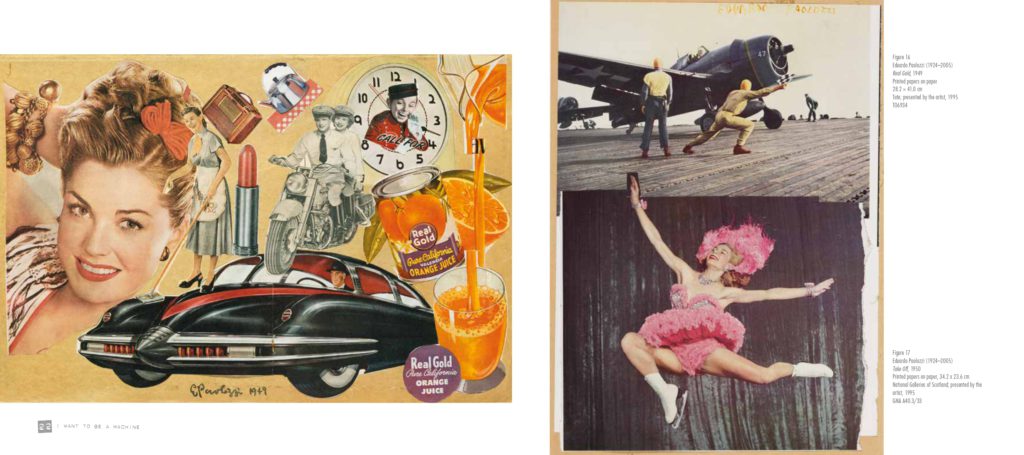
In the summer of 1968 the Art Advisory Service of the Museum of Modern Art in New York organised an exhibition of five artists in the lobby of the famous Four Seasons restaurant at 99 East 52nd Street. Included in the five were Andy Warhol and Eduardo Paolozzi. Warhol was represented in the show by six of his silkscreen prints of Marilyn Monroe produced in the previous year. As the press release says: ‘This particular image is one he has used many times before, but never more successfully than in these newest works … Viewed together, the varied range of expression is remarkably striking. Dramatic shifts in color as well as character are achieved in each separate screen.’ Paolozzi was represented by a highly polished aluminium sculpture Marok-Marok-Miosa, 1965, ‘mirroring its surroundings’, and two ‘brilliantly colored silkscreen prints done this year and closely related to his sculpture’.1
Marok-Marok-Miosa consists of a series of aluminium parts, welded together to form a winding group of figures, with snake-like pipes emerging from them – probably inspired by the famous ancient Graeco-Roman sculpture Laocoön (now in the Vatican Museums in Rome), which fascinated Paolozzi at this particular time. The synthesis of classical sculpture with machine-made, serial metal structures goes back in Paolozzi’s work to his earliest paper collages in 1946, when he was only twenty-two years old. The two brightly coloured prints which mirrored the shapes of the sculpture were from Universal Electronic Vacuum, a portfolio of ten screenprints that evidences the beginnings of Paolozzi’s interest in the relatively new imagery emerging from computer printouts – the latest metamorphosis of the machine. Working with the master printer Chris Prater in Kelpra Studio, London, Paolozzi was one of the first artists to exploit the full potential of screenprinting: beginning with a photographic image that was transferred onto the screen, but then proceeding to use a whole series of successive screens to print a range of colours. In 1963 he had taken advantage of the relative ease of changing the colours by printing each of the forty-sheet run of the key screenprint Metalization of a Dream with a different colourway. What Paolozzi was doing in screenprinting was a parallel exploitation of the mechanical processes inherent in the medium to the way that he used prefabricated metal parts to make sculptures.
At the same time, on the other side of the Atlantic, Warhol was carrying out similar experiments with mechanical processes, so as to exploit the full potential of photography and colour. The set of Marilyn Monroe screenprints (six instead of the full ten) shown in the exhibition at the Four Seasons were also printed in different colour combinations. Although the photographic image remained the same, the changing colours made her features look different and certainly seemed to alter her expression. While Warhol made this kaleidoscopic series in 1967, a full four years after Paolozzi rang the colour changes in Metalization of a Dream, there is a fundamental difference in the two print productions. Paolozzi never intended to show all the differently coloured prints together. In a way, it enabled him to turn an inherently serial production of near-identical prints into unique works of art. The mechanical process of photo-screenprinting allowed him to do this with relative ease. Warhol, on the other hand, made the set of Marilyn prints with the express purpose of them being shown together. Each individual print was differently coloured, but each set was identical. In a way it was like the Campbell’s Soup Can series. The basic shape and structure were the same – like Marilyn’s head – but each print showed a different can of soup. The point was that each can of black bean, each can of tomato, tasted the same. There was uniformity within variety. And Warhol liked that. He felt that it was very democratic and very American. Warhol’s ‘discovery’ of screenprinting in the summer of 1962 (probably around the same time as Robert Rauschenberg (1925–2008)) allowed him to use photographs as the direct basis for his paintings, without the need to trace and enlarge or project and copy the images. The process was as near to the mechanisation of art as it was possible to get at that time and Warhol was very aware of this. In a key interview given to Gene R. Swenson in 1963, he talks about the anonymous, mechanical nature of screenprinting paintings:
‘That’s … one reason I’m using silk screens now. I think somebody should be able to do all my paintings for me. … I think it would be so great if more people took up silk screens so that no one would know whether my picture was mine or somebody else’s … The reason I’m painting this way is that I want to be a machine, and I feel that whatever I do and do machine-like is what I want to do.’2
1 Eduardo Paolozzi, Universal Electronic Vaccum, 1967
2 Andy Warhol in Gene R. Swenson, ‘”What is Pop Art?” Interviews with Eight Painters (Part 1)’, ARTnews, November 1963
I Want to be a Machine: Warhol and Paolozzi by Keith Hartley is published by the National Galleries of Scotland Publishing, priced £7.95
The streets of Edinburgh hold a million stories. Sometimes you see them being told by caped storytellers to interested tourists in the centre of town. But, as David Robinson found out, there is more than one way to tell our capital city’s tales. . .
Constitution Street: Finding Hope in the Age of Anxiety
By Jemma Neville
Published by 404 Ink
If anyone has a year or three to spare to write it, here’s a great idea for a book, and I’ll give it to you for free. It’s very specific, because it’s about just one street in Edinburgh, the people who have lived there in the past and those who live there now. And before you can say, ‘Why should I care about that if I don’t live there?’ – let me tell you.
I’m talking about the Cowgate. Why? Because it’s got everything and been everything. Back in the fifteenth and sixteenth centuries, this was where you wanted to live if you were, say, an ambassador to the Scottish court or a high-ranking courtier in it. Yet in the nineteenth, it was an overcrowded and mainly Irish slum, the place revolutionary socialist James Connolly called home. ‘To look over the South Bridge and see the Cowgate below full of crying hawkers,’ wrote Robert Louis Stevenson, ‘is to view one rank of society from another in the twinkling of an eye.’
Exactly. But rather than do the usual riff on that quote – you know, divided city, Jekyll and Hyde, Caledonian antisyzygy, yadiyahiyah, let’s imagine someone else leaning over South Bridge and looking down. Someone who, as far as I know, never even visited Edinburgh in the first place.
Let’s imagine that the great American oral historian Studs Terkel (1912-2008) not only came back from the dead but to Scotland’s capital too and that he also took in that very same view from South Bridge. Right now, in the middle of the Festival, the ‘blackened urban ravine’ of Cowgate is plastered with flyers and crowded with Fringe-goers ‘haphazardly crossing over or standing in little knots in the middle of the road as if no-one had told them that roads were for cars and pavements were for pedestrians.’ (The quotes are from Kate Atkinson’s One Good Turn, which gets one thing about the Cowgate absolutely right: even in daytime, there’s no street in Edinburgh where it’s easier to run someone over.)
But let’s imagine too – indulge me – that a reborn Studs Terkel isn’t just looking for stories from the Cowgate in August, but the rest of the year too. That he is ranging, tape recorder in hand, round, say, the Cowgate’s hostel for the homeless, or the grim black box of the city morgue nearby (where most of the bodies in Ian Rankin’s novels end up), or just interviewing random strangers he encounters on a street which has a shop selling dinosaur fossils at one end and a parliament at the other. What story-hunter wouldn’t swoop down onto the Cowgate utterly confident that they were bound to return with the most amazing tales? The kind of stories that we don’t hear any more, and haven’t heard ever since journalism started haring off after celebrity instead of being properly curious about real life? A no-brainer, surely?
When he wrote his career-defining book Division Street in 1967, Terkel was looking at Chicago as a microcosm of the US itself, and for street interviewees who, in their diversity, were a microcosm of the city. ‘I was on the prowl for a cross–section of urban thought, using no one method or technique,’ he wrote. ‘I guess I was seeking some balance in the wildlife of the city as Rachel Carson sought it in nature.’ He hadn’t, in other words, any predetermined thesis to prove: his only aim, as he set out to do the 70 interviews in his book, was to take the collective pulse of his city and, by implication, his country.
Set it on the Cowgate, and that’s a book I’d love to read too, and if you’d like to write it so much the better. As for what to call it, I was thinking about Scotland’s Street but Alexander McCall Smith has sort of got there first. A Street through Scotland? Division Street Revisited? You write it, you decide. Just let me know how you get on.
Whatever you call it, such a book would be fairly unusual. I can’t think of anything ever written in Scotland remotely like it. Or I couldn’t until I picked up a copy of Jemma Neville’s debut book Constitution Street, out next month from 404 Ink, and I was delighted to see that she had been thinking along similar lines too. Similar, but different, because while my putative book (the one I was too lazy to write) would have followed Terkel in “using no method or technique” – in other words, just letting the interviewees’ stories speak for themselves – Neville has a far clearer purpose in mind.
What she wants to do is twofold. First, there’s an overlap with what I would have wanted the Cowgate book to be: a reminder of the sheer diversity, singularity and unpredictability of people’s lives. Neville comes up with a particularly good example. A few yards from the end of Constitution Street is the domed Bank of Leith, which dates back to 1793. Once upon a time, Sir Walter Scott was a customer. These days, it is an outpost of the Buddhist Samye Ling Centre. And Ani Rinchen Khaniar, the shaven-headed Buddhist nun, who brought the former bank and turned it into a centre for meditation and yoga is … and this is what I mean by unpredictability … a former Mancunian model called Jackie Glass who was the first love of George Best’s life. According to the Daily Mirror, they went out for two years before she dumped him.
Neville is more high-minded and right-on than me, so she doesn’t call that chapter (as I would have done) ‘The Nun Who Gave George Best The Boot’. Instead, it is called ‘The Right to Freedom of Religious Belief’, which is a key to the second – and arguably more important – purpose of her book. Because Neville’s extended stroll down Constitution Street isn’t just an exercise in journalistically reflecting what she finds. It also asks the reader to think about how its residents’ lives could be improved too. In these uncertain, choppy, Brexity waters, she argues, Scotland needs its own written constitution. Constitution Street – where she has lived since her student days – would be as good a place as any to start looking how a new Bill of Rights could work.
Neville’s background in human rights law (she worked for the Scottish Human Rights Commission before taking up her current job as director of Voluntary Arts Scotland) makes her a good guide to the topic. Her love of Leith, both past and present, and the warm-hearted intelligence she shows in her writing about her neighbours, give the book all the necessary grounding it needs to interest all those readers who aren’t idealistic constitutional lawyers. As books about streets through Scotland go, Constitution Street is informative, empathetic, and almost certainly the best on the market. It will probably remain so for a long time – at least until someone heads down the Cowgate with a tape recorder, notebook, pen – and a publisher’s contract …
Constitution Street by Jemma Neville is published by 404 Ink, priced £12.99
Although Edinburgh is busy and buzzing throughout August, you may want to escape to the calm of Scotland’s islands, just like Sue Lawrence who shares her culinary highlights from her island travels. And when the food is as good as she says . . .
Extract taken from A Taste of Scotland’s Islands
By Sue Lawrence
Published by Birlinn
Honey
(Colonsay)
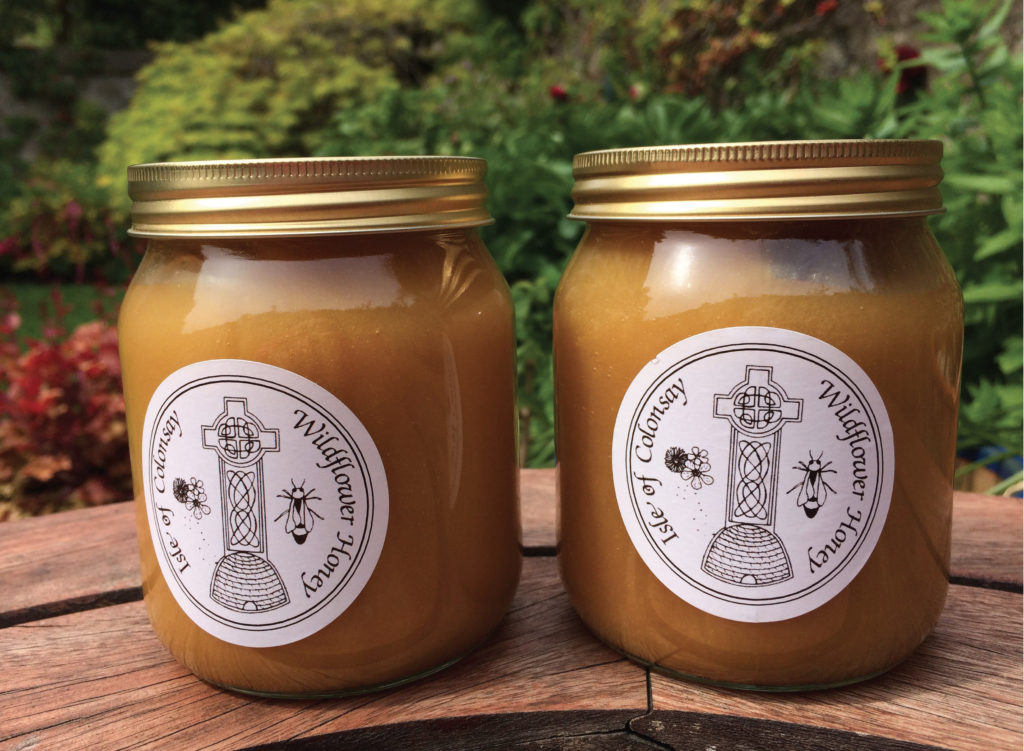
When you attend a book festival as an author, you are invariably given a goody bag, something to look forward to with anticipation. Sometimes you find a book, a pen, a scarf or even some whisky. But without doubt, one of the most welcome gifts I have received as an author was at the Colonsay Book Festival in 2017. There in my bedroom at the Colonsay Hotel was a jar of the island’s honey. What a nice touch, I agreed with my fellow authors, and thought nothing more of it until the following morning when the same honey appeared on the breakfast table. The taste was and is exquisite, unlike any other honeys I have tasted. Nuanced and floral, the texture is rich, creamy and unctuous. I was hooked over breakfast and could not wait to find out more about this honey’s provenance.
Andrew Abrahams has been producing Isle of Colonsay Wildflower Honey for some four decades, a labour of love that he fits in between his many other jobs, including that of oyster farmer. Andrew lives at the Strand, right at the south end of Colonsay opposite the small tidal island of Oronsay and has beehives – some 50 to 60 – all over both islands. His bees are a strain of the native black bee, whose hardiness means they are able to harvest on cool, sunless days and even in a strong wind.
When I asked Andrew about the distinctive, complex flavour of his honey, he summed it up perfectly by telling me it is ‘the essence of all the flowers on Colonsay’. There is a lot of heather in it – and unusually there is both ling and bell heather. Most heathers in Scotland grow on moorland; on the island, however, they also grow on rocks and this gives a different flavour to the honey. There are also wild thyme, clover, sea pinks, hawthorn and many more flowers growing on the sandy machair and on the moors of Colonsay.
The honey is harvested once a year, usually in September, and then comes the process of extracting the honey from the wooden frames of honeycomb. Honey is extracted by centrifrugal force, usually radially. However, given the high proportion of heather, those honeys with the specific consistency that Andrew’s have are extracted tangentially instead. They are then potted into jars and labelled with a picture of the Celtic cross representing Oronsay’s fourteenth-century priory.

When asked how he likes to eat it and if he has any particularly recipe using honey he would like to share, Andrew insists you mustn’t mess about with it. Apart from serving it with ice-cream where it is simple enough to retain the pure honey flavour, he says why eat it with anything other than on a simple piece of bread or toast. In times past on the Scottish islands, honey was eaten with bannocks made of beremeal or oats (and sometimes rye) and it was used as a sweetener in that harvest-time pudding, Cranachan, made from hedgerow brambles, crowdie and toasted oats. There are also some old recipes that predate the arrival of sugar to Scotland, in rich game dishes such as hare with honey and claret.
Personally, I like to use it in simple recipes, but best of all, with honey as delicious as Andrew’s Colonsay honey, I also like to eat it neat, from a spoon, straight out of the jar. Nectar.
Colonsay Honey Ice-cream
serves 6–8
I had finished the jar of honey I brought back from the Colonsay Book Festival with indecent haste on my return to Edinburgh, but my agent Jenny managed to buy the last two jars in the village shop on Colonsay when she was there. And with this, I made this exquisite ice-cream. Because the recipe is so simple, the true, floral, elusive taste of island honey takes centre stage.
600ml double cream
4 heaped tbsp Colonsay honey
¼ tsp of sea salt
1 397g tin of condensed milk
Strawberries/raspberries and
perhaps some shortbread, to serve
Pour the cream into a bowl and whisk gently (at low speed if using an electric mixer) for a couple of minutes, then increase to a medium speed (or use a heavier hand whisk!) until you can see it start to thicken.
Now add the honey, one spoon at a time, whisking after each spoonful. Add the salt and continue to whisk until you have soft peaks, then pour in the condensed milk. Using a large metal spoon, combine gently until thoroughly combined. It should be light and thick. Pour this mixture into a freezer container, seal tightly and pop in the freezer for several hours (at least 6 hours) or overnight. Let it wait at room temperature for a couple of minutes before serving, perhaps with some shortbread and berries: both strawberries and raspberries go well with honey.
A Taste of Scotland’s Islands by Sue Lawrence is published by Birlinn, priced £20.00
BooksfromScotland is carrying on with its new strand, ‘Rediscovering’, bringing back into focus authors from the past whose books still deserve a spotlight shone on them. This month Lee Randall takes a look at D E Stevenson, a writer who sold more than her more famous second cousin in her day. But with new reprintings, it looks like she may get a deserved revival.
Sam Abbott bursts in on his uncle at the publishing firm of Abbott & Spicer, waving a manuscript, declaring, ‘Uncle Arthur, the feller who wrote this book is either a genius or an imbecile.’
Chronicles of an English Village, purports to be by John Smith. Fans of the novel within a novel know the re-christened Disturber of the Peace is by Barbara Buncle, a mousy spinster of no importance in Silverstream. Thus when an outraged neighbourhood goes on the warpath to discover—and punish—the villager who’s made free and easy with their secrets, no one considers her a candidate.
I imagine D.E. Stevenson (1892 – 1973), author of Miss Buncle’s Book (1934), also confounded expectations. It can’t have been easy growing up clever in an age when middle-class mores dictated that a woman’s destiny was marriage. Dorothy wasn’t sent to school, but educated at home. She sat the Oxford entrance exam and received an offer, but her parents decreed further education ‘an unforgivable deterrent to potential suitors.’ No doubt they were unaware she’d been hiding in a cupboard writing books since she was eight.
Born into the Lighthouse Stevensons, she’d marry into another renowned family. In 1915 she published a collection of poetry, and around then, met James Peploe, a captain in the 6th Ghurkha Rifles, in Edinburgh on medical leave after losing most of his hearing to a head wound incurred at the Battle of Mons. (His father’s half-brother was famous Scottish Colourist, Samuel.) They married in 1916.
By 1923, when she published Peter West, the first of her 45 novels, they had three children. Nine years passed before her next novel, Mrs Tim of the Regiment, a gap possibly connected to the death of their eldest daughter, in 1928, and the arrival, in 1930, of a fourth child. From 1946, until retiring in 1969, Stevenson published a book a year, earning the bulk of the income required to run a household that included full-time help.
I bring that up because when asked why she wrote a novel, Miss Buncle’s answer is immediate and honest: ‘I wanted money.’ Her dividends have run dry; her future looks terrifying. Stevenson lets Barbara rescue herself through work, rather than via advantageous marriage, and the novel’s clear-sighted about the difficulties facing women without independent means. It also, some may be surprised to learn, includes a lesbian couple, post-natal depression, an abusive husband, and love between the middle-aged.
Stevenson was, by all accounts, as likeable as her heroines. In 2011, her daughter, Rosemary Swallow, told the BBC, ‘She would sit down on the sofa, put her legs up and light a cigarette. She had a special wooden writing board covered in green baize and would just carry on writing whatever was going on around her.’
Her industry paid off. She was one of the bestselling novelists of the 1930s, shifting seven million copies of her novels in the UK and the USA, where her fan base remains strong thanks to an active network of soi-disant ‘Dessies’.
During World War II, after Glasgow was bombed, the Peploes moved from Bearsden to 1 North Park, Moffat. (Dorothy died there in 1973.) War was a recurring subject, reflecting the times, and her husband’s background. Her successful Mrs Tim series (Mrs Tim of the Regiment, Mrs Tim Carries On, et al), sprang directly from her diaries, offering a firsthand account of a career officer’s wife.
In her master’s thesis, Love in Conflict: D.E. Stevenson, War-time Romance Fiction, and The English Air, Ingrid L Baker observes, ‘Her novels were popular and successful, which suggests that this kind of fiction met the needs of readers . . . [and] reflected how women . . . internalised and survived the uncertainty of their lives while their husbands, brothers, and friends were distant and in peril.’
Mrs Tim won critical favour, with The New York Times saying, ‘Stevenson never seems to work at being funny, but she has spiced this tale of British army with an unobtrusive, effortless wit which often proves deceptively sharp.’
Why, then, are we perpetually rediscovering Stevenson? Because she was a woman, writing about the female experience.
Scott Thompson, co-publisher of Dean Street Press’s Furrowed Middlebrow Imprint, which publishes five of Stevenson’s novels, says, ‘She has inspired passionate and often lifelong devotion in her readers. [But] most of her books were out of print before Persephone got the ball rolling by reprinting Miss Buncle’s Book. The reasons are probably the same as for so many brilliant women writers of the time. Their tendency to focus on domestic themes and the challenges and changing roles of women meant that male critics and scholars dismissed them as “women’s fiction.” If the likes of Barbara Pym and Elizabeth Taylor had lapsed out of print, what chance did D. E. Stevenson’s books—so often mischaracterised as “romances”—have?’
He adds, ‘Readers have come to realise that the canonical 20th century novels they studied only tell a fraction of the story. We were missing out not just on women’s voices and perspectives, but also on the meticulous and fascinating details of day-to-day life at pivotal historical moments.’
Like Hester Tim and Barbara Buncle, Stevenson is appealingly gemütlich. She once wrote, ‘Sometimes I have been accused of making my characters “too nice”. I have been told that my stories are “too pleasant,” but the fact is I write of people as I find them and am fond of my fellow human beings.’
For me, the defining image comes from the Bearsden Film Club’s 1930 short, Fickle Fortune. Dorothy wrote the screenplay, about Rob Roy McGregor, and plays his wife, Flora. Watch it here.
Stevenson bursts out of the cave buckling her swash for all it’s worth, rallying her clan. She injects a jolt of energy and devilry, evincing the lively spirit of mischief that’s present in her deceptively quiet novels—which surely explains their hold on successive generations lucky enough to rediscover them.
D.E. Stevensons books are published in handsome editions by Persephone Books: http://www.persephonebooks.co.uk, and Dean Street Press’s Furrowed Middlebrow imprint: http://www.deanstreetpress.co.uk/authors/stevenson.
In 2017, the Edinburgh City of Literature Trust commemorated
- E. Stevenson with a plaque installed at her childhood home on 14 Eglinton Crescent.
Backlisted Podcast #96 centred around Miss Buncle’s Book. Listen to it here: https://www.backlisted.fm
In the latest feature in our Translation as Conversation strand, in association with A Year of Conversation, we asked Tom Pow to write about a Scottish poetry legend, and one at the vanguard of translation in the 20th century, Alastair Reid.
From What Gets Lost/ Lo Que Se Pierde by Alastair Reid
I keep translating traduzco continuamente
entre palabras words que no son las mias
into other words which are mine de palabras a mis palabras.
Y finalmente de quien es el texto?
Who do words belong to?
Del escritor o del traductor writer, translator
o de los idiomas or to language itself?
When I was editing Barefoot – The Collected Poems of Alastair Reid, I spent much time in the National Library of Scotland, mainly focused on his own poetry. Subsequently, when StAnza asked me to talk about Alastair as a translator, I returned to the NLS papers to draw most of my observations. The story of his translation ‘apprenticeship’ to Robert Graves is well-known, as is his subsequent friendships with Borges and Neruda. (‘Don’t just translate my poems, Aleester, I want you to improve them’.)
One reviewer of Barefoot lamented the fact that ‘equal measure was not given to Reid’s significant translations.’ So, perhaps the first thing to say here is that Alastair himself did not give them equal weight. In all his publications they were kept apart from his own compositions. Nor were they ever ushered into his own style and claimed as being ‘after’ or being ‘imitations’. He shared an attitude with Borges, outlined in the introduction to one of his works that Alastair translated in 1972:
‘As for influences which show up in this volume…First the writers I prefer – I have already mentioned Robert Browning; next those I have read and whom I echo; then those I have never read but who are in me. A language is a tradition, a way of grasping reality, not an arbitrary assemblage of symbols.’
In his short essay, ‘La Mutualidad: Translation as a Pleasure’, Alastair writes,
‘When I look back on the whole business of translating, now that I have left it behind…I realise that it has much in common with solitary confinement, the translator shuttered up with a text, dictionaries and blank paper, sentenced to producing an acceptable version that will free him. Nor do translations yield up anything like the satisfaction of writing: I have found it to be dangerous to pick them up, once published, for they are never perfect, and inevitably I begin to tinker with them all over again, for translating is something of an addiction. I think I have kicked the habit, but, as with cigarettes, one can never be sure.’
Allying translation with smoking ties in with comments made by another prominent translator, Michael Hoffman, who in his essay on translation, ‘Sharp Biscuit’, describes it as ‘a secret business, a guilty business’; while, in an essay on Latin American writers, ‘Basilisks’ Eggs’, Alastair quotes Nabokov’s assertion that, ‘while a badly written book is a blunder, a bad translation is a crime.’
Perhaps this is why translators, lacking the primary authority of writers, search so carefully for the proper description, the apt metaphor, for what they do. Here is Alastair, from papers in the NLS, having multiple goes at describing his work translating Estravagario by Pablo Neruda:
- The title is untranslatable, but the English equivalence may demonstrate in miniature how close translation can come but how far away it must stay.
- Translation is a mysterious alchemy – some poems survive it to become poems in another language, but some refuse to live in any but their own, in which case all that the translator can manage is a reproduction, a map of the original.
- The proper wish of the translator is that he has somehow extended and multiplied the existence of the originals. From them the life comes. [Scribbled over.]
The finished version:
- Some of these translations have appeared previously in clumsier versions, translation being a process of getting closer and closer to the aura of the original, but never arriving. It is for the reader to cross the page.
But this constant unsatisfactory, shifting attempt at definition reminds us of the movement of one of the poems Alastair felt closest to, as he felt closest to its author’s idea of Ficciones. Here is where all language becomes translation. This is the ending of Borges’ ‘The Other Tiger’. Attempts to describe the first two tigers have failed, so –
Let us look for a third tiger. This one
will be a form in my dreams like all the others,
a system, an arrangement of human language,
and not the flesh and bone tiger
that, out of reach of all mythologies,
paces the earth. I know all this; yet something
drives me to this ancient, perverse adventure,
foolish and vague, yet still I keep on looking
throughout the evening for the other tiger,
the other tiger, not the one in this poem.
I’ve written in the introduction to Barefoot about Alastair’s seguing from his own poems towards translation, but Alastair was someone who followed his own interests and was clear what these were. To illustrate, here is a brief exchange I found between Marion Wood, Sr Editor at Holt, Rinehart and Winston, who had admired Alastair’s periodic essays in The New Yorker, ‘Letters from a Spanish Village’, and had written to ask him about the possibility of him extending them into a book. But something went seriously awry. Set out in the short lines Alastair often favoured, I like to think of this as a poem.
August 5, 1977, The New Yorker
Dear Marian
I think it must be as clear to you
as it is to me, that you and I will
never do a book together. The
wavelength is dramatically wrong.
Yours
Alastair
Dear Alastair
Never having had much interest in stating
the obvious, I’m delighted you did.
M
Nevertheless, Michael Hoffman, a fine poet who admits to feeling most comfortable within the confines of a single page, describes in his essay, ‘Sharp Biscuit’, how his translations of The Radetzsky March and two long Hans Fallada novels affected his own writing. He saw them ‘as distraction on an industrial scale’ in which ‘the still small voice of poetry’ was ‘decibeled over’.
Yet the excitement for Hoffman of making key works of European literature available to readers of English must bring huge satisfaction and the same was true of Alastair’s role as translator, interpreter and ambassador of Latin American writing. He would hate that triumvirate, but here is Roger Angell, The New Yorker’s chief fiction editor, writing to him in November 1975. The letter begins by berating the ‘current uncertain or unhappy state of fiction in this country and in England’, then continues:
‘It is plain, of course, that just the opposite thing is happening in Latin America and Shawn [editor] believes – and so do all of us in the fiction department – that the sensible and exciting plan for us is to tap this immense and important source of new fiction. You can help us more than anyone else, and I hope you will want to give us the benefit of your advice and guidance…For my money this is like starting a publishing house or a magazine and being able to say, ‘Well, we’re just starting up and we only have these two names on our list so far, so there’s no telling how we will fare. All we have is Dickens and Dostoevsky.’
There was, as regards the poetry, also the collaborative pleasure of working with writers that he knew personally – something that is shared by Richard Gwyn in his recent anthology of contemporary Latin American poetry, The Other Tiger. One of those whom he enjoyed working with most was Jose Emilio Pacheco. The NLS has evidence of the process involved in Alastair’s translation of No me preguntes como pasa el tiempo (Don’t ask me how the time goes past). Alastair first made jottings in the book itself, then wrote longhand translations, each poem the first hypothesis, which he then corrected and re-corrected. A typed up version of these was sent to Pacheco and came back heavily annotated. One of Pacheco’s notes reads:
La traduccion esta muy bien. El problema es que se trata de un texto ilegible sin el contexto hispanico.
When I included Pacheco’s poem, ‘High Treason’, in Barefoot, it was to serve as the sole, but necessary, representative of the permeability of sensibility to which translation can lead. In introducing the poem in his essay, ‘Digging Up Scotland’, Alastair writes that he came across the poem in a book of Pacheco’s he was translating and that it ‘so coincided with a poem I myself might have written that while I was translating it I felt I was writing the original.’
Only of course he wasn’t, as Pacheco points out, when Alastair translates ‘fortalezas’ as ‘castles’.
‘No hay en Mexico castles en el sentido Europeo, como bien sabes.’
There is a slight finger wagging in that last phrase – ‘as you well know’?
But such interchanges were the pleasure of translating for Alastair – the closer to the author he could get, the more Alastair enjoyed the process. However, he described such occasions as ones of ‘luxurious exception’. He writes that ‘Pablo Neruda did not bother much about the versions translators made of his poems, for it would have claimed too much of his time…Borges, on the other hand, always so polite and impenetrably modest, professed to like any translated version better than his original.’ Even more irritating than indifference, the shadow world of translation is stalked by what Alastair called the ‘translation police’ or what we might term the ‘translation betters’. Here, Alastair’s editor at Farrar, Straus and Giroux, Michael di Capua, writes to him, in March 1977, about a letter from Donald D. Walsh, who has castigated his translation of Extravagaria, claiming that it demonstrates that he himself is the best living translator of Neruda. Here are the guts of the letter.
Dear Alastair
I thought twice and three times about bothering you with this and finally decided that I should. Have you come across the work – if that’s the word for it – of Donald D. Walsh? If so, I need say nothing more. I enclose a copy of his February 24 letter to Roger Strauss, along with his ten-page list of ‘major errors’ in your translation of Extravagaria. Please don’t attempt to defend yourself.
To give Walsh the benefit of my considerable doubt, I asked Carmen Gomezplata, our bi-lingual copy editor, to review his list of errors. She got through the first six pages before giving up…
If you can bear to study this stuff, I’d be glad to have your reactions, specific and/or general. If nothing else, I can wrap my name around them and hurl them back at Walsh. He is a menace.
Also enclosed is the copy of Walsh’s ‘Poets Betrayed By Poets’ that he sent to Roger Strauss. You are one of the eleven betrayers.
All best
Michael
William Gass writes, of his experience of translating Rilke, that what is produced when the translator has finished his work is ‘a reading enriched by the process of arriving at it, and therefore, really, only the farewells to a long conversation.’
And it’s with the idea of conversation that I wish to end. In the two thousands, Alastair worked with the Mexican poet, Pura Lopez Colomé, on a series of CDs. They were good friends, Pura later published Antologiá Resonante, a collection of Alastair’s poems and essays. For the recording, each brought a sheaf of favourite poems and translations and sat opposite each other, talking, translating and recording. Resonancia – Poesia en dos lenguas. The regard in which Pura held Alastair is eloquently expressed in an email she sent to me, part of which appears on the back cover of Barefoot:
‘Alastair Reid was a live chain connecting the very best writers in Latin America, championed by Borges and Neruda. Alastair was too modest to boast about his own work. When my generation learned, thanks to him, that you could own a style, a personal craft, be truthful without having to spread the Mexican tragedy on top of works of imagination, we actually started to write differently.’
Of course, legend preceded him. Neruda’s opinion concerning his work was in everyone’s mind. Knowing Alastair´s depth and superior level of craftsmanship in both poetry and prose, Neruda asked him to do with Estravagario what he did when writing original poems. In other words, he actually learned from Alastair to control whatever excesses he naturally moved towards, without losing style.
‘Through key notes in Alastair’s verse, such as the dry human truths expressed with care, devoid of sentimentality and full of real emotion, humour and childlike playfulness, I felt I actually belonged to the same kingdom of language.’
As I listen to Pura’s reading of ‘High Treason’, I bear in mind the deep affection and admiration she feels for Alastair. I also bear in mind the conversations that have fed into it – the conversations with himself that the poem stirred up, his conversations with Pacheco in the translating of it, and his conversations with Pura as they faced and read to each other the poems they loved:
HIGH TREASON
by José Emilio Pacheco
I do not love my country. Its abstract splendour
is beyond my grasp.
But (although it sounds bad) I would give my life
for ten places in it, for certain people,
seaports, pinewoods, castles,
a run-down city, gray, grotesque,
various figures from its history,
mountains
(and three or four rivers).
This is an edited version of a talk delivered at StAnza Poetry Festival in 2019 as one of a series of Year of Conversation events concerned with the theme of Translation as Conversation.
Barefoot: the Collected Poems of Alastair Reid, edited by Tom Pow is published by Galileo Publishers, priced £16.99
Who says the adults should have all the reading fun on your holidays? Not us, and so we’ve gathered together a selection of the best YA titles to come from our favourite Scottish publishers this year. With action, laughs, heartache and adventure, there’s truly something for everyone here . . .
Sonny and Me by Ross Sayers (Cranachan Books)
With his latest novel that is genuinely laugh-out-loud funny and a brilliant, heartwarming portrayal of teen friendship, Ross Sayers has been gaining plaudits far and wide for his second YA book.
Daughter and Sonny are two best friends just trying to get through fourth year at high school without too many detentions. But when their favourite teacher leaves unexpectedly, and no one will say why, the boys decide to start their own investigation. As they dig deeper into the staff at Battlefield High, they discover a dark secret which one person will kill to protect…
If you like whip-smart dialogue, and unforgettable characters, then get your hands on a copy of Sonny and Me as soon as you can!
Summer Bird Blue by Akemi Dawn Bowman (Ink Road)
Akemi Dawn Bowman is an author to watch with a gift for writing books that provoke every kind of emotion.
Rumi Seto loves to play music with her younger sister, Lea, but when Lea dies in a car accident, and her mother sends her away to live with her aunt in Hawaii Rumi struggles to deal with those losses. With the help of the “boys next door”–a teenage surfer named Kai, and an eighty-year-old named George Watanabe, who succumbed to his own grief years ago, Rumi attempts to find her way back to her music, and to write the song she and Lea never had the chance to finish.
Aching, powerful, and unflinchingly honest, Summer Bird Blue explores big truths about insurmountable grief, unconditional love, and how to forgive even when it feels impossible. You might want to get your tissues out for this one.
Sea Change by Sylvia Hehir (Stirling Books)
Sylvia Hehir’s first YA novel is the winner of the Pitlochry Quaich from the Scottish Association of Writers, and was shortlisted for the Caledonia Novel Award in 2017.
Struggling to look after his grieving mother, sixteen-year-old Alex wants nothing more than to leave school. He makes friends with the mysterious Chuck, a stranger hiding out in this remote part of the Scottish Highlands. Then Chuck turns up dead next to Alex’s fishing boat. Were Chuck’s paranoid stories about men hunting him actually true? And is Alex facing even greater danger?
Hold on to your hats with this one; there’s thrills and spills in Sea Change from start to finish.
One Shot by Tanya Landman (Barrington Stoke)
Inspired by the life of the infamous Wild West sharpshooter, Annie Oakley, Tanya Landmann takes us back to 19th century America with this enthralling historical novel.
After the death of her beloved father, Maggie and her family are thrown into a life of destitution. Maggie tries to provide for her family the way her father always had – with his hunting rifle and whatever animals the forest would provide. But when her mother is confronted with her “unladylike” behaviour, Maggie is thrown into a life of unthinkable cruelty and abuse. With no one to care for her and only the hope of escape, all Maggie can do is survive.
A powerful and deeply moving coming-of-age drama unlike any other, and a glimpse into a time and place that has been much mythologised.
Girl in a Cage by Jane Yolen & Robert J Harris (Cranachan)
Staying with historical dramas, but with a setting closer to home, Jane Yolen and Robert J Harris bring to life a breathless chapter from Scottish history in this thrilling novel with an unforgettable young heroine.
When her father, Robert the Bruce, is crowned King of Scotland, Marjorie Bruce becomes a princess. But Edward Longshanks, the ruthless King of England, captures Marjorie and keeps her prisoner in a wooden cage in the centre of a town square, exposed to wind, rain, and the bullying taunts of the townspeople. Marjorie knows that despite her suffering and pain, she must stay strong: the future of Scotland depends on her…
Outcasts by Claire McFall (Kelpies Edge)
The million-selling Ferryman Trilogy comes to a brilliant, heart-stopping end with Outcasts, and fans can also take heart in knowing that a Hollywood movie deal has been secured too!
Tristan and Dylan have escaped death and conquered destiny. Finally, there is nothing to stop them from being together. But every action has a consequence, and their escape to the real world has caused an imbalance in the afterlife. It’s owed two souls — and it wants them back. When the world of the dead claims Dylan’s parents to restore the balance, Dylan and Tristan are offered a terrible bargain: stay together and condemn innocent souls to death, or return to the wasteland to take their place and face separation. Forever. With no place left for them in the world of the living or the dead, will Dylan and Tristan make a heartrending sacrifice?
Good Boy by Mal Peet (Barrington Stoke)
Powerful, unsettling and wholly original, if you’ve not already become a fan of Mal Peet, then you really must dig into your pockets for this one.
Sandie has been battling it since childhood: the hulking, snarling black dog of her nightmares. For years, her precious pet dog Rabbie has kept the monster at bay, but when he is no longer there to protect her, the black dog reappears to stalk Sandie in her sleep. . .
Illuminating the undeniable power of Mal Peet’s pared-back prose, Good Boy is an evocative examination of fear and anxiety that will leave you guessing long after its final page.
The Year After You by Nina de Pass (Ink Road)
If you’re a fan of stories with a boarding school setting, then you must pick this one up, as it offers that and more, giving us a story that packs a real emotional punch.
Up in the Alps, in a Swiss finishing school, Cara’s old life feels a million miles away. Nobody at Hope Hall knows her past, and the tragic death of her best friend, Georgina, and she intends to keep it that way. Yet, as much as she keeps her distance, her new friends break down the walls she has so carefully built up – especially the offbeat, straight-talking Hector, who understands how she feels better than anyone. But the closer Cara grows to Hector, she wonders, can she allow herself this second chance?
The Disconnect by Keren David (Barrington Stoke)
Hands up if you think you spend too much time on your mobile phone? If you agreed, then you might want to check out this novel from Keren David with its very topical and interesting premise . . .
Could you disconnect from your phone for six weeks? Six weeks without sharing photos, without group messages, without being kept in the social‑media loop? An eccentric entrepreneur has challenged Esther’s year group to do just that, and the winners will walk away with £1,000. For Esther, whose dad, sister and baby nephew live thousands of miles away in New York, the prize might be her only chance to afford flights for a visit … But can she really stay disconnected for long enough to win?
Black Snow Falling by LJ MacWhirter (Scotland Street Press)
If you’re a fan of fantasy writing, may we introduce the debut YA novel from LJ Macwhirter, a dark, medieval fairy tale that really pushes the boundaries of the imagination . . .
A girl with spirit is a threat and Ruth has secrets. An old book of heresy belonging to her long-absent father. A dream that haunts her. A love that she has to hide from the world. When she is robbed of all she holds true, her friends from Crowbury slide into terrible danger. Hope is as faint as a moonbow. Dare Ruth trust the shadowy one who could destroy them all?
Exploring themes of loss, hope and resilience Black Snow Falls is a novel full of enchantment, magic and adventure.
Following the publication of her new picture book, Finn the Little Seal, we got in touch with illustrator Sandra Klaassen to discuss sources of inspiration, characterisation, her illustration process, and the wild Scottish landscape.
Finn the Little Seal
By Sandra Klaasen
Published by Floris Books
Hi Sandra, thanks for speaking with us today. Could you tell us a bit about yourself and your career so far?
I was born and raised in The Netherlands, and for as long as I can remember I was always busy drawing. According to my mother, I wanted to become a children’s book illustrator from an early age. I would make up my own stories so I could make illustrations for them. My parents supported me in my choice. After graduating from The Royal Academy of Art, I managed to start working as an illustrator, and that was nearly thirty years ago.
Were there any artists or illustrators that really inspired you when you were starting out?
When I started out, I was inspired by several artists, especially at that time Quentin Blake, Tony Ross and William Steig. I was very impressed by their work. Another artist I was (and still am) inspired by is the Dutch illustrator Thé Tjong-Khing. I think his work is outstanding.
What’s your favourite thing about being an illustrator?
My favourite thing about being an illustrator is being inspired by every new story. I literally feel a sparkle inside every time. It’s so exciting to develop ideas for illustrations.
What sort of things do you most enjoy drawing?
I have a preference for illustrating very young children, nature, animals or fairy-like illustrations, but in particular I like to draw attention to emotions and sensitivity. I try to express this in poses and atmosphere. I think this comes from my own character. I cannot draw full, noisy illustrations with a lot happening. I love emptiness and the sound of silence.
Could you walk us through your method for creating your artwork?
Roughly:
I always start with research about my subject. I gather as much information as possible, jot down loads of ideas and keywords and I collect images that might be useful.
I make a storyboard, which helps me plan how the story and illustrations will develop.

I make sketches and studies of the main character, compositions and other relevant subjects, asking myself ‘what is important to show’? What do I want to emphasize? And (very important) how can I add humour? (For example, the puffin who comes and goes in the background of most of the spreads in Finn the Little Seal). I make my sketches in felt tip because you cannot rub them out, and I work more spontaneously this way. I’m not using any colour yet at this stage.

Before creating the final artwork, I make a full-size dummy book with the finished sketches. This lets me experience the work as if it is a finished book and helps to check that everything is well ‘constructed’. I usually end up with a huge pile of paper.

After making copies of all the pages I use my lightbox to transfer the sketches/drawings with pencil onto watercolour paper. I stretch the paper on glass and when dried I can start drawing and colouring the final artwork, using ink, watercolour pencils and watercolour paints.

Can you tell us a bit about your research for Finn the Little Seal?
My research for Finn covers a big part of my own experiences. When I lived on North-Uist we often saw grey seals with their pups in the sea, but also pups all by themselves lying between the rocks. I have loads of photos as well I can draw inspiration from.
Both Peg and Uan (from your previous books) were based on animals you knew, while Finn is a brand-new character. Did this change the way you approached drawing him, compared to the other two?
Drawing Finn was a bit different from drawing Uan and Peg. Uan and Peg were our pets. I cuddled them, held them on my lap, played with them… There was physical contact. I can still smell them and remember how they felt when I stroked them. I knew their characters. With a seal it’s different. You have to observe from a distance and try to get to know a seal’s real character before you can translate it into a children’s book character like Finn.
There is a real sense of motion in your work on this book, particularly in the vignettes of Finn exploring rock pools and later playing in the water – how do you achieve this in your work?
I always try to imagine myself being the character I have to draw. I think it helps to achieve this sense of motion and playfulness. I like the spread with Finn and Sula playing together. They look so happy.
What did you most enjoy about working on this project?
I most enjoyed the process of developing Finn’s character, and the other characters as well, figuring out how to express their emotions through the illustrations.
The Scottish coastal landscape comes across really strongly in your illustrations, do you have a favourite place in Scotland?
I love every place in Scotland; as soon as I touch ground in Scotland, I feel happy. But North Uist is still my favourite place to be. I lived there for many years and I still feel connected with the island and its people. The scenery is so wild and so beautiful, but bleak, harsh and implacable as well. There is water everywhere. The light in winter is absolutely unsurpassed. When there is no wind (not that often…) the reflections of the landscape in the water create a magical, nearly surreal atmosphere. It was here that I experienced what nature really is.
Finn the Little Seal, by Sandra Klaasen is published by Kelpies (an imprint of Floris Books), priced £5.99
Imagine waking up in an unfamiliar bed, with an unrecognisable life, and memories of another life that are utterly different to your surroundings. This is the premise of Stephanie McDonald’s second novel, the psychological thriller, Inference. Read this extract, and you’ll have to discover what happens next . . .
Extract taken from Inference
By Stephanie McDonald
Published by Ringwood Publishing
I come to with a gasp, sucking in air as though it is in dangerously short supply. I survey the room with hungry eyes, praying that the urgent nature of my awakening is down to the fact that I’ve been released from the nightmare that I had come to believe was real life. But prayers, as I accepted a long time ago, are pointless. No-one is listening. At least, not to me.
I run over the memories of my date with Kevin again – for that’s what they are, memories – and verify every part of our conversation, every bite of my meal, every light brush of his hand against mine. It wasn’t a dream. It happened.
I didn’t want to fall asleep again, for fear of where I might be, or what might have happened to me, by the time I woke up again. And now that I’ve awoken for the second time in this strange room, I have to agonisingly come to terms with the fact that what I am enduring right now is definitely not a dream, and that my only hope of getting out of this hell-onearth predicament that I’m in is to figure out why I am here. And why this is happening to me. The only explanation I can produce is that I’ve been kidnapped. But how? And why? And why is this man trying to make me believe that I’m someone else entirely?
I burst into tears, shivering with cold and with the despair that slides through my veins like an icy ink. The room is darker now, with barely any light illuminating its contents. But only a glance to my left, to where the heavy curtains are drawn, is needed to confirm my fear: that I am not at home.
Jamie is not in the room, which is at least something to be thankful for. I don’t even remember falling asleep, but a glance at the clock, which I’m noticing for the first time because its hands are neon yellow, tells me that I have been offline for about three hours. The fact that not a single morsel of food has passed my lips since the sticky toffee pudding I had for dessert on my date with Kevin is brought to my attention by a loud, uncomfortable growl emanating from my stomach. Jamie offered to make me something earlier, but how could I possibly think about eating? I feel like I am literally living a nightmare, and the sensation does not support a healthy appetite.
Last night, I was a carefree, single woman of thirty-two, enjoying dinner and a few drinks with an old flame. The most pressing issues working on my mind when I laid my head on my pillow after returning home were whether it was truly wise to see Kevin again, and whether it would be obvious to my boss that I had been out drinking on a school night. Now, less than a day later (or two days, if Jamie’s assertion that today is Saturday is to be believed), I’m trapped on an island that I apparently have no means of getting off of, with a man who claims that I have been in a relationship with him for over three years, and furthermore claims that my recollections of my past, my life, are nothing more than hallucinations created by a malfunctioning psyche. What am I supposed to do with that?
The only thing I can think of doing, in this instant, is reinforcing the truth in my mind.
My name is Natalie Elizabeth Byron. My first name was chosen at random, for no other reason than I ‘looked like a Natalie’ when I was born, but my middle name is an homage to my grandmother on my mother’s side. My father is a railway worker of thirty years’ experience, by the name of Iain Byron. My mother is a paralegal; her name is Gillian.
I was born in Glasgow’s bespoke maternity hospital on the twenty-ninth of July nineteen eighty-three, which means that I am still closer to thirty-two than thirty-three by the skin of my teeth, and I’m going to cling to that status for as long as possible. I am the second eldest of four, with an older sister called Gemma, a younger one named Anna, and a younger brother called Max.
I live alone, and have done so for some years now, having flown the coop at the tender age of nineteen when I opted to live a little closer to the university that I attended for one year, then abandoned in favour of gainful employment. My home is a relatively small but cosy house that I was fortunate enough to procure for a decidedly knock-down price when the property market took a nose dive a few years ago.
I work full-time, for the Criminal Records Bureau in Glasgow, ritually performing mind-numbing tasks that I have been carrying out for so long that I could do them with my eyes closed. As jobs go, it’s not the worst – it is far from difficult, and affords me a decent lifestyle. I have a nice home, a recently-purchased car (not brand new, but not an old banger either), and usually manage to enjoy two or three holidays per year.
I have a loving family a stone’s throw from where I live, and a small but close circle of friends that I see often and would trust with my life.
*
I’ve been wracking my brains, trying to come up with a motive, a reason why Jamie would do this, but other than him being the one out of the two of us with serious mental health issues, I am at a loss. Something like this takes meticulous planning, surely, so there must be a part of him that lives in the real world. An organised, calculating part. He has managed to get me here, all the way from Glasgow, so he must have had a pretty detailed plan in order to pull that off. Perhaps he had help, I think to myself with a shudder of unease.
There must be something I’m missing. First of all, why have I been chosen? I have never so much as laid eyes on Jamie before, and I can categorically say that I had no idea that the Isle of Càrn even existed before today. So, perhaps I was kidnapped at random. I don’t know whether the randomness is a good thing or a bad thing, but I do know that being kidnapped is most certainly not good. Secondly, whilst it’s probably safe to assume that the person doing the kidnapping is something of a crazy person, what does he have to gain by telling me that I’m crazy? So that I am more likely to comply, I quickly provide in response to my own question. If he can wear me down, and make me dance to his tune, then by definition his life will be a lot easier than if I were hell-bent on escaping from him and returning to my life.
A ripple of fear travels the length of my spine as I try to assess just how scared I should be of this man who has me here at his mercy. So far, he hasn’t done anything to hurt me, physically. He hasn’t been mean or nasty to me or given me any reason to think that my gruesome, painful death might be imminent. He hasn’t laid an inappropriate finger on me, and I have woken up wearing the same clothes that I dressed myself in earlier, seemingly unbothered. All things considered, I don’t know whether his apparent innocuousness makes me more terrified than if he were an axe-wielding, wild-eyed lunatic.
What does he want from me? Assuming that, somehow, he could get me to play along with his alternative reality and ‘become’ Jen, where do we go from here? Am I destined to live out the rest of my days on an island with more elevations measuring above one hundred feet than people?
If what he told me earlier is true, and today is Saturday, then there is a very good chance that my absence will have been noted and highlighted to the appropriate authorities by now. If all of Friday came and went without any contact taking place between my mum and I, then at the very least my parents will have gone to my house to investigate. They have a spare key, for emergencies, and given the close relationship that I have with my family, the absence of at least a text in a twenty-four-hour period (more than that now) will have prompted alarm bells to ring.
Inference by Stephanie McDonald is published by Ringwood Publishing, priced £9.99
Charco Press have been translating and publishing gems from South America for only two years, and yet have been gaining fans with each new publication. Alice Piotrowska takes a look at their latest release, Selva Almada’s The Wind That Lays Waste.
The Wind That Lays Waste
By Selva Almada, translated by Chris Andrews
Published by Charco Press
Reverend Pearson is on a mission from God. Accompanied by his slightly resentful and mostly reluctant teenage daughter, Leni, he drives across northern Argentina to convert lost souls into followers of Christ. When their car breaks down in the middle of a desert despite Pearson’s unwavering faith (‘The car won’t let us down. The good Lord wouldn’t allow it’), they end up in the workshop of Gringo Bauer and his assistant Tapioca, whose impressionability and ‘pure soul’ seem to Pearson the perfect mission target. Translated from Spanish by Chris Andrews, The Wind That Lays Waste by Selva Almada is a distinctive debut: atmospheric, tension-packed, and written in vivid, poetic language.
The story is set in one location – a remote car workshop – and happens over a single hot afternoon. The ‘scorching sun’ and deserted landscape are almost tangible through Almada’s writing: the world comes to life with a skirt ‘sticky with sweat,’ the ‘solitude of a cotton field,’ a heat-exhausted dog swishing its tail under the table. This is elegant, compact prose, where every description has a well-thought-out place in the narrative. Pearson’s evangelistic quest, for instance, is repeatedly associated with the act of washing and purifying with water – he’s here ‘to wash dirty souls, to make them sparkling clean again’ – conveying his own baptism story, where ‘the river man plunged him into the filthy waters of the Paraná to lift him out again, purified.’ (The contrast between Pearson’s sincere spirituality and the practical minds of the people around him is often genuinely funny. While he remembers his baptism as a formal, life-altering event, his mother ‘just thought [she] would bring him to the river – “I heard on the radio that the Preacher was coming, and I thought I’d go and see what it was about . . . ” His mother laughed as if remembering a prank.’)
These shifts in tone stem from the novel’s multi-perspectivity and Chris Andrews does an excellent job with the English translation, capturing the vivid descriptions and these smallest shifts in tone. Almada changes the point of view every few paragraphs, giving equal attention to all four characters (aside from one chapter where the narrative switches to Bauer’s dog, zeroing in – for good reasons – on its sense of smell). What could become cumbersome in a longer book with multiple settings, works perfectly for this tight and character-driven plot – it gives complexity to the characters and meaning to their actions. It would be easy, in a novel of this length (The Wind That Lays Waste is barely more than a hundred pages), to opt for cut-and-paste characters that can be summarised in a couple of words: a spiritual preacher, a down-to-earth mechanic, a rebellious teenager. Instead, each person is more than he or she seems; the plot is propelled by backstories and motivations that we learn about as we go along. The relationships are similarly complicated; Leni ‘admired the Reverend deeply but disapproved of almost everything her father did. As if he were two different people.’
With this focus on the interactions between the characters, especially paired with the single setting, I often felt that the book could be brilliantly adapted for theatre – a suspenseful God of Carnage-like play where civilised discussions gradually turn sour and finally end in a (literal and metaphorical) storm. As cliché as it sounds that the weather reflects the action in the book, it is a crucial part of Almada’s worldbuilding. For the first half of the novel, everyone seems suspended in the pause before the storm: dozing off, sipping on beer, and engaging in small talk while they try to survive the stifling heat. Nonetheless, the tensions between them grow just as the thunderstorm brews on the horizon, and we’re all waiting for it to come and clear the air – which it does, in a surprising and emotional climax.
A word on translation – and why Charco Press does it so right. By now most people have probably heard of Charco, an Edinburgh-based company that publishes contemporary fiction from Latin America, or at least about some of their books – last year, Die, My Love by Ariana Harwicz (translated by Sarah Moses and Carolina Orloff, the company co-founder) was longlisted for the Man Booker International. In a past issue of Books from Scotland, co-founder Samuel McDowell talks about Charco’s approach to publishing works in translation:
A second part of our mission is to bring the very important role of the translator to the fore. It is an art form unto itself and deserves much wider recognition than it currently receives.
All Charco translators are named on the jackets alongside the author. Instead of subtly obscuring the fact that a book has been translated, Charco recognise the work and talent that goes into making a story accessible to a different audience without losing the distinctive style of the original. This is a brilliant mission to have and, hopefully, one that other publishers will follow.
The Wind That Lays Waste by Selva Almada is translated by Chris Andrews and published by Charco Press, priced £9.99
Catherine Czerkawska found out more than she bargained for when she explored her family’s history, which she shares in her latest book, A Proper Person to be Detained. BooksfromScotland caught up with her to talk about what she found out.
A Proper Person to be Detained
By Catherine Czerkawska
Published by Contraband
Your new book, A Proper Person to be Detained, has such an intriguing back story to it. Could you tell us how you came to write this book?
I knew only that there had been a murder in my Leeds Irish family in 1881 and that the victim had been my great, great uncle John Manley, my great grandmother’s young brother, who had been stabbed in the street on Christmas Day. The story in the family was that the murderer had ‘got away with it’ – something that turned out to be only partly true. When I began to research the crime and its terrible aftermath, I discovered a story that was both fascinating and harrowing. One of the biggest surprises for me was that part of the tale took place in Glasgow. We moved to Scotland when I was twelve. My biochemist father got a job here and we made our home in Ayrshire, but I had no idea that the family had any previous connection with Scotland.
How did you find the experience of writing about your own family? Was it harder to switch off from this project than your previous books?
It was certainly harder, but also more rewarding because it filled in a number of gaps in my family history. I had to tell the truth about those long ago events, but I also had to do it from a position of involvement. It might have been more difficult if I didn’t have a background in social history. (I have a Masters in Folk Life Studies from Leeds University.)
However, I don’t think even I knew the full extent of the poverty and hardship that Irish migrants to the industrial cities of Britain had to cope with. I went through many months where every new fact unearthed, every new certificate or document that landed in my inbox, seemed to contain some dreadful tragedy. On the other hand, I don’t think it’s a miserable book. These were strong people, especially the women, and they were survivors. They overcame so much that I wanted to celebrate them.
Did you ever think you would tackle the genre of true crime as a writer?
I don’t think I would have tackled this if it hadn’t been uniquely personal. I’m as fascinated as the next person by true crime. I think all writers want to know what makes people tick, want to try to understand why these things happen, but I don’t think as a writer I’m heading in that direction. The book turned out to be as much about the aftermath of the crime both for my family and to some extent for the murderer’s family as anything else.
Crime is an excellent genre for writers to tackle issues of social and political importance, and your book becomes more than an investigation into a family tragedy. Could you tell us a little bit about what you found?
I’ve always been fascinated by the possibility of giving voices to those who have been ignored throughout history, especially the women. Elizabeth Manley, my great great aunt, was the murdered man’s sister and it seemed to me as though her life was curtailed by the crime as surely as the victim’s. It just took a little longer. Viewed from a 21st century perspective, I could understand that she must have been traumatised by witnessing her brother’s violent death, but at the time, very few people, if any, would have understood that, nor the part it might have played in her state of mind and future behaviour. Her story moved me beyond belief.
Your book is set in the late 19th century. How do you think it relates to what’s happening in the UK right now?
There is a very definite relevance. We are inclined to demonise the ‘other’ and so often that means immigrants. In the 19th century, that meant the incoming Irish, fleeing famine. They took jobs that nobody else wanted to do, but were blamed for it anyway. There’s some evidence, for example, that Irish migrants worked in flax rather than cotton mills. 19th century cotton mills were no picnic, but conditions in flax mills were significantly worse. The Irish were damned for working and damned for not working. I like to think of it as Schrödinger’s migrant: being a layabout and stealing jobs simultaneously. It’s not hard to see parallels with Brexit and the hostility towards central and eastern European workers in particular. It’s one of the reasons why I wanted to take the story forward into my own childhood. My father was a postwar Polish refugee. He fought for the allies at Monte Cassino and was resettled in Yorkshire where he met and married my mother. He experienced a certain amount of prejudice, and continued to experience it throughout his working life in particular. Much as I loved him, I’m glad he isn’t around to see what’s happening now.
You’ve often written about the past. What is it about the lives that went before us that inspires you as a writer?
You can get some perspective on the past, whereas it’s much harder to get a real perspective on the present. I would have no idea where to begin to write about what’s going on in the UK now, for example. Even a decade makes a difference. I wrote a play about Chernobyl (Wormwood) for the Traverse Theatre in 1996, but it would have been much more difficult to tackle it in the immediate aftermath of the disaster. Watching the recent wonderful drama about Chernobyl, I found it fascinating to see how distance in time had lent Craig Mazin an even better perspective on what had happened. I think you need a willingness to acknowledge the truth, alongside the ability to put yourself in another person’s shoes. That said, I do get irritated by a tendency in fiction to revise historical attitudes to suit our present day perspectives and preoccupations. When I wrote about Jean Armour (another strong woman) in The Jewel, people often asked me if I would have fallen for Robert Burns, and seemed disappointed when I said ‘of course!’ Simple honesty comes into play. Which of us can say, hand on heart, that we haven’t fancied unsuitable people? But more to the point, back then, his combination of charm, good looks and a certain ‘bad lad’ reputation would have made him irresistible to all but the most staid. His promiscuity would have been fairly commonplace, but his ability to make and keep female friends was unusual for a man of his time. As the great Hilary Mantel says, you really can’t make people in historical fiction think things that they never would think. Even if that upsets people.
You’ve also written many books about how women’s lives are shaped by events around them. Are you pleased to see the upsurge in books that shine a light on women’s stories over the centuries? Are there more stories of the unsung that you’d like to see (or write about!)?
I’m very pleased that women’s stories are being told, and pleased too to see initiatives like the West Yorkshire Archives/Huddersfield University History to Herstory project (http://www.historytoherstory.org.uk/) as well as excellent projects in Scotland such as the Glasgow Women’s Library. (https://womenslibrary.org.uk/)
In my own writing, I tend to tackle something that fires my imagination rather than a particular issue, although I do think older women are badly served in both fiction and drama. For once, I have no idea what I’m going to write next. Or, indeed, if. I have a non fiction project with a Burns connection to finish which I’m enjoying very much, but after that, I don’t know. I may go and ‘live alone in a bee loud glade’.
Are there other writers of historical books that you would recommend?
I grew up reading Rosemary Sutcliff and Mary Renault. Two books that have stuck with me for years and that could loosely be called historical are The Owl Service and Red Shift, both by Alan Garner, books in which ancient and modern history are intertwined in extraordinary ways.
I dramatised Stevenson’s Kidnapped and Catriona for BBC R4 in ten hour-long episodes, and still love both books. Alan Breck is probably my favourite fictional hero (or should that be anti-hero?) of all time. Not so much a historical novel as a remarkable novel of its time is The Annals of the Parish by John Galt. I read it when I was researching The Jewel, and was struck by how insightful, funny and affectionate it was, but also how little has changed in small lowland Scottish towns and villages over 200 years.
Another novel I read recently was Dickens’s Barnaby Rudge. It is, essentially, a historical novel, set at the time of the anti Catholic Gordon riots, about which I’m ashamed to say I knew very little. The account of the riots is so vivid and precise that Dickens must surely have spoken to somebody who had witnessed them in the previous century.
What are you reading now?
I always have several books on the go at once. I’m just finishing Douglas Skelton’s Thunder Bay which I’ve enjoyed enormously – classy, elegant prose. Beautifully written. Then I’ll probably go back to Dickens. He was my late mum’s favourite writer and there are a few of his novels I’ve still to read. If I had to name one favourite contemporary author it would be China Mieville. Of course there are parallels with Dickens: the way he creates whole worlds that hang together, no matter how fantastic, the richness of his imagination, the equal richness of his language, the way he can write about cities with a combination of love and terror that is unsurpassed. One of the most frightening and absorbing novels I’ve ever read is his The City & The City. It’s a murder investigation, but so much more than that. It intrigued me and filled my dreams. I always want to tell young writers, or ‘beginning’ writers (I hate that term ‘budding’!) to read Mieville before they prune their prose out of existence. When I was starting out, a writer told me to ‘stop watering my Dylan Thomas adjectives and watching them grow’ – and he was right. But I often think the pendulum has swung too far the other way. Writers and would-be writers need to free their spirits and let them soar. Mieville does it to perfection.
A Proper Person to be Detained by Catherine Czerkawska is published by Contraband, priced £9.99
There have been a spate of great books on walking pilgrimages this year. David Robinson takes a look some of them and finds a variety of interesting journeys.
To the Island of Tides: A Journey to Lindisfarne
By Alistair Moffat
Published by Canongate
The Shepherd and the Morning Star
By Willie Orr
Published by Birlinn
The Spanish have a saying about pilgrimages that makes sense whether you say it backwards or forwards. La ruta nos apartó otro paso natural – ‘the path provides the natural next step.’ Of course it does, and that palindrome expresses a truth we have known for ages. Long before Chaucer’s Canterbury-bound pilgrims met at the Tabard Inn at Southwark or the first pilgrims sewed a scallop shell into their cloaks to show that they were walking to the shrine of St James at Santiago de Compostela, we have known all about how taking our fears and failings on a purposeful journey seems to make them disappear or allow us to face up to them. Ambulato solvitur, as Saint Augustine is supposed to have said. It will be made better by walking.
The best essay I have read on pilgrimages – and where I first came across that Spanish saying – is an article Robert Macfarlane wrote for the Guardian in 2012. In it, he tried to work out why so many people, agnostics as well as believers, want to wander in the spiritual footsteps of others. At the cathedral of Santiago de Compostela, the endpoint of the Camino pilgrimage routes, the number of visiting pilgrims makes the case perfectly: 690 in 1985; 327,378 in 2018. And this isn’t just something happening in Catholic southern Europe. It is happening in largely secular Scotland too. Why?
In Travels with a Stick (Birlinn, April 2019), Richard Frazer not only gives an engaging account of his own pilgrim’s progress along the Camino but shows how transformative the whole experience can be. In banning pilgrimages, he argues, the Kirk took a wrong turn 450 years ago: ‘If the Reformers wanted people to use their consciences, think for themselves, and come up with their own, very personal relationship with the universal mysteries … there is no better place to attempt this than on a pilgrimage, where all enjoy equal status.’ As minister of Greyfriars Kirk in Edinburgh, Frazer successfully pushed the Kirk to change its collective mind about pilgrimages, to the extent that more pilgrim walks are opening up in Scotland right now than in any other part of the UK.
Last month, this website featured a book about just one of them – Ian Bradley’s The Fife Pilgrim Way (Birlinn, June 2019), a hugely informative guide to the history of the places walkers will pass on the 64-mile path between Culross or North Queensferry and St Andrews which officially opens this month. On its signposts, they will see a small vertical ovoid logo based on a 15th century pilgrim’s badge discovered during excavations in St Andrews in 1998. It shows St Andrew being crucified on his diagonal cross, but because the right-hand edge of the badge was missing, it has been completed with the words ‘Fife Pilgrim Way’. As Bradley writes, this design ‘points to the brokenness of pilgrims, many of whom set out on their travels to seek forgiveness of sins and to come to terms with their failings.’ It also hints at ‘the incompleteness of every earthly journey. We set out only to come back again, and every departure involves a return until we make the pilgrimage that awaits each and every one of us as we depart from this world.’
That’s the context in which I’d like to mention two new books by Scottish writers who I don’t think know each other, but who are as affable, creative and thoughtful as any definition of contrariness allows. Yet even though both are defiantly agnostic, two places of pilgrimage – Iona and Lindisfarne – have played an important part in their lives.
Iona was where Willie Orr’s life turned around. When he arrived there, he writes in The Shepherd and the Morning Star (Birlinn, June 2019), he was an impoverished young actor who had just had a breakdown and was addicted to psychiatric drugs. He was also the eldest son of a politician who would go on to lead the Ulster Unionists and become Imperial Grand Master of the Orange Order (until a bigamy scandal cleared the way for Enoch Powell to take his parliamentary seat in 1974). Such establishment links were anathema to Willie, who became a shepherd, forestry worker, tenant farmer, mature student, historical researcher for Tom Devine, teacher and counsellor for disaffected and difficult teens.
I know Willie a small bit but enough to like him a lot, and in the 1990s commissioned him to write a column for the Weekend Scotsman under the byline ‘Rural Voltaire’ that distilled some of the wisdom acquired over his varied career. I didn’t, however, know many of the engrossing stories his book reveals such as how Iona Community founder George MacLeod sat up with him for two nights running to wean him off the drugs, or how RD Laing convinced him that his breakdown was entirely natural, nor did I realise some of the traumas revealed in his memoir brought about by his background and life experiences. But I did at least know that Iona was where he met his wife Jan, and I had some hint of how, even to an agnostic like him, that small Hebridean island was a ‘thin place where past, present and future meet, and the eternal is just below the surface’ and that the island, and the Iona Community in Glasgow, played a pivotal role in him getting his life back on track.
What constitutes ‘thinness’ is, I think, closely linked to pilgrimage itself. Iona and Lindisfarne are, of course, where saints – Columba and Cuthbert respectively – have trod, and walking in the footsteps of St Cuthbert is what Alistair Moffat sets out to do in To the Island of Tides (Canongate, 1 August 2019). The notion that places can somehow absorb the goodness of people who have lived there may well be superstition, but it’s one that we seem prepared to accept, which is why we are so ready to associate ourselves with the holy dead. As he tracks Cuthbert from Old Melrose to Lindisfarne, Moffat comes across plenty of examples: it’s why Walter Scott and Earl Haig wanted to be buried in the north transept of Dryburgh Abbey, and why people were prepared to vandalise St Cuthbert’s Cave in Northumberland by inscribing their names on the boulder by its entrance. On Lindisfarne, it’s why people attach plastic flowers and laminated cards in memory of loved ones to the benches on the Heugh. It’s as if people think that Shakespeare got things the wrong way round in Julius Caesar and that the evil that men do is buried with them while the good lives after them, somehow accessible in the ‘thin places’ of pilgrimage.
I don’t think Moffat really believes that. Though he’s writing a book about a Christian saint, he’s not a Christian himself, but someone who has always believed in the power of place to illuminate history. He’s right about that: surely you have to get up for the early morning communion service, to feel the cold, to hear the prayers that have been said to the same God for 13 centuries, to look out by night and see the dark hump of Bamburgh castle across the sea, to learn about the plants that provided the still hardly faded colours of the Lindisfarne Gospels – surely you have to find out all of these things to open up your mind to a long-dead saint from a small sandy island at the edge of Christendom. If he spent a week there, he writes, ‘perhaps some of the eternal spirits of that magical place would speak to me.’ Even though the Cuthbertian history is fascinating and written with Moffat’s customary elan, there’s clearly something more going on here.
And this bring us right back to where we started. To solving problems by walking, to facing up to fears by making up a journey, to making a pilgrimage – even an entirely secular pilgrimage – and realising the incompleteness of every earthly journey. Because as well as writing about Cuthbert from a firmly Borders perspective (fair enough: the English have claimed him as entirely their own for too long), To The Island of Tides is Moffat’s most personal book since his 2003 memoir Homing. Here, he is also looking back on his own life, his own family (the still-birth of a grand-daughter affected him badly), the mistakes he has made, and the slights and deceits of others he still hasn’t learnt to forgive and forget, but realises that he needs to. At 69, he has, he reckons, ‘ten more summers of active, healthy life in front of me, if I am lucky.’ So the journey to Lindisfarne (‘old name Ynys Medcaut, from Insula Medicata, meaning Isle of Healing’) has another purpose: to refresh his joy in life and help him learn how to face up to death. Pilgrimages have always done this, and maybe in a secular age we actually need them more than ever. La ruta nos apartó otro paso natural, after all.
To the Island of Tides: A Journey to Lindisfarne by Alistair Moffat is published by Canongate, priced £20.00
The Shepherd and the Morning Star by Willie Orr is published by Birlinn, priced £9.99.
At BooksfromScotland we love a book with a Sixties setting, and we think David Wharton’s debut, Finer Things, is an excellent portrayal of London in 1963, just as it’s about to start swinging. In the novel, we meet two very different young woman, destined to be friends, Delia, an East End shoplifter, and Tess, a sheltered but curious art student. In this extract, Tess visits Delia for the first time for a portrait sitting.
Extract taken from Finer Things
By David Wharton
Published by Sandstone Press
She had imagined she was getting to know this city. The truth, she realised as she walked alone through Fenfield the following Sunday afternoon, was that she had been confined only to the narrow track between her house in Camden and the Moncourt Institute. For half a year, under the impression she was experiencing London, she had been holidaying in a Butlin’s Bohemia: a world created from ideas – and ideas that were not even indigenous. Its artistic passion and sexual carelessness had been borrowed from Paris, its jazz music and beatnik clothes from New York, its espresso coffee from Rome. All this time, there had been an entirely different London just a few Tube stops away from her house, beyond the walls of the camp.
At least the weather had changed. Almost all the snow was gone: melted away over a couple of days and washed into the drains by a night’s rainfall, so she could see Fenfield uncovered.
The reclaimed marshes that had bequeathed this part of the East End its name were long gone, but there were still horses on the streets. One clopped by her now. The old man leading it wore trousers held up with rope, and beneath his flat cap, rheumy eyes squinted out from a labyrinth of black-grained lines. He might have been ninety. His great grandparents could have seen the eighteenth century; lived during the French Revolution. His grandfathers might have fought in Nelson’s navy. Perhaps his parents had sat in the cheap seats of a theatre and sobbed to hear the deaths of Nancy and Little Nell read by Dickens himself. This old man was a reminder of a city now unimaginable: one that pre-dated these dirty Victorian brick tenements, these rows of doors and stacks of windows.
But here too, more recent history was erasing the deeper past. She walked by a Blitzed-out street where kids played hide and seek in the rubble, undeterred by barbed wire fences and UNEXPLODED BOMB signs. After that, she came across a bank of peculiar, semicircular iron buildings, like giant tin cans half-buried in the ground. She recognised them as Nissen huts, the sort you would find on any army camp. These ones must have been thrown up in the post-war years to provide short-term housing for families displaced by the bombing. Their temporariness forgotten, they had evolved into homes, prettily painted, with tidy gardens. All very nice, Tess thought, but you’d surely freeze in winter; in summer you’d boil; and finding furniture to fit against those curved walls must be impossible.
As she walked past one of these Nissens, a threadbare ginger cat jumped up onto a picket fence and picked its way clumsily beside her, mewing and imploring. It slipped on a white-painted paling and had to scrabble frantically to regain its foothold, so Tess stopped to comfort it. At once, the creature’s character transformed. It hissed and swiped at her. Tiny beads of blood bubbled out of the four long scratches its claws left on the back of her hand.
*
Doddington Road was a couple of streets further on. A long, broad thoroughfare. According to her directions, Tess was looking for the first floor of number 158.
Just shout up at the window, Delia had written. I will hear you. It is always open. So Tess looked up and saw that sure enough there was an open casement.
‘Delia!’ she called, keeping her voice low, not wanting to disturb the neighbourhood. Her nerves were still jangling from the encounter with the woman in the Nissen hut. She felt bourgeois, ill-fitting. When nobody answered, she called a second time, raising her voice to an unexpectedly satisfying bellow.
Delia’s face appeared at a different window, further along the wall. ‘Oh, hello there. I didn’t know if you’d come.’
‘Sorry. I’ve been shouting up at the wrong place.’
‘No, that’s mine all right. I’m in my friend’s flat. She’s doing my make-up. Hold on, I’ll come and let you in.’ Delia vanished inside again. A moment later, someone else stuck her head out of the same window. This must be the friend Delia was visiting: a young woman, blonde, around Tess’s age. Her features were terribly damaged, the bottom jaw misaligned, the left eye almost closed, the nose broken.
‘You the one ‘oo’s painting Dee?’ she said, revealing that several of her front teeth were missing.
‘That’s me.’
‘Nice. Make a better picture than I would, won’t she? Face like mine!’ There was no bitterness in the young woman’s voice, only gloomy acceptance.
‘Actually—’ Tess began. She was about to explain that suffering and loss were the most interesting things to paint, and this ravaged creature would make an excellent subject. But she realised how unkind this sort of truth was, and she stopped herself.
‘Yeah?’ the young woman said.
‘I’m here for Delia today. But I could come back another time.’
The door to 158 opened. The face at the window vanished indoors.
Delia was barefoot, in tight high-waisted grey trousers and a white cotton blouse, like a man’s business shirt cut for a woman’s body. Precise, well-made clothes, incongruous in this rough doorway on this run-down street. Her broken friend had done an excellent job with the make-up too, just enough to sharpen and underline her features. Tess had guessed Delia must make her living from men somehow. Clearly she was doing well out of it.
*
In the living room, Delia sat self-consciously on a battered leather settee. Tess paused from drawing.
‘You don’t need to keep so still, you know.’ She tried to sound like it wasn’t a criticism. ‘It’s not that sort of portrait.’
‘Sorry.’ Delia changed her unnatural pose for another just as bad, then she froze again.
The room was furnished in a jumble of styles – from, Tess assumed, whatever had been around when necessity arose. A ponderous 1930s sideboard stood next to new melamine shelves. The coffee table’s pointed legs and rounded corners had been fashionable ten years previously.
There was one of those spring-loaded ashtrays on an art deco pillar. The sort that looked like a flying saucer. Before now, Tess had only seen them in coffee bars, never in anybody’s house. The green of the linoleum on the floor had faded here and there where the light fell most strongly, and in what appeared to have been the only consciously aesthetic decision anyone had made, the walls had been painted cream, not quite obscuring the wallpaper’s pattern of tiny pink flowers beneath. Shabby as it was, everything looked clean. Delia owned no dust-collecting ornaments, had hung no pictures on the walls. The only remotely personal items Tess could see were a few books on a shelf. As well as the entrance to the flat, there were three other doors: two closed and an open one, through which the kitchen was visible.
‘How long have you been here – in this flat?’ Tess asked.
Delia counted out the time on her fingers. ‘Twelve years.’
‘Is it rented? I rent a room myself. It’s hard to make it personal, I find,’ she said, in a feeble attempt to make some kind of connection. Really, Tess’s study-bedroom was filled everywhere with markers of herself. There were novels she loved; a promotional poster for Lust for Life she’d persuaded the cinema manager in Dewsbury to let her have; picture postcards she had received; bits of her own artwork. The crazy, ancient typewriter.
Delia wasn’t taken in. She remained cagey. ‘This building belongs to my boss – Stella. The rent comes out of my earnings.’
‘I see. I suppose she doesn’t allow you to change too much of it?’
‘She don’t care, long as you don’t burn the place down. A lot of the girls in here’ve made their flats really nice. Me, I don’t like a lot of clutter.’
‘No. I can see that.’
‘You never know when you might have to move on, do you?’
Twelve years of that attitude must feel like a long time, Tess thought. But she’d broken through to something more honest, more personal, so she pursued it. ‘So, Stella owns the shop?’ she said.
Delia looked puzzled, ‘The shop?’
‘Where you work? You mentioned at the Gaudi that you work in a shop.’
‘Yeah, that’s right. Stella owns the shop. It’s a little couturier’s in Chelsea.’
Tess had become something of a liar herself recently. It had given her an ear for it. She put down her pencil and said, ‘Thanks for letting me do this.’
Delia reached down the side of the settee for her handbag and took out a silver cigarette case. Something about the way her manner had changed reminded Tess of the cat that had scratched her earlier.
‘Why are you here, Tess?’
‘You know why. To do some sketches of you for a portrait.’
‘But why a portrait of me? What makes me so special, to bring you all the way out here to the East End?’
‘I thought you were interesting, that’s all. That is—’ There was a liberating, thrilling quality about telling the truth. Careful, she thought, once you start, you might not be able to stop. ‘You struck me as the sort of person who has secrets.’
Delia tapped her cigarette against the flying saucer ashtray. ‘Secrets?’
‘Well, I don’t know what you do, but I don’t believe you work in a shop.’
‘Good,’ Delia said. ‘That’s better than trying to wheedle things out of me all roundabout. If you want to know anything, just ask. Here, let me show you something.’ She crossed to one of the closed doors and opened it. ‘Come and take a look.’
When the house had been carved up into flats, this must have been intended as a bedroom. Delia had turned it into a wardrobe. There were several rows of metal rails, the kind you saw in shops, on which hung uncountable coat hangers bearing dresses, blouses, skirts, jackets and coats. A long theatrical dressing table stood against the far wall with lights around the mirror. On it, Tess saw half a dozen wigs of different colours, four jewellery boxes and a vast array of make-up.
‘It’s only me in the flat,’ Delia said. ‘So I sleep in the box room and I keep all my things in here.’
Tess stepped inside. She didn’t know much about fashion, but she could see how expensive this hoard must be. Time to risk some genuine truth telling, she thought.
‘So you’re a thief, then?’
‘A hoister,’ Delia said.
Finer Things by David Wharton is published by Sandstone Press, priced £7.99
Jenny Colgan is the award-winning author of numerous novels, across a range of genres and audiences, and her writing never fails to put a smile on the faces of all her fans. BooksfromScotland caught up with her to ask her about her latest novel The Bookshop on the Shore.
The Bookshop on the Shore
By Jenny Colgan
Published by Sphere
You have just released a new novel, The Bookshop on the Shore. Can you tell us about it?
It’s about a single mother, Zoe, who leaves London with her kid to look after somebody else’s (slightly feral) kids, as well as run a little bookshop in the Highlands.
It’s not quite a follow up to The Little Shop of Happy-Ever-After, though the setting the same, and some characters reappear. Why did you want to revisit Kirrinfief?
That’s right. I just loved the town and location I’d come up with – a small village nestling next to Loch Ness – and wanted to go back there. Plus I like my little book bus, tootling about, serving remote communities who don’t have a bookshop of their own, so I wanted to write about that too.
You’ve set other books in the Highlands. What is it about rural Scotland that you find makes for good storytelling?
I think there’s a couple of reasons: partly because the beauty of the place really knocks you out. You can’t ignore it. We’re only in Fife, so practically sassenachs, but even so, it’s just so formidably lovely that even if you aren’t an outdoorsy person you can’t really help being affected.
The other thing is I like writing about slightly isolated communities where you have to get to know your neighbours and do things communally and so on, which is quite common in Scotland, and that means I get to write across the generations; older people and younger, richer and poorer and so on.
The novel also has bookselling at its core. Have you been a bookseller yourself? Why do you think bookshops are ideal as a romantic setting?
I have! I had a Saturday job at the bookshop in Ayr that eventually became James Thin’s, when it was at the top of the town. I wasn’t very good at it though I just read all the stock and ignored the customers. But the women who worked there were lovely to me. When I left to go to university they presented me with my entire first-year reading list as a going-away present, an exceptional act of kindness I have never forgotten.
The novel has been described as ‘heartwarming’, ‘sweet’ and ‘wonderful’, yet you don’t shy away from writing about serious subjects such as poverty and mental health. How do you balance tackling these themes and keeping your books positive?
Do you know I was thinking about that the other day! I’m known as a ‘feel good’ author; except in my books I have had catastrophic mental health issues; a middle-aged man who took two entire novels to die of cancer; a Syrian refugee who loses his wife and his children; infertility and African adoption; fatal fishing accidents and childhood abuse – so I am not entirely sure how I earned the tag! I suppose I try and come at life in a cheerful way. It’s never quite as bad as what we hear on the news.
You are a hugely prolific writer, and write in a number of genres for a number of audiences too. How do you keep all these many worlds clear in your head for each project?
Genre is imposed from the outside really, I’m just writing stories that I love, then they get parcelled into categories later on, so it’s not remotely difficult.
What writers inspire you as a reader?
Loads! Obviously in my work James Herriot, Douglas Adams and Enid Blyton but I read a lot of non-fiction. I break the fourth wall sometimes like CS Lewis – what DO they teach you at school these days, that kind of thing. Adams did that a lot as well, I am always a sucker for a bit of digression that starts, ‘The thing about X is..’ Oh and I loved Maeve Binchey too, I love her generosity towards all her characters.
What are you reading just now?
I’ve just finished Midnight in Chernobyl; I’m reading everything I can lay my hands on about the topic because the TV series was just so excellent. The real story was inevitably more complex but it doesn’t take away from how much the tv show got to the essence of the truth. And I’ve just read a run of really good crime – I love Denise Mina, and her new one is going to blow everyone away, and the new Nikki French is predictably excellent.
Do you think you’ll revisit Zoe and Hari in another novel?
They have cameos in my forthcoming novel The Switch, because I really love writing children, and The Bookshop on the Shore has a bunch of them.
The Bookshop on the Shore by Jenny Colgan is published by Sphere, priced £12.99
ALSO ON BOOKS FROM SCOTLAND
-

David Robinson Reviews: The Loch of the Bees
‘The past’s current flows through the characters in his fiction so strongly that it almost becomes t …
-

The Nightkeeper’s Apprentice by Jude Reid
‘She’d never seen anything like it. The whole sky was lit up in ribbons of colour – blue, green, yel …
-

David Robinson Interviews: Gavin Francis
‘He’s not my GP so I can’t say this for sure, but based on this book – wise, informed, well-written, …
-
The Cromarty Library Circle by Shona MacLean
‘No one in the room could have been unaware of what it was that Dr Fraser alluded to. The horrors pe …
-

In Search of Gems by Kenneth Steven
‘It still amazes me that these magnificent shells grow in a river. Never mind whether they have pear …
-

Winterbourne by Elisabeth Wolf
‘The Coopers stared at each other for a second, two seconds. ‘It’s a sign—’ said Cooper.’
FEATURED AUTHOR:
Karen Campbell

Karen Campbell is the author of nine novels. A former police officer, then Glasgow City Council press officer, she won the Best New Scottish Writer Award in 2009. She also teaches creative writing and has worked with young offenders, homeless people, r …
FEATURED PUBLISHER:
Foggie Toddle Books

Foggie Toddle Books is a small independent publisher (and children’s bookshop) based in Wigtown, Scotland’s National Booktown. We publish children’s picture books with a Scottish theme, including Scots Language titles. In 2021 we were awarded a Scots L …