


EXPLORE ISSUES



‘The very thought of those grey faces made my skin grow cold.’
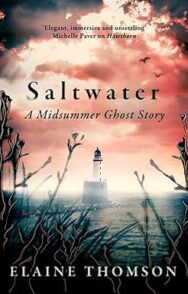
Saltwater: A Midsummer Ghost Story is the second release in Elaine Thompson’s ghost story quartet. The year is 1896 and Tom Torrance has been sent to the Isle of Stroma to oversee the completion of a lighthouse on an island that doesn’t seem to want one. Read on to see Tom confiding in Stroma resident, Flora, about the strange things he’s been seeing.
Saltwater: A Midsummer Ghost Story
By Elaine Thomson
Published By Sphere
Flora was outside a low shieling, a shed-like structure made of stone with a thatched roof, like a small black house. She was sitting in the last rays of the sun, her head back, watching me approach.
‘I knew you’d come,’ she said.
‘Miss Christie, you cannot be seen with my brother. With men from the camp.’ Even to my own ears I sounded petulant, irritated, but Flora seemed not to notice.
‘No one saw him but me and my aunt,’ she said.
‘Why was he here?’ I knew it was none of my business, but I could not help it.
She shrugged. ‘He said you had left him alone and gone off for the evening. That he had no one to talk to.’
‘No one to talk to?’ I said hotly. ‘Talk to about what?’
She raised her eyebrows. ‘What is it to you?’ She showed me none of the deference one would expect, and I felt a stirring within myself. I felt sure that she knew it, that she had noted the way the colour had flooded into my cheeks, could hear the way my blood beat in my veins, making my voice tremble.
‘You should not encourage him,’ I said.
She sighed. ‘What brings you here, Tom Torrance?’
I closed my eyes, suddenly too tired to say anything. Why had I come? I had told myself that it was because I wanted to thank her for her help earlier, but that was not the real reason.
‘They say you can see the dead,’ I said at last. ‘Is it true?’
‘Aye,’ she said. ‘At least, I see those who want to be seen.’
‘Ghosts?’
She nodded. ‘Ghosts, spirits, wraiths, people call them many things.’
‘I’ve seen them too,’ I said. I had said nothing of my visions to anyone, had denied them even to Davy when he lay twisted and broken at my feet, and I felt a surge of relief that I had, at last, told someone. Someone who would surely understand. She did not reply, but looked at me strangely, with something almost like pity in her eyes. Her silence acted as encouragement, and I plunged on.
‘I’ve seen them in the haar,’ I said. ‘In the shadows. Today they came to me at the lighthouse. Dead men,’ I whispered.
‘Drowned men. Drowned seamen.’ I shivered. The very thought of those grey faces made my skin grow cold. Were they drowned seamen? I could not be certain, but their appearance, their clothes, their beards, their grey weathered faces … I knew a sailor when I saw one. Besides, what else might they be? I did not want to think of them, but I had to tell someone.
I squeezed my eyes closed, putting my palms hard against them until I saw stars. ‘How my head aches,’ I said. But then the stars vanished and instead I saw Davy falling from the scaffolding, the four grey figures standing at his back. And then all at once I saw my mother’s waxy face, her open grave in the kirkyard as her coffin was lowered. I let out a stifled sob. ‘Dear God,’ I whispered, pulling my hands away from my face in horror. ‘What’s happening to me?’
‘You’re suffering from the megrim,’ Flora said, watching me. ‘The sick headache. Lack of sleep, too much time in the sun, worry, anxiety, grief, all these things will cause it. And with it come strange disturbances – bright lights, shadows, shapes. How can you be sure that what you’ve seen is any- thing other than that? There are many things that one might mistake for something else under such circumstances.’
‘I saw their faces,’ I muttered. ‘They were not shadows.’ ‘And why would they come to you?’
‘I don’t know,’ I said. ‘I am not myself at the moment. I don’t know why they would come to me, I don’t know what they want from me.’
She reached forward and laid a cool hand upon my brow. The touch of her fingers, the tender caress of another human being, was almost too much for me. I felt a sob rising in my chest, as if I were drowning. I gulped it down and, closing my eyes, let myself focus on the feel of her hand against me, the closeness of her.
‘Would you like something to make it better?’ Her voice was low and soft, like a lover’s in my ear. She did not wait for me to answer but disappeared into the shieling, returning a moment later with a small bottle of green glass. It was stoppered with a black waxy substance, so that I was reminded of the witch bottle that McCready and the others had stuffed into the wall of the lighthouse. “Ten drops in water every night,’ she said. I’ve put some in here for you and stoppered the bottle, so that it will not spill as you walk back to the camp.’ She held out a tin cup to me, half filled with well water, and watched as I drank it down. ‘And now you must leave.’ All at once she seemed anxious, afraid almost, as she glanced fearfully at the shadows that had risen, the haar that had grown thicker as we stood together amongst the kale and lavender.
I could not see that she meant me any harm, and I was grateful to try anything that might make me feel better. And yet there was something about her look, the smile that curled at the edge of her mouth, that I did not like. The air about us was so still it was as if the earth held its breath, waiting for the final setting of the sun.
Saltwater: A Midsummer Ghost Story by Elaine Thomson is published by Sphere and is available now, priced £18.99
RELATED BOOKS

ALSO ON BOOKS FROM SCOTLAND
-


The Scottish Colourists: Art & Life by Alice Strang
‘Together the quartet embodied a new spirit in Scottish art and they are celebrated as Scotland’s le …
-

David Robinson Reviews: Our Noble Selves by Kate Atkinson
‘As I suggested at the start, there’s a whole heap of plot in Our Noble Selves – spies, murders, and …
-
‘They had spoken perhaps ten sentences each and it had already begun. Moira’s resentments, her preju …
-

Ayont the Thistle by Jim Mackintosh, Alan Riach and James Robertson
‘Nane ae this then but – ma hert daen its hing/ an yon wee smile ae yours in the saft smir ae the ga …
-

David Robinson Reviews: This Door of the Seas
‘He sees what he wants to. And it makes a kind of sense too – especially to colonists from Scotland, …
-

The Broons and Oor Wullie Celebrate their 90th Birthdays!
‘Whatever the future may hold, we can be sure that The Broons and Oor Wullie will always be a part o …
FEATURED AUTHOR:
Leonie Charlton

Leonie Charlton travelled extensively as a child, living in England, Africa, Wales and Scotland. She has worked as a cowgirl in Australia, an English teacher in Japan, and her degree in Hispanic Studies took her to Catalonia for two years. Marram, publ …
FEATURED PUBLISHER:
Scotland Street Press

Scotland Street Press publishes with a mission to concentrate on debut authors and, particularly, older women. They publish memoir, literary fiction, poetry and biography with special attention paid to quality in the editing, design and typography. Sco …