


EXPLORE ISSUES



‘I hope that readers finish the book thinking not only about hearing loss but about connection and the many different ways we can understand one another.’
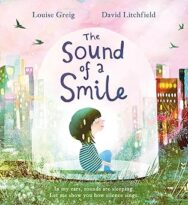
The Sound of a Smile is a stunning picture book for children exploring deafness, friendship and the universal ways we communicate with each other. Below, author Louise Greig writes about the inspiration behind writing the book.
The Sound of a Smile
By Louise Greig
Published by Orchard Books
When asked what inspired The Sound of a Smile perhaps people expect me to refer only to hearing loss. Of course, that is a significant part of the story. I have lived with progressive genetic hearing loss for many years eventually becoming profoundly deaf. My experience inevitably shaped the book. But the deeper inspiration was discovering that the world I thought I had lost was replaced by another that had always been there.
When we think about our senses we assume they only deliver information about the world. But they also shape the way we experience it. Hearing gives rhythm to our days. It alerts us, reassures us and connects us to everything and everyone around us. When that begins to disappear it can feel as though your place in the world is disappearing too, or certainly changing.
My own experience of hearing loss was not just about sounds fading. It was about conversations becoming exhausting, confidence diminishing and independence slipping away. Everyday interactions that hearing people rarely think twice about became obstacles requiring concentration, guesswork and resilience. Over time, I found myself withdrawing from situations that had once brought joy because the effort of communication became overwhelming.
Yet, unexpectedly, as one world became less accessible, another began to slowly reveal itself. I started noticing things that had always existed but had previously been overshadowed by sound. The movement of an animal’s ears, the fall of leaves, the quiet gestures in people. Communication can happen without words at all. I realised that the world beyond sound was not empty at all and that realisation inspired The Sound of a Smile.
I did not want to write a book that explained hearing loss or listed the practical challenges faced by Deaf or deafened children. Those books are important but I wanted hearing children to step, briefly, into another way of experiencing the world.
Children are wonderfully open to seeing the world from unexpected perspectives. Rather than presenting hearing loss as something to be analysed I wanted to invite readers into an experience. The silence in The Sound of a Smile is a metaphor that children can immediately understand regardless of whether they have any personal experience of hearing loss.
Every child’s experience of hearing loss is different. Some wear hearing aids. Others have cochlear implants. Some hear speech but struggle to distinguish sounds in busy environments. Others hear environmental sounds but cannot easily access language. There is no single deaf experience and I was conscious of trying not to represent one universal story.
Instead, I focused on something I believe is universal which is that every child wants to feel understood.
Understanding has become increasingly important to me. We rightly celebrate diversity and inclusion in schools and children’s literature and I believe enormous progress has been made. Today’s children are often wonderfully accepting of difference. But acceptance and understanding are not quite the same thing. Acceptance says, ‘Come into our world. You belong here.’ Understanding says, ‘I want to come into your world. I want to know what your world feels like.’ That extra step is a great leap because it creates empathy rather than just tolerance.
One of the things hearing people may not always appreciate is that communication belongs to everyone involved. When a conversation becomes difficult because of hearing loss it is often assumed that the deaf person carries sole responsibility for making communication work. But communication is a shared responsibility. This can transform an interaction. Understanding that difference completely changes the relationship. It moves us away from accommodation and towards partnership. That idea inhabits The Sound of a Smile.
The little girl at the heart of the story has what I think of as a secret map. It is the way she navigates a world that feels different from that experienced by those around her. Rather than asking others to observe her journey she invites them to walk alongside her for a while.
I feel incredibly fortunate that David Litchfield illustrated this book. His artwork captures emotions far beyond words. There is such warmth, sensitivity and quiet beauty in his illustrations and he instinctively understood that this book was not about absence but about discovering presence in unexpected places.
Ultimately, I hope The Sound of a Smile offers something to every child who reads it. For Deaf and deafened children I hope it provides the comfort and recognition of seeing an experience that reflects something of their own. For hearing children I hope it gently widens their understanding of how someone else might experience the world.
I hope that readers finish the book thinking not only about hearing loss but about connection and the many different ways we can understand one another. After all, some of the most meaningful things we ever communicate are never spoken aloud.
The Sound of a Smile by Louise Greig is published by Orchard Books, priced £14.99.
RELATED BOOKS

ALSO ON BOOKS FROM SCOTLAND
-


Flight Patterns by Lorna J. Waite: An Appreciation by Janette Ayachi
‘I’ve recently heard poetry archives described as ‘fugitive, ephemeral’, but here the wish of collec …
-
The Scottish Colourists: Art & Life by Alice Strang
‘Together the quartet embodied a new spirit in Scottish art and they are celebrated as Scotland’s le …
-
David Robinson Reviews: Our Noble Selves by Kate Atkinson
‘As I suggested at the start, there’s a whole heap of plot in Our Noble Selves – spies, murders, and …
-
‘They had spoken perhaps ten sentences each and it had already begun. Moira’s resentments, her preju …
-

Ayont the Thistle by Jim Mackintosh, Alan Riach and James Robertson
‘Nane ae this then but – ma hert daen its hing/ an yon wee smile ae yours in the saft smir ae the ga …
-

David Robinson Reviews: This Door of the Seas
‘He sees what he wants to. And it makes a kind of sense too – especially to colonists from Scotland, …
FEATURED AUTHOR:
Mairi Kidd

Mairi Kidd is the Director of The Saltire Society. She leads on delivery of the Society’s programmes championing the arts and culture of Scotland. She has previously worked at Creative Scotland providing strategic leadership for literature, languages a …
FEATURED PUBLISHER:
Curly Tale Books

Curly Tale Books was launched in May 2013 with the publication of author Alan Grant’s first story for young children The Quite Big Rock. We publish illustrated children’s books with a focus on Scotland and in particular the Belted Galloway breed of cat …