


EXPLORE ISSUES



‘Only a moment ago, dolphins flicked / from this firth’s surface, grace-danced air.’
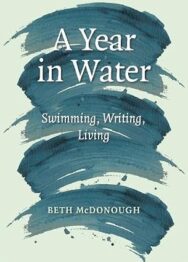
Poet Beth McDonough has written a wonderful reflection on wild swimming across the seasons. Through poems, memories, advice and humour, she delights the reader with time well spent in the waters near and far to her. Here is an extract that focusses on the summer months.
A Year in Water: Swimming, Writing, Living
By Beth McDonough
Published by North House Press
Taken from Summer: Taking to the Waters
Unfathomed
Long-warned, not one of us ventured out of our depths,
but just plotted the normal upfirth walk.
Everyone understood these waters,
eyed our regular turning point before rocks,
readied to hitch back on the effortless tide.
Nothing was new on the glass-flat slack.
But, every day’s different,
and though spaced apart, we each felt our feet
disturbed by an effervescent mud,
the unknown thrills of a thousand springs.
A concert of gasses, perhaps exhalations
of a million sand-trapped worms.
Some disconcerting presence,
thermal or animal, unseen in the clarity
breathing an ankle-deep jacuzzi.
What could we do, but all turn fish?
Seek out different slipstreams,
never try to touch the seabed
whatever we’d been told.
Lingering in the longer days, and the beginning of stings
Summer, and the water is warming – but as our comforts rise, often we are reminded that we are not alone. And though not all of our fellow swimmers are easy company, seals, certain oddballs apart, are generally excellent chums. On my first Tay crossing, one accompanied me from Tayport to Broughty Ferry, eyeballing me vigilantly the whole way. Certainly, be cautious of getting too close, and never swim between parents and pups. Nor should you ever be tempted to touch a seal, however sociable it appears. These are wild animals and we need to respect them.
But in general, these selkies (as they are called in Scotland) are benevolent, lovable company, with a reputation for shape shifting from seal into human and back again. I have no evidence of their strange transformations, but the stories are wonderful. Kelpies, and other water horses like the evil each-uisge, have never been problematic on any of my swims and so they stay submerged in the waters of myth and fairy tale. Altogether our friends, the seals, are not an issue. Let’s consider instead some more difficult drifters:
Gulls – they may well snaffle your faffjacks. Beware!
Dogs – very friendly and nosy ones have a similar capacity to ours to like many a chittery bite. These snacks are not good for our canine friends, and the dearth of them is not great for the shivering swimmer either.
Swans – the monarch owns them apparently and whoever holds the associated traditional ‘sinecure’ can come on swan-spotting duty. And that’s at any time. In addition, these are elegant creatures, yes, but no swimmer wants to be too close. There are so many urban legends of swan attacks and sheer bird strength with enough muscle to break a human arm. I have not witnessed anything of the kind, but, as ever, rather like seals, be extra cautious when their young are around. Don’t put yourself between an adult and its little one. And should you find either of these wonderful creatures in an injured state, seek the right help. Any local vet will advise. Even touching some animals is a bad idea, and can transmit certain conditions – to both parties – so please call for the right help rather than intervening directly. And, remember, wild creatures have long had good reason to be wary of humans.
King ragworms – who dug them up? Fishers, looking for bait, I daresay. You are unlikely to meet them otherwise, and neither do you want to. For, yes, they do bite!
Flounders and other flatfish – not dangerous at all, but you can find yourself mid-swim more rapidly than you ever intended if you stand on a one-eyed and half-sleeping fish in the sand as you paddle in. If this kind of activity appeals to you, you may wish to go flounder tramping with a bucket, but I suspect you won’t swim much.
Jellyfish, and other beasties of that ilk – we will meet later.
Note: I’m not certain these days that this traditional means of fishing from Cumbria and Dumfriesshire happens very often; the use of a ‘leister’ or trident is now banned, which is doubtless a mercy for bare, wading feet. It’s not for me to explain the gorier details of the practice of what is also called ‘treading’, but, at present, the annual World Flounder Tramping Championships are held on the first Saturday of every August, on the Urr Water, just south of the village of Palnackie on the Solway. Should that be of interest to you, even if you don’t catch much, you will be raising money for the very excellent Royal National Lifeboat Institution.
Full of it
That brown-masked gull
bellies about the beach. On patrol it
picks inspects red-legs sand insists
on every thing from the dunes’ rise
to the wrinkly-margined sea
where you paddle to shorts-damping height.
Let me reel in your tremble-out words,
hook you in to new phrases. Did you see?
Only a moment ago, dolphins flicked
from this firth’s surface, grace-danced air.
We bottle-nose together towards where
they might magic splash again.
Son, blind back at that sergeant gull. Ignore
those chesty thrusts. Never mind
how it angers out the unseen worms
from all this slack, complacent mud.
A recipe for a gastric upset following inadvertently swallowed dodgy water
Many water users recommend a drink of a proprietary fizzy dark drink, and not the diet variant. Some suggest you partake of a large quantity of it before you even swim. Certainly, doctors do recommend that flattened gassy stuff to replace electrolytes lost during a bout of sickness and/or diarrhoea. If you need to vanquish the bubbles quickly, add in some sugar, allowing plenty of space in your glass for the brief but violent effervescence. There’s scientific reason why sugar does that, but, as ever, I don’t know it. I have only practical experience of the kind of resultant accidental sticky kitchen spillage. In its flattened capacity (administering about a small tumbler each hour) the fluid acts to rehydrate the swimmer. It has no function whatsoever in the advance battling of pollutants, whatever certain popular lore may suggest. If someone has swallowed gallons of such a drink for years and never had a dodgy tummy despite swimming in murky places, then that’s all about coincidence rather than prevention or cure. Here, I offer an alternative response to the situation which can cause sickness in the first place.
What I suggest is this: have a look at the well-swum waters of Copenhagen. Right in the middle of that capital city. The presumption, in Denmark, is that the waters are clean enough for swimming and other water sports. On the very rare occasion that their fine waters fall below that high standard, their government makes a national announcement. That, really, is where we all need to be. If you have become ill swimming in an area where swimming and water sports are encouraged, then I suggest you follow it up with a complaint to your elected representatives, and if you have time and strength, a mini-campaign through print and online media outlets might do no harm. In advance of your return to bathing, you might want to look at data provided by SEPA, Surfers Against Sewage and certain water companies to ensure the water is safe. Certainly, add in the rehydration drink, but don’t accept pollution as the norm. Swimmers, and our beleaguered planet, deserve better.
A Year in Water: Swimming, Writing, Living by Beth McDonough is published by North House Press, priced £15.00.
RELATED BOOKS
ALSO IN THIS ISSUE

 On the Bodies of Strangers by Hannah Stevens
‘Across the road, a flash of colour catches Valeria’s eye.’
 Even the Trees by Roshni Gallagher
‘To teach myself belonging / I try to find the name / of the blossom tree darkening / by the wind …
ALSO ON BOOKS FROM SCOTLAND
-


The Scottish Colourists: Art & Life by Alice Strang
‘Together the quartet embodied a new spirit in Scottish art and they are celebrated as Scotland’s le …
-

David Robinson Reviews: Our Noble Selves by Kate Atkinson
‘As I suggested at the start, there’s a whole heap of plot in Our Noble Selves – spies, murders, and …
-
‘They had spoken perhaps ten sentences each and it had already begun. Moira’s resentments, her preju …
-

Ayont the Thistle by Jim Mackintosh, Alan Riach and James Robertson
‘Nane ae this then but – ma hert daen its hing/ an yon wee smile ae yours in the saft smir ae the ga …
-

David Robinson Reviews: This Door of the Seas
‘He sees what he wants to. And it makes a kind of sense too – especially to colonists from Scotland, …
-

The Broons and Oor Wullie Celebrate their 90th Birthdays!
‘Whatever the future may hold, we can be sure that The Broons and Oor Wullie will always be a part o …
FEATURED AUTHOR:
Iain MacLachlain

Iain Maclachlain is an award-winning first-time novelist from Morayshire. He believes passionately in writing in his local North-east Scots. From a working-class background, Iain was shortlisted for the Penguin/ Random House WriteNow programme in 2020.
FEATURED PUBLISHER:
Muddy Pearl

Muddy Pearl is a young independent publisher based in Edinburgh and specialising in books that help people explore issues of spirituality and prayer, international and social justice, health and lifestyle from a faith perspective. Our authors include t …