


EXPLORE ISSUES



‘The past is not dead. It does not disappear. It continues through the living, the real people who carry on their daily lives in Scotland.’
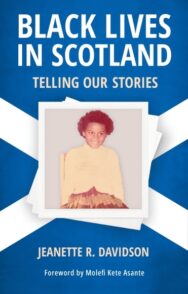
Black Lives in Scotland is an excellent social and cultural history full of vital stories—of challenge, love, support, strength and accomplishment—across the generations of Black Scottish born and New Black Scots from Africa and the Diaspora. We spoke to author Jeanette R. Davidson about her writing and of the lives of those she interviewed for her book.
Black Lives in Scotland: Telling Our Stories
By Jeanette R. Davidson
Published by Edinburgh University Press
Congratulations on the upcoming publication of your book, Black Lives in Scotland. What can you tell our readers about it?
Thank you! I am excited about the book coming out! I hope in some good ways it will make a significant contribution to the literature about Scotland. I think it has something to offer all kinds of readers—the everyday reader, students and academics, and people of all ages and walks of life.
The book includes stories of individuals of African descent who grew up in Scotland, from babyhood to adulthood, (including my own story) as well as the immigration narratives of people who have moved to Scotland from African countries, the Caribbean, the United States and from other parts of the UK. The stories are wide-ranging and include people with roots from all over the African Diaspora. I find each story to be fascinating, offering a bird’s eye view into the highs, lows and often sensitive intricacies of lives that most do not talk about publicly. I was fortunate that the people I interviewed trusted me, as an ‘insider’ as well as a researcher, enough to confide in me.
What can you tell us about your childhood in Scotland? How did your experiences influence your life’s path?
I was truly blessed with a wonderful, happy childhood in Scotland. The foundation of love in my family set me up for everything good in my life. I was cherished and protected by them and also had very strong friendships, supportive neighbours, teachers and church members who made life smoother for me than it might have been otherwise. Of course, there were challenges for me as I was always the only Black child wherever I went. Having strong support helped my development as a child and so I was able to deal with racism when I encountered it, at least as best as a child could. It is not a surprise though that I became a professor of social work and African & African American Studies, and a social science researcher. These occupational choices were likely rooted in my experiences, and the awareness and empathy that developed in me as I grew up.
You interview many people in this book from different generations. How did you find gathering together these stories? What surprised you? What resonated? How have the stories changed with each generation?
First, I should say the people I interviewed were incredibly generous with their time and energy. I am deeply indebted to each of them. They wanted to contribute to this collection of stories and hoped it would be helpful to people from all backgrounds: to be encouraging and inspirational to other Black people, and to be informative and lead to increased understanding in other groups.
The interviewees for this book discussed ordinary aspects of life (because we live our lives in many ways just like anyone else) but they also had to talk about very emotionally charged experiences. That is hard to do and takes courage! I was fortunate to find individuals from different segments of society: they include artists, musicians, one supermodel, entrepreneurs, hairstylists, academics, psychiatrists, actors, filmmakers, social workers, politicians, lawyers, activists and students. The list could go on. Many of the stories are full of joy and accomplishments, love of Scotland, and appreciation of personal identification with Scottish and African heritage. People were also willing to disclose about their vulnerability and trauma when they faced racism and discrimination, including a shocking amount of violence. Often, Black Scots do not tell anyone what is going on. It is just part of our lives and so we moved on silently. Set in the historical and cultural context of Scotland, these stories are a complex mix. Often, Black Scots are met with equity, humanity, kindness, and a spirit of belonging, but sometimes are faced with the exact opposite. I think, like me, readers will resonate with these heartfelt, deeply human stories.
Perhaps the greatest surprise for me was the gift of being able to present a three-generation story in the book. Along with the other narratives in the book, this family story highlights differences and similarities over the generations. Stories from earlier times always show how very few people of African descent were in Scotland, how isolated they were, and the difficulties they faced being seen as ‘outsiders’. They also show the mixed reception Black Scots experienced: sometimes warm and welcoming, and sometimes not so much! The younger people that I interviewed, generally had more diverse social groups and attended more diverse schools. Still, they often experienced similar (albeit ‘updated’) kinds of prejudice in their daily lives based on the colour of their skin.
The Scottish experience for the Windrush generation doesn’t often get as much attention in the media in comparison to other places in the UK. Why do you think that is?
I imagine that is related to the larger numbers of the Windrush generation who settled in England, though Scotland did indeed benefit greatly from their contributions. We owe them a debt. In my book there are two wonderful stories about men who came to Scotland from that generation: Sir Geoff Palmer and Mr Edwin Minnis. Their stories are very different in the ways they are told but overlap in illustrating their childhoods and the impact of colonization, their depth of character, talents and dedication, and priceless contribution to the Scotland they loved. Their narratives emphasize the throughline of history. The past is not dead. It does not disappear. It continues through the living, the real people who carry on their daily lives in Scotland.
You now live in the US. Can you tell us more about your discoveries in the connections between the US and Scotland?
In parts of the book, I present insights and comparisons of life in the US alongside observations about Scotland. Despite its many positives, the US has a long, ingrained history of violence and racism, exacerbated with its widespread use of firearms. Anti-Black racism (and racism against other groups) is a deadly, daily reality. Scottish history is inextricably intertwined with that of the US and even though certain differences may be cited in how race relations play out in each of these societies, it is irrational to ignore the harsh reality of racism in Scotland and to glibly point to the US as ‘worse’. Scotland also has the legacy of slavery that includes a racial hierarchy that designates African people as inferior, and that has, over the centuries, impacted the culture at large, the structure of Scottish society, and has reached down to everyday living.
What are your thoughts on Scotland’s own reckoning with its past? Are you encouraged by the stories and studies that are now coming through?
This is an important time for Scotland. In the not-too-distant past there was persistent denial about its history of slavery and colonization, and it was considered ‘unseemly’ to speak about racism and discrimination. Recently more stories and studies, and public events have been forthcoming, and that is very encouraging, though not enough for sustainable, systemic change. People are out marching on the streets, advocating for very different trajectories for Scotland’s future. Progressive folks look to the promise of a productive, collaborative anti-racist multiracial society. Others want to go backwards in time. This book sheds light on what people of African descent—those who were born in Scotland and New Scots who have migrated to the country— are really like, how their lives are lived, and how much they contribute individually and collectively to Scotland in very positive ways. Theirs are stories of strengths, hard work, persistence, surviving and thriving. Scottish people from all backgrounds are perhaps at a crossroads right now where they can choose to work together for a transformative, positive, hopeful, inclusive, truthful, liberated and free society of which we can all be proud.
Black Lives in Scotland: Telling Our Stories by Jeanette R. Davidson is published by Edinburgh University Press, priced £19.99.
RELATED BOOKS
ALSO IN THIS ISSUE

 Author Profile: Christopher Rush
‘After a lifetime of hill-running and marathons, my favourite exercise is now reaching for the neare …
 Josephine Jay Reviews: The Shape of Monsters by C. L. Hellison
‘Hellisen’s world is one that ponders the driving forces of fate against personal agency – asking wh …
ALSO ON BOOKS FROM SCOTLAND
-


The Scottish Colourists: Art & Life by Alice Strang
‘Together the quartet embodied a new spirit in Scottish art and they are celebrated as Scotland’s le …
-

David Robinson Reviews: Our Noble Selves by Kate Atkinson
‘As I suggested at the start, there’s a whole heap of plot in Our Noble Selves – spies, murders, and …
-
‘They had spoken perhaps ten sentences each and it had already begun. Moira’s resentments, her preju …
-

Ayont the Thistle by Jim Mackintosh, Alan Riach and James Robertson
‘Nane ae this then but – ma hert daen its hing/ an yon wee smile ae yours in the saft smir ae the ga …
-

David Robinson Reviews: This Door of the Seas
‘He sees what he wants to. And it makes a kind of sense too – especially to colonists from Scotland, …
-

The Broons and Oor Wullie Celebrate their 90th Birthdays!
‘Whatever the future may hold, we can be sure that The Broons and Oor Wullie will always be a part o …
FEATURED AUTHOR:
Nan Shepherd

Anna (Nan) Shepherd was born in 1893 and died in 1981. Closely attached to Aberdeen and her native Deeside, she graduated from her home university in 1915 and for the next forty-one years worked as a lecturer in English. An enthusiastic gardener and hi …
FEATURED PUBLISHER:
Tapsalteerie

Tapsalteerie is an independent poetry press based in rural Aberdeenshire. We publish a diverse range of poetry with a focus on new and innovative writing, translations, collaborative working, and the Scots language. Tapsalteerie started life as a pamph …