


EXPLORE ISSUES



‘I think at its heart, Shorelines is about re-arrival, about what it means to return and, consequently, what it means to change over time.’
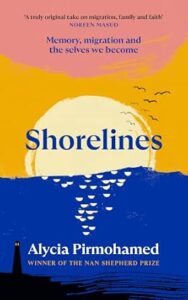
Shorelines is the first non-fiction book from award-winning poet Alycia Pirmohamed. BooksfromScotland chatted with her about her book and her appreciation of the natural world.
Shorelines: Memory, migration and the selves we become
By Alycia Pirmohamed
Published by Canongate
Congratulations Alycia on winning the Nan Shepherd prize and for the publication of this award-winning Shorelines. Can you tell our readers about the book? What did you want to explore in writing it?
Thank you so much! I’ve been thinking about how to answer this question succinctly…
I think at its heart, Shorelines is about re-arrival, about what it means to return and, consequently, what it means to change over time. As someone with a varied history of multiple migrations, I write a lot about place and about home. This kind of work lends itself to narratives about departure, about loss and about all that is left behind. But I found while writing that I was growing interested, too, in the act of return, in the zigzagging and recursive qualities of migration, even if that return takes place in the imagination.
More concretely, these pieces are rooted in different places I call home or have lived in. They take place in Alberta, in Oregon, in East Africa and in Scotland, and in them, I wanted to explore the legacies of migration and colonialism. Thematically shifting between familial inheritance, climate grief, racial identity, faith, and friendship, Shorelines considers how place and identity intertwine, and how the ways we build community shape us into who we become.
Your book plays with the genre expectations of nature writing – it’s already been called ‘genre-defying’. What is your relationship with nature writing as a reader as well as a writer?
I’ve realised over time that carving out space in the Western tradition of nature writing as a woman of colour involves continuous resistance against an industry that wants to neatly package our work. I’ve really grappled with this question over time, and my perspective is constantly transforming. At first, I hesitated to call myself a nature writer. The tradition felt out of my reach, especially seeing so few people like me represented in the genre. And then my questions morphed in shape. I began to ask instead, what literary borders – what kind of gatekeeping – perceived me as outside the boundaries of these traditions?
The truth is, I have always been drawn to landscape and nature writing, and so my work has always been in conversation with the natural world. In the past, this interest was largely informed by a reflective, nostalgic, or figurative relationship to the natural world – a diasporic connectedness to ancestral land(s). More recently, my practice has been building outward, moving from individual, singular practices and toward poetry as a communal and changemaking process. Now I find myself gravitating toward nature writing that focuses on global solidarity and justice, one that resists being apolitical.
I think of Shorelines as a very hybrid book, both in terms of subject and form. Lately, I’ve been thinking through how hybridity is decolonial and radical in practice, something many Black and brown writers have taught us already. Bhanu Kapil writes that hybrid forms come ‘from the capacity of the body to form and extend a new gesture’ and I think that’s what I was hoping for. Different narrative methods exist in this book, along with different structural experiments, as I try search for new gestures to help articulate new ways to subvert, resist, and reclaim what, at times, feels inarticulable.
What is your first memory of the natural world?
My first memory of the natural world is visiting Sylvan Lake in Alberta as a young child with my family. We didn’t get away from the city too often – something that I think has to do with class and accessibility – but every year when we went to Sylvan Lake, it was an event. A family affair, with aunts and uncles and cousins and frilly swimsuits and frisbees and huge ice cream cones. But I have subtle memories of the natural world before those trips too, like playing in the field across from my childhood home with my neighbourhood friends. Or building snow forts at recess when in elementary school. I’m lucky to have grown up in Alberta, where the natural landscape was so seamlessly a part of my life.
What natural spaces in Scotland mean this most to you?
I live very near to Lochend Park and over time, it’s become a very special place to me. In one section of Shorelines, I describe walking the loop around the water and reading poems out loud to the waterbirds. Of course, I love the eastern shore and the sea, which I’m often swimming in, and I love the highlands, especially around Moniack Mhor, too. But Lochend Park was there for me every day during lockdown, during that immense period of disconnection, and it became a companion of sorts. Visiting Lochend during that time became a ritual almost, a kind of prayer, and being in that accessible green space, when so much else felt inaccessible, brought me peace. When I was asked this question at a reading once, I mentioned Lochend Park and learned that it’s beloved to many people. Someone in the audience and I bonded over the heron we always see there – stoic, often alone (though once I saw four all together. That was a good day).
How do you approach your non-fiction writing in comparison to your practice as a poet? Is there a difference?
I let my poetic impulses take over in some parts of Shorelines, and in places the book slips between the thresholds of genre. Like in poetry, in my creative non-fiction explores the possibilities of the fragment. I don’t question my compulsion toward fragments and poetic thought, which I’ve learned feels like the truest way to express my thinking and my experiences, which themselves feel in-between and fragmentary.
But I loved the challenges creative non-fiction posed when it came to portraying a narrative arc. I enjoyed working within traditional narrative structures, too, which felt to me different than the atemporal and surreal/imagistic poetry I tend to write. Although my poetry is often subjective, and often about my real experiences, that isn’t always true. I use the terms semi-autobiographical or fictionalised to describe it. But writing in a genre where truth (a tenuous term in itself, I know) is expected, where the subject is undoubtedly myself and my life, also requires a different approach. In writing and revising Shorelines I paid particular attention to my own personal questions and worries around spectacle and consumerism and spent time thinking around my own act of withholding. I was absolutely influenced by Dionne Brand’s The Blue Clerk and her thoughts on the said and unsaid. Turning one’s life into a book can be liberating; I’m so glad to have had the agency and opportunity to tell my story. But, as I’m sure all writers know, creating content born from real life always feels political, too.
What will you be reading over the summer?
I’ll be reading Adriana Onita’s Descântec For My Split Tongue, Nicole Lachat’s The Red We Silk, and Jay Gao’s The Dead One, The Unconscious One, Thundering in Your Ear, Thriving Slumber, new collections by extraordinary poets who I’ve literally grown up with, who have taught me so much about language, and who have made me the writer I am today.
I’m also going to be reading Scotland-based Roshni Gallagher’s debut collection, Even the Trees. Roshni’s clarity and precision have always astounded me. Another debut I can’t wait to get my hands on is the fantastic poet, Clementine Ewokolo Burnley’s, Belling the Leopard. I’ve been eagerly awaiting both of these collections since they won the James Berry Prize a few years ago. And since a theme here seems to be books about trees, Victoria Chang’s Tree of Knowledge is also on my summer list. I find her so, so inspiring.
As for non-fiction, I’ll be reading Arundhati Roy’s Mother Mary Comes to Me and Ece Temelkuran’s Nation of Strangers, and Polly Atkin’s Swimming the Seasons, all of which have been recommended to me by so many friends!
Shorelines: Memory, migration and the selves we become by Alycia Pirmohamed is published by Canongate, priced £18.99.
RELATED BOOKS
ALSO IN THIS ISSUE

 My Name is Zayn by Fidan Meikle
‘That was my plan. Stay out of trouble and get my refugee status. Then I’d travel to every city in t …
 David Robinson Interviews Olga Wojtas
‘Wherever she goes, though, she will be well worth following.’
ALSO ON BOOKS FROM SCOTLAND
-

The Scottish Colourists: Art & Life by Alice Strang
‘Together the quartet embodied a new spirit in Scottish art and they are celebrated as Scotland’s le …
-

David Robinson Reviews: Our Noble Selves by Kate Atkinson
‘As I suggested at the start, there’s a whole heap of plot in Our Noble Selves – spies, murders, and …
-
‘They had spoken perhaps ten sentences each and it had already begun. Moira’s resentments, her preju …
-

Ayont the Thistle by Jim Mackintosh, Alan Riach and James Robertson
‘Nane ae this then but – ma hert daen its hing/ an yon wee smile ae yours in the saft smir ae the ga …
-

David Robinson Reviews: This Door of the Seas
‘He sees what he wants to. And it makes a kind of sense too – especially to colonists from Scotland, …
-

The Broons and Oor Wullie Celebrate their 90th Birthdays!
‘Whatever the future may hold, we can be sure that The Broons and Oor Wullie will always be a part o …
FEATURED AUTHOR:
Hannah Kaner

Hannah Kaner is a Northumbrian writer living in Scotland. She works as a senior digital consultant in Edinburgh, delivering digital healthcare, tools, and services for the public sector. She has a first class degree in English from Pembroke College, Ca …
FEATURED PUBLISHER:
Extremis Publishing

Extremis Publishing is an independent publishing house based in the heart of Scotland which is dedicated to producing the highest quality of non-fiction in the subject areas of the arts, media and culture. We are committed to the delivery of a publishi …