


EXPLORE ISSUES



‘He called me, behind my back, the Brylcreemed Bolshevik. Despite this, I liked and respected him.’
Compiled from fourteen years of in-depth conversations with journalist and close collaborator Brian McGeachan, this long-anticipated posthumous autobiography captures Jimmy Reid’s life as trade union leader, orator, broadcaster and political activist. Below is an extract where he talks of his first job at the Glasgow Stock Exchange.
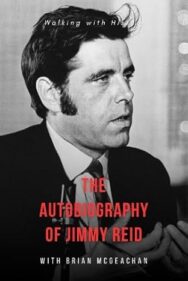
Walking with History: The Autobiography of Jimmy Reid
By Jimmy Reid with Brian McGeachan
Published by McNidder and Grace
YOUNG RADICAL
A haircut and a handshake from Dad, and I was off on a new adventure.
‘Are you the new boy?’ an austere woman in a tailored Utility suit asked.
I nodded.
‘If you’d care to be seated, I’ll see if Mr Robertson is available.’
I was impressed by his book-lined office. I didn’t know they were ledgers containing figures. David Robertson was a tall, imposing figure with a military-style moustache. My eyes darted to his monogrammed cufflinks.
‘Sit down, James,’ he said. ‘Your headmaster, at…St Gerard’s?’
I cleared my throat nervously.
‘Mr Moore? He gave a glowing report of your character. You seem to have been something of a star pupil.’
I almost fell off the leather chair.
‘You’ll have to complete some examinations.’
He saw my discomfort.
‘I’m sure you’ll sail through them,’ he smiled.
My own desk was shabby in comparison. A stiff wooden chair, in a windowless, but large, room of suited men. No one spoke as I sat down. Not even the glint of a smile.
I looked around me, at men in their late forties and early fifties, and pondered whether their ‘success’ was worth the climb. I saw invisible chains around their ankles. No doubt they were making a good few bob, but at what cost?
I thought of Frances’s dad: ‘Keep my soul by weighing it down with money.’
The training went smoothly, and I drew attention from the girls in the typing pool. But I was faithful to Frances and accepted their attentions from a polite distance. Within months, I was looking after the books of other companies, discussing discrepancies with them.
By day, I drowned in figures, but spent evenings immersed in words. It was a deliberate escape from inane work and stultifying talk of expanding client wealth. I trundled into work with little enthusiasm. My older brother was an early riser, and often kicked me out of bed when I overslept.
My colleagues and I were hardly compatible. Their topic of conversation was golf, wine lists and the Book of Common Prayer. My own were football, socialist politics and Jack London. One colleague was clearly suffering from shell shock and trembled when he heard doors slam
I was reading through my lunch break when one of my colleagues asked, ‘Karl Marx?’
‘Bernard Shaw,’ I assured them, ‘Don Juan in Hell. Would you like to borrow it?’
‘No need,’ he assured me, ‘I’ve been to hell.’
He called me, behind my back, the Brylcreemed Bolshevik. Despite this, I liked and respected him.
One baleful influence they had was cigarettes. Smoke swirled around the office as they worked, and it looked debonair. I began buying packs, and it was the beginning of a 60-a-day habit. Robertson was a good boss and a decent man. I brought the Daily Worker and Forward magazine into the office. Robertson would ask to read them. He was chairman of the Glasgow Stock Exchange and took me to the Conservative Club, Bothwell Street, where he introduced me to rising stars of Scottish conservatism.
‘This is James,’ he’d proudly announce, ‘He’s a young socialist.’
In the evenings, I attended the Glasgow Youth Parliament, which met in Community House, run by George McLeod’s Iona Community. We formed a Labour cabinet, and one of the members said, ‘James, you work in the stock exchange, you can be Chancellor of the Exchequer.’ I duly began work on presenting a budget. I took as my text Labour’s 1945 election manifesto, ‘Let Us Face the Future’, and entirely ignored the rightward drift of their policies in government.
I rose to my feet, arms resting comfortably on the podium… ‘We hereby pledge to nationalise steel, the Bank of England, the mining industry, the railways and electricity, gas and telecommunications…’ There was uproar, behind me, on the Labour benches, but they were already committed to voting for it. The communist members of the parliament cheered.
Robertson sent me on courses in economics. One lecturer got lost in a tangle of verbiage that appeared to last three days. I sprang to attention when he announced, ‘The Stock Exchange will last as long as the existing economic system.’
‘Aren’t we entitled to better job security than that?’ I asked.
Robertson was amused, but history has proved me wrong. Today, the City of London is deeply entrenched, wielding more power than a Prime Minister. I was convinced that human reason and collective action were the future, and I wanted to play my part. But until that equitable society arrived, I had to live in the real world. That meant nights at the greyhound racing at White City Stadium. I won £60 at the tracks on my 15th birthday and treated pals to double nougat bars. Before I reached home, word had spread that I’d been the recipient of a birthday bounty. Mum was waiting for me at the front door, and I’d never seen her so delighted.
On Fridays, in the office, we’d party with cups of tea. I was too young to imbibe alcohol. I sang them a ballad about a sailor who came to Govan…
The first time I struck Govan, the first time I reached that shore, I went down the smoky alleys, trying to find a welcome door.
Within a year, I was the youngest transfer clerk in the Glasgow Stock Exchange. But I was approaching 16, and wasn’t happy at the prospect of making stockbroking my life’s work. To me, being a socialist made it untenable.
I asked to see Robertson.
‘Don’t be foolish, James,’ he said. ‘You’re throwing away your future. Think it over, talk to your parents.’
‘I’m sorry. I’ve made my decision.’
If I’d stayed, my life would’ve been massively different. I didn’t leave with any rancour or prejudice, believing all stockbrokers to be grasping and vicious. And I think, even if I’d stuck to my politics, they could accommodate them. At least Robertson could. I wanted to work in industry among the workers. When I told my dad I’d left the job, he thought I was joking.
‘Who else around here had a chance like that?’
‘I can’t spend my life counting up rich men’s cash.’
‘A boy with your brains? Why make crazy paving out of a career path?’
Mum took my side, as she always did.
‘It’s his life, Leo,’ she said. ‘He can’t go against his beliefs. If he could, he wouldn’t go against mine, and my church.’
With youthful arrogance, I was headstrong with my dad. I didn’t appreciate the struggles he’d gone through. He never spoke about lodging at the Govan Poorhouse with his siblings as a destitute child. But it scarred his life.
I caught up with him in one of his hostelries.
‘They don’t let boys drink in here,’ he said.
‘That’s just it, I’m no boy.’
He looked up from his pint and said, ‘Don’t make my mistakes. Make your own.’
I wasn’t sure if it was disapproval, so I just stood in silence.
‘I can’t judge anyone, James.’
He handed me a crumpled sheet of paper and stared into the gantry.
‘What’s this, Dad?’
‘Don’t tell anyone I passed you a poem, mind?’
It was ‘If—’ by Rudyard Kipling.
‘I got the lassie in the library to type it out.’
I carried it with me till age withered it, and it fell apart.
Walking with History: The Autobiography of Jimmy Reid by Jimmy Reid is published by McNidder and Grace, priced £17.99.
RELATED BOOKS
ALSO IN THIS ISSUE

 Even the Trees by Roshni Gallagher
‘To teach myself belonging / I try to find the name / of the blossom tree darkening / by the wind …
 Seasonal Snacks by Gabriella English
‘The height of summer is the only time to buy peaches, so I eat them whenever I can.’
ALSO ON BOOKS FROM SCOTLAND
-


The Scottish Colourists: Art & Life by Alice Strang
‘Together the quartet embodied a new spirit in Scottish art and they are celebrated as Scotland’s le …
-

David Robinson Reviews: Our Noble Selves by Kate Atkinson
‘As I suggested at the start, there’s a whole heap of plot in Our Noble Selves – spies, murders, and …
-

‘They had spoken perhaps ten sentences each and it had already begun. Moira’s resentments, her preju …
-

Ayont the Thistle by Jim Mackintosh, Alan Riach and James Robertson
‘Nane ae this then but – ma hert daen its hing/ an yon wee smile ae yours in the saft smir ae the ga …
-

David Robinson Reviews: This Door of the Seas
‘He sees what he wants to. And it makes a kind of sense too – especially to colonists from Scotland, …
-

The Broons and Oor Wullie Celebrate their 90th Birthdays!
‘Whatever the future may hold, we can be sure that The Broons and Oor Wullie will always be a part o …
FEATURED AUTHOR:
D. V. Bishop

D V Bishop is the author of more than twenty published novels, an award-winning screenwriter, and a TV dramatist. His crime fiction debut City of Vengeance won the Pitch Perfect competition at Bloody Scotland 2018 and was published by Pan Macmillan in …
FEATURED PUBLISHER:
Royal Botanic Garden Edinburgh

The Royal Botanic Garden Edinburgh (RBGE) is a world renowned centre for plant research, conservation and education. Our four Gardens are also popular visitor attractions, offering fun and inspiring events for adults and children. The RBGE Publications …