


EXPLORE ISSUES



‘She also resolves to keep a gratitude diary, celebrating not only winter, but friendships, food, travel and everything that helps to get her through its darkest days.’
Billy Connolly once said ‘there is no such thing as bad weather, just the wrong clothing’. David Robinson finds writer Helen Moat determined to appreciate the dark days of winter despite dreading it in previous years.
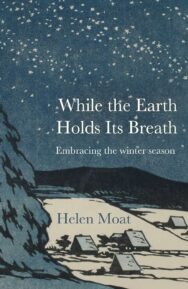
While the Earth Holds Its Breath: Embracing the Winter Season
By Helen Moat
Published by Saraband
Officially, according to the astronomical definition, winter begins with the solstice of 21 December and lasts until the spring one on 21 March. Meteorologists disagree. They simplify things a bit, so they make winter start on 1 December and end on the last day of February.
I think they’re both wrong. Winter surely begins in November. Thermologically speaking, November is one of our three coldest months. Most of our trees have already shed their leaves. Nature is shutting down rather than, with the coming of longer days, starting up – like crocuses poking their heads out of the earth in late January – and actively planning ahead for spring. Bleak midwinter is surely what you can expect to find in mid-December, around the time we’re singing carols about it.
Whenever it happens, though, bleakness and winter are forever entwined. If autumn is a season of mists and mellow fruitfulness, winter is all too often a time of emptiness, fatigue and seasonal affective disorder. Or at least, as she outlines in her book While The Earth Holds Its Breath, it always has been so for travel writer Helen Moat.
Every year for as long as she can remember, she writes, the coming of winter meant spiralling down into anxiety. The cause and parameters of this aren’t clearly defined. Sometimes, it is ‘a feeling of being a shadow of myself, flimsy and ethereal, not quite solid … drowsy, dozy, disengaged’; at other times it is altogether more debilitating. But although she writes about wanting to push away ‘an internal darkness’, and ‘learning to deal with feelings of abandonment, rejection and judgement’ and ‘feelings that weighed me down like a stone’ and although all of these feelings always surface with the onset of winter, that’s where her self-analysis ends.
In this respect, While the Earth Holds Its Breath has a useful counterpoint in Katherine May’s 2020 international bestseller Wintering. Like Moat, May draws links between literal and metaphorical winter, examines how different cultures get through the year’s darkest months, and gathers her experiences under the chapters with the headings of winter months. But the differences are stark too. While anyone reading Wintering could tell you precisely what discontents May was wrestling with (illness, change of job, worries about her son), Moat reveals comparatively little about herself. The proof copy I read, for example, doesn’t even mention that she and her husband now live in Angus.
Against that, there’s no denying that Moat’s book has the more dramatic opening. She is on a travel writers’ freebie trip to the Finnish winter sports resort of Kittilä, which is within the Arctic Circle and has been led away to try ice fishing on a frozen lake. It’s -20C, she is sitting on a small camping stool above a hole in the ice, holding onto a small fishing rod. She doesn’t catch anything.
Instead of feeling cold, depressed, or any of the other emotions that she has hitherto most associated with winter, she experiences altogether different emotions:
‘I’m taken back to an existence before memory, a time when I floated gently in amniotic fluid, womb-dark and safe. Something primeval is happening to me….. I feel adrift from myself and somehow anchored to the frozen land and to the arch of sky surrounding me, as if held in a snow dome … In the stillness, the whitened trees and indigo-blue sky whisper to me. Flittering thoughts ease out; I have become one with the ghosted landscape.’
Winter, in other words, has become its opposite: a comfort, something to cherish. Just as Finnish Laplanders apparently spend as much time as possible outdoors in the dark depths of winter – and love it – so, she resolves, will she. Not only that, but she will write about it, noting what works for her and what doesn’t. She also resolves to keep a gratitude diary, celebrating not only winter, but friendships, food, travel and everything that helps to get her through its darkest days.
So when she and her husband visit the Welsh town of Laugharne in their campervan on a rainy October day, instead of feeling down, she
‘gave myself up to the energy of the tides, the currents in the estuary, the cold rain drizzling down my cheeks, the edge-or-winter coastal air sharp on my face. There was rapture on this shore, a feeling of joy, a coming to, an awakening I experienced every time I looked out at sea.’
It’s not just the sea: the Peak District moors, memories of cross-country skiing in Switzerland, forest-bathing in Japan, night-time rambles with neighbours – anywhere nature can dwarf her can also bring joy. But so too can the friendships she makes along the way, or the discoveries of other ways of living. The Japanese, she finds out on another freebie trip, wouldn’t dream of talking negatively about winter: it’s just one season that balances the others and life must be lived in harmony with all. Then again, she thinks, visiting friends who have settled in an Andalusian village, isn’t their life the perfect answer to the winter blues too?
All these places provide different triangulation points for Moat’s own study of ways of wintering. Unlike May’s book, the gratitude diary format dominates. Sometimes Moat’s determination to enjoy winter slips and there are cold, rainy days when she does indeed stay under the duvet, cursing her lack of resolve. As the period she is writing about encompasses both the pandemic and the war in Ukraine, there is plenty to temper her optimism.
The gratitude diary approach has its limitations, just as a newspaper would which only concentrated on good news: if you’re only looking in one direction, you tend to find what you’re looking for. But as Moat’s book is just looking for joy in the bleak midwinter, what’s the harm in that?
While the Earth Holds Its Breath: Embracing the Winter Season by Helen Moat is published by Saraband, price £12.99.
RELATED BOOKS

ALSO ON BOOKS FROM SCOTLAND
-


The Broons and Oor Wullie Celebrate their 90th Birthdays!
‘Whatever the future may hold, we can be sure that The Broons and Oor Wullie will always be a part o …
-

Pretty Valuable Things by A. J. Leslie
Harper considered Charles for a few moments, lit a cigarette, then said ‘we are treating it as murde …
-

Shadow of Madness: A Q & A with D. V. Bishop
‘Yet a great novel of historical fiction also has us escape the here and now by immersing us in the …
-

‘I don’t think I decided to become a writer. I just was.’
-

Lessons From Scottish Schools: A Q & A with Lindsay Paterson
Ten years will not be enough to restore Scotland to where it was in the past…
-

Saltwater: A Midsummer Ghost Story by Elaine Thomson
‘The very thought of those grey faces made my skin grow cold.’
FEATURED AUTHOR:
Isobel McDonald

Isobel McDonald is Curator of Social History at Glasgow Museums. Having originally studied archaeology at Edinburgh University, she had expected to go into fieldwork, however a chance conversation with a friend about job opportunities at the British Mu …
FEATURED PUBLISHER:
Scottish Mountaineering Press

Launched in 2020, the Scottish Mountaineering Press exists to promote and share Scotland’s natural wonders, embracing the creativity born out of an explorer spirit and celebrating the joy and endeavour in a life lived outdoors. We are a wholly-owned su …