


EXPLORE ISSUES



‘O’Farrell brings all her remarkable skills as a descriptive writer to bear as she shows us Lucrezia’s loneliness in a court far from her family and the Florentine palace in which she has been virtually confined all her life.’
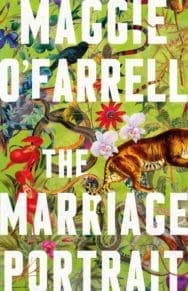
David Robinson reads Maggie O’ Farrell’s much anticipated follow up to Hamnet, The Marriage Portrait, and appreciates its exploration of the iconic, of how art speaks to art.
The Marriage Portrait
By Maggie O’Farrell
Published by Tinder Press
For all lovers of ekphrasis, Page 337 of Maggie O’Farrell’s latest novel The Marriage Portrait is a must-read. Ekphrasis is, in case you’ve forgotten your English Higher, a posh word for describing or reflecting on a work of art, and on Page 337 we come across a clear case of that rare thing, the only slightly muted double ekphrasis.
Allow me to explain. It’s 1561, a highly significant year in the life of Lucrezia di Cosimo de’ Medici (1545-1561). She is staying with her husband Alfonso, the Duke of Ferrara, in a remote hunting lodge, convinced that he is about to murder her. (This isn’t a spoiler, but something we have been told at the start of the novel.) The Duke has set everything up for his young bride to have her portrait painted by his favourite artist. This novel is, essentially, a meditation on that portrait, on what it – or any work of art – can and cannot show.
Now if, after you learnt about ekphrasis in Higher English, you went on to study the subject at university, you may have come across Robert Browning’s 1842 dramatic monologue ‘My Last Duchess’, which is widely supposed to have been written about Lucrezia and Alfonso. And even if you have never read it, you would have noticed that O’Farrell chose its opening lines as one of her novel’s two epigraphs:
‘That’s my last duchess painted on the wall,
Looking as if she were alive …’
The Marriage Portrait is a lot more than a nod to Browning’s poem: it takes it for a tango over every square foot of the dance floor. ‘There she is,’ Duke Alfonso says on Page 337, ‘my first Duchess’. This is, to use another show-off word, a fine example of parapraxis (or Freudian slip, as the hoi polloi might anachronistically prefer to call it). As soon as he has said it, the duke realises he has misspoken. ‘My beautiful Duchess,’ he quickly corrects himself.
An informal and completely unreliable survey reveals that this corrected remark is what most of my friends think Browning’s poem is about: a duke showing a courtier a portrait of his dead wife, lovingly mourning her youthful beauty. In fact, it’s almost the opposite. As he looks at the portrait, the duke concentrates on her inadequacies, the way she didn’t appreciate ‘my gift of a one-hundred-years-old name’, how she would smile promiscuously at anyone in the court, not just him. As he tells the courtier
Oh, sir, she smiles, no doubt,
Whene’er I passed her; but who passed without
Much the same smile? This grew; I gave commands;
Then all smiles stopped together.”
Reader, he murdered her.
So that’s the first bit of ekphrasis sorted out: all of this is revealed by the Duke to a diplomat from another court pushing the claims of another woman as a replacement bride as they contemplate the portrait of Wife No 1. (It’s a bit odd that any Duke would admit to bumping off his first wife, or even speak ill of her, while talking to a man he hopes will supply his second, but take that up with Browning, not me.) If I have spent so long on Browning, it is because his poem, itself an example of one art form transforming into another (painted portrait to poem) is now the source of a second, rarer, transformation, from poem about painting to novel. O’Farrell doesn’t follow Browning slavishly, and her range is wider, but his are the tracks she set off following, even if she chooses an altogether different terminus.
As with her last novel Hamnet, winner of the Women’s Prize and, in the US, last year’s National Book Critics Circle Award, O’Farrell brings someone from the shadows of factual history into the limelight of fiction. Can a Renaissance princess ever really be in the shadows, you might wonder. But just read the second epitaph O’Farrell places after the Browning quote. ‘The ladies,’ writes Boccaccio in The Decameron, ‘are forced to follow the whims, fancies and dictates of their fathers, mothers, brothers and husbands, so that they spend most of their time cooped up within the narrow confines of their rooms, where they sit in apparent idleness….’
Browning and Boccaccio, you may notice, contradict each other. If the last duchess were indeed confidently smiling at everyone in the court as Browning’s poem has it, she could hardly be the cloistered, surrendered wife that Boccaccio seems to be suggesting is the only possible future for a woman at a Renaissance court. The Marriage Portrait explores the tension between these two extremes through the eyes of Lucrezia, the fifth child of Cosimo, Grand Duke of Tuscany (1519-74) and his wife Eleanora of Toledo.
As with Sarah Dunant’s impressive Renaissance-set historical fiction, the challenge here is to find a protagonist who can challenge the limitations society placed on women’s lives without dragging the novel into ahistorical feminist wishful thinking. Lucrezia fits the bill perfectly. There’s a spark to her, an independence of mind. When her siblings’ antiquities tutor gets to that part in The Odyssey when Agamemnon sacrifices his daughter in order to persuade the gods to give him a favourable wind on the way to Troy, Lucrezia winces at the king’s deceit, how he lured away Iphigenia by promising her she was to marry Achilles at the altar instead of being sacrificed there herself. None of the duke’s other daughters get nightmares from thinking of this, but none of the other children notice half as much. They’re not drawn to drawing, to art. Books don’t stick in their brains the way they do in Lucrezia’s.
They’re not as daring either. Her father, Duke Cosimo, keeps a tiger in the basement dungeons of the Palazzo Vecchio (fact), but Lucrezia is the only one of his children who dares to reach through the bars and touch it (fiction?). Not being the eldest daughter, Lucrezia is also given greater freedom to mingle with and befriend the servants, and does this so effectively that she can even, when necessary, pass as one. To her siblings, she’s a drama queen and they wonder how she can be any other kind: she herself realizes she lacks the small talk and social graces necessary for court. Even her father fears that the marriage to the Duke of Ferrara will all be over within a month.
The story frequently switches between Lucrezia’s childhood and early teenage years in Florence and her time in Ferrara, where she increasingly realises the danger she is in from Duke Alfonso as long as she remains childless. These are the strongest scenes in the book. O’Farrell brings all her remarkable skills as a descriptive writer to bear as she shows us Lucrezia’s loneliness in a court far from her family and the Florentine palace in which she has been virtually confined all her life. In this new court, there are mocking, undecipherable asides, different fashions, incomprehensible gossip, so many new faces to remember, so many strange, echoing corners to explore, so many secrets, so many spies, so much to fear ….
I won’t reveal what happens after the twin tracks of ekphrasis merge on Page 337. But I would urge you to read the Browning poem all the same. You don’t need to: O’Farrell’s novel is complete in its own right. But do read ‘My Last Duchess’ if only to ask this question: if you yourself had decided to write a novel based on it, just how far short of a novel as wonderful as this would it fall?
The Marriage Portrait, by Maggie O’Farrell, is published by Tinder Press on 30 August, price £25
RELATED BOOKS

ALSO ON BOOKS FROM SCOTLAND
-


Spring 2026 Round Up of Scots & Gaelic Releases
‘Discover Jansson’s uninhibited imagination full of love, kindness, and adventure.’
-

Walking Edinburgh’s Lost Railways By Robin Howie and John McGregor
‘In earlier times it was a site where lovers came to relax and dream, hence the beautiful traditiona …
-
David Robinson Reviews: The Loch of the Bees
‘The past’s current flows through the characters in his fiction so strongly that it almost becomes t …
-

The Nightkeeper’s Apprentice by Jude Reid
‘She’d never seen anything like it. The whole sky was lit up in ribbons of colour – blue, green, yel …
-

David Robinson Interviews: Gavin Francis
‘He’s not my GP so I can’t say this for sure, but based on this book – wise, informed, well-written, …
-
The Cromarty Library Circle by Shona MacLean
‘No one in the room could have been unaware of what it was that Dr Fraser alluded to. The horrors pe …
FEATURED AUTHOR:
James McGonigal

James McGonigal is a poet was a lecturer in English at the University of Glasgow. He was, for many years, a close friend and confidant of the poet, Edwin Morgan and wrote an acclaimed biography of the poet, Beyond the Last Dragon, in 2010. McGonigal al …
FEATURED PUBLISHER:
Historic Environment Scotland

Historic Environment Scotland Historic Environment Scotland is the lead public body for Scotland’s historic environment: a charity dedicated to the advancement of heritage, culture, education and environmental protection. Our books tell the stories of …