


EXPLORE ISSUES



‘I am always blown away by the way individuals are able to connect with and find solace in the ancient world.’
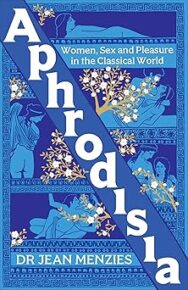
In Aphrodisia, Jean Menzies dives into the hidden history of women’s sexuality in Ancient Greece and Rome. Delving into the literature, art and artefacts of the ancient world, from sex toys to seduction tips to kink, the book centres women, their lives, and their desire. We asked Jean to tell us more about her fascination with the ancient world.
Aphrodisia: Women, Sex & Pleasure in the Classical World
By Dr Jean Menzies
Published by Monoray
Congratulations on your new book, Aphrodisia: Women, Sex and Pleasure in the Classical World. Why did you want to write this book?
Thank you so much! It feels like a long time coming. Some version of this book has been brewing in my mind for years now so I’m glad I was finally able to write it. I spent almost seven years studying for my PhD part time and my focus was on the way in which sexual violence against women was used as a rhetorical tool by political speech makers in democratic Athens. It was an incredibly worthy subject and I’m very proud of the work I did but it was also hard. Not just in terms of ‘doing a PhD is hard’, but constantly researching and writing about the sexual violence perpetrated against other women is hard. It’s impossible not to link it to the modern world and your own experiences as a woman. One of the escapes I found during this time, however, was romance literature. There I found depictions of positive relationships that centred women’s pleasure and I have to give those books some credit here. I went through my own transformation, becoming more comfortable with my own sexuality in my 20s, while i was also researching for my PhD. All of which made me more curious, even determined, to seek out the history of women’s pleasure. To look at how women viewed and approached their own desires, their own bodies, and their own sexuality, not how others did.
In a contemporary world beset by political and moral outrages, why do you think it is important to explore pleasure?
It’s a super interesting time to have written a book like this. We simultaneously seem to have more sexual freedom than ever before, while there has also been a rise in purity culture. It feels like we’re living in a constant push and pull between embracing sexual pleasure, and shaming people for experiencing something completely natural. Sex toys are easily accessible and romance books are selling like hot cakes yet every third post on social media seems to be calling women porn addicts for enjoying a sex scene in their literature. Obviously I fall on the more sex positive side of things. And so far I’m super lucky that the response to Aphrodisia has been positive too. Well, minus the one commenter on Instagram who claimed women only care about history if it’s about sex when I announced my book… I do expect detractors but they are also why I think this book is especially important. What writing Aphrodisia enforced for me is that sex is a part of life, but so too is pleasure. We have always had sex, and we have always sought out pleasure. As women in particularly, I think there is something incredibly empowering about embracing ourselves as sexual beings in a world that so often treats us as sexual objects. Our sexuality is our own and so to is our pleasure.
What do you think the study of antiquity gives to modern readers?
I love ancient history but I don’t think it’s unique, in that I genuinely believe all of history is incredibly important. The more we learn about our past, where we went right, where we went wrong, what has changed, the ups and downs, the more we understand the world we live in today and also where we might go next. On a personal level though, I am always blown away by the way individuals are able to connect with and find solace in the ancient world. A few years ago I wrote a short non-fiction book called All the Violet Tiaras, which is about the way in which modern LGBTQIA+ readers and writers explore their experiences and identifies through reimagining Greek Mythology and it felt incredibly powerful. We learn from history but we also find connection through history. To the past and to our present.
How did your enthusiasm for the classical world begin?
At home, in the library, and with my dad. I think like most kids at comprehensive schools in Scotland, we never touched on ancient history or classics in class. When I went to the open day at Edinburgh University I didn’t even realise ancient history was called classics and originally rocked up to the history stand where they promptly explained the difference – aha! So, I was really introduced to the ancient world through the media I was consuming. I obsessively read Asterix comic books from the library, I had a bunch of DK Eyewitness books on the Pyramids and Ancient Rome, my dad used to take me to museums in Scotland and abroad, and I honestly just loved Xena: Warrior Princess. This combo was what then pushed me to that history stand at the Edinburgh university and to apply to study classics after that. I’m happy to say I’ve never looked back.
Which classical author do you recommend to beginners? Which classical author has brought you the most pleasure?
Good question! We are incredibly lucky to have such a wealth of literature from both Ancient Greece and Rome; there really is a hundred options depending on what someone is most interested in. Philosophy? Check out Plato’s Symposium. History? Check out Suetonius’ The Lives of the Caesars. Poetry? I don’t think I can choose between Sappho or Homer – haha. But if I were to pick one book, one that I think makes for a fun accessible starting point as well as one that has brought me a lot of pleasure, it would be Daphnis and Chloe by Longus. This is one of the earliest examples of a fictional story written in prose – an Ancient Greek romance novel essentially. It’s funny, clever, and short. It can be enjoyed as a quick easy read or you can get academic about it and do a deep dive on its history and the history of its genre which will give you a whole new lens to appreciate it from.
Your first fantasy novel, The Lady of the Lake, has just been released in paperback too. Could you tell us how you approach writing fiction? How did you enjoy writing your first novel?
I adored it. I’ve wanted to write fiction since I was a child, scribbling in W H Smith notebooks my grannies bought me. The Lady of the Lake was a dream come true; it was also the perfect post PhD escape. I’d just graduated when I sat down to write The Lady of the Lake and it was like being woken up from the post-PhD malaise. I got to exercise my muscles as historian and researcher, immersing myself in Arthurian literature and medieval texts. I got to explore these stories from a female perspective as well as writing a sapphic romance plot line that made my bisexual heart sing. I also feel honoured that I was able to publish something that brought other people the joy reading fiction does for me.
How does your love for fantasy intersect with your love for ancient history?
I am a lover of most genres if I’m honest. Horror, romance, historical, sci-fi, mystery, but fantasy was definitly my first love. It’s a truly transportive genre. And even though it’s probably the farthest removed from reality in some ways, writing fantasy isn’t that different from writing about history. It requires a lot of research and planning and a lot of fantasy finds inspiration in historical periods or mythologies. In fact, isn’t fantasy just building on a long history of folklore and fairy tales? Using seemingly far-fetched tales to explore human experiences and the world we live in? I definitely find inspiration for my own work in these stories. I’m even working on a fantasy novel inspired by one of my favourite Scottish folk tales right now: Tam Lin.
What has been your favourite book you’ve read this year?
Can I pick a piece of fiction and non-fiction? If so, I think the best novel I’ve read this year was either Cleopatra by Saara El-Arifi or Paladin’s Grace by T. Kingfisher. For non-fiction, meanwhile, I can’t stop thinking about Minority Rule by Ash Sarker. It’s brilliant. Sorry, that was three wasn’t it…
Aphrodisia: Women, Sex & Pleasure in the Classical World by Dr Jean Menzies is published by Monoray, priced £19.99.
RELATED BOOKS
ALSO IN THIS ISSUE


 Cast Away by Francesca de Tores
‘And as he passes me, I get a true sense of his size – twice my length, he is as thick as a forty- t …
ALSO ON BOOKS FROM SCOTLAND
-


The Scottish Colourists: Art & Life by Alice Strang
‘Together the quartet embodied a new spirit in Scottish art and they are celebrated as Scotland’s le …
-

David Robinson Reviews: Our Noble Selves by Kate Atkinson
‘As I suggested at the start, there’s a whole heap of plot in Our Noble Selves – spies, murders, and …
-
‘They had spoken perhaps ten sentences each and it had already begun. Moira’s resentments, her preju …
-

Ayont the Thistle by Jim Mackintosh, Alan Riach and James Robertson
‘Nane ae this then but – ma hert daen its hing/ an yon wee smile ae yours in the saft smir ae the ga …
-

David Robinson Reviews: This Door of the Seas
‘He sees what he wants to. And it makes a kind of sense too – especially to colonists from Scotland, …
-

The Broons and Oor Wullie Celebrate their 90th Birthdays!
‘Whatever the future may hold, we can be sure that The Broons and Oor Wullie will always be a part o …
FEATURED AUTHOR:
Sylvia Hehir

Sylvia was awarded a doctorate in creative writing from University of Glasgow in 2018 and is a former recipient of a Scottish Book Trust New Writer Award. Her debut YA thriller, Sea Change, published by Stirling Publishing 2019, was winner of the Pitlo …
FEATURED PUBLISHER:
Ringwood Publishing
Ringwood Publishing is a small independent Scottish Publisher, based in Glasgow, dedicated to publishing quality works of Scottish fiction and non-fiction around the key national themes of politics, football, religion, money, sex and crime. Submissions …