


EXPLORE ISSUES



‘It begins with Jack Parlabane locked in a state room with a body: not only is he covered in the dead man’s blood, but the corpse is liberally soused with his too. In terms of DNA, it’s as big a slam dunk as you can get.’
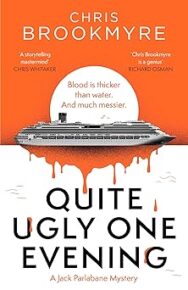
Thirty years after introducing Jack Parlabane to readers, Chris Brookmyre returns to his most iconic character in Quite Ugly One Evening, a sharp and darkly comic locked-room mystery set at sea. In this Q&A, Brookmyre reflects on revisiting Parlabane, and the ideas behind the novel.
Quite Ugly one Evening
By Chris Brookmyre
Published by Abacus
Hello Chris and well done on another brilliant novel. What can you tell us about Quite Ugly One Evening?
Quite Ugly One Evening is a locked-room mystery set on board a transatlantic cruise liner that may or may not bear a resemblance to the Queen Mary 2. It begins with Jack Parlabane locked in a state room with a body: not only is he covered in the dead man’s blood, but the corpse is liberally soused with his too. In terms of DNA, it’s as big a slam dunk as you can get. Parlabane has until the ship reaches New York to find out who really did it, but first of all, he has to get out of that locked stateroom.
Why did you decide to bring back Jack Parlabane? Have you missed writing him?
I realised that the summer of 2026 would mark thirty years since the publication of Quite Ugly One Morning, which got me thinking about Parlabane again. I decided that if I’m writing about him, I need to lean into the time that has passed, so I have him staring down the barrel of Sixty, and contemplating what he has done with his life. It is not a pretty sight. He has a failed marriage and is largely alienated from his family, realising he has given the best years of his life to his career, and that a job doesn’t love you back. I had never written about his family background before, deliberately so, because thematically it never fitted and would have been a distraction. However, this time, family is at the heart of the story. This is ultimately a warm-hearted novel about what brings us together, what we have in common, and what truly matters in a world where people are manipulated by billionaires and politicians using culture wars to drive us apart.
You’ve created a fantastic premise too. How did you come upon setting the story on a convention on a cruise ship?
My wife Marisa Haetzman and I were invited on board the Cheltenham Literature Festival at Sea in 2024. It was by some distance, the cushiest perk either of us has ever had in our careers: a week travelling from Southampton to New York on the Queen Mary 2 and being paid to do it.
We were booked to do this more than eighteen months in advance of the sailing, so I had a long time to think about it. I’ve never been a big fan of ships, and for all it sounded glamorous, the prospect of being trapped for seven days with thousands of people was something that did prey on my mind. Inevitably, that led to me having story ideas. I thought, I tend to treat Jack Parlabane fairly badly. Why don’t I chuck him in there? And then I thought, how do I make it the worst scenario possible? The great thing about the Literature Festival At Sea was that you got to hang around with friends, fellow authors, and spend the days watching brilliant literary events, the perfect entertainment programme. So I wondered, what would be the opposite? What would Parlabane absolutely detest being stuck in the middle of.
I was also thinking I wanted to make the book about the culture wars. I thought there seemed to be no bottom to the absurdity of the things right-wing grifters would seize upon to create social divisions that they could exploit and monetise. I thought, what is the daftest thing I can come up with that might plausibly be the next front in the culture war. I dreamt up the notion of The Imaginators, a 1960s children’s puppet show that has enjoyed a revival in its popularity, but with accompanying question marks over its dated values and problematic content. And so the anti-woke crusaders cry persecution and travesty over a proposed reboot of the programme that will update the show to make it more palatable to modern values. Thus Parlabane finds himself on a ship with hundreds of people who are on board for a week-long convention dedicated to The Imaginators, as well as the wealthy descendants of the program’s originators who have been living off the royalties ever since.
Parlabane is therefore surrounded by people who take this programme way too seriously, as well as by people who are pretending to take it way too seriously for their own political agendas.
Fandom is an excellent context for crime writing with its intriguing mixture of devotion to and hyper-knowledge of someone/something. What are your thoughts on being a fan? Have you ever been an obsessive fan of anything?
I’ve been a fairly obsessive fan of many things, most prominently St Mirren Football Club, but we don’t tend to examine sports fandom in quite the same way, because there’s a reality on the other side of it: whether you judge it meaningful or not, football matches are real-world events. Cultural fandoms sometimes become problematic because they blur the lines between fiction and reality. Or rather, the fans know it’s fiction, but some develop a sense of entitlement about what that fiction ought to be.
In my time I have been a fairly obsessive fan of Firefly and Buffy the Vampire Slayer, both creations of the now rather problematic Joss Whedon, which leaves you with the question of divorcing the art from its creator.
What’s your relationship with your readers? Has being part of the Fun Lovin’ Crime Writers changed how your readers see you?
My relationship with my readers remains a source of great pride and satisfaction. The fact that it’s thirty years since I started, and that I continue to have people who read every book is a source of amazement to me. I do get off on the fact that as soon as I announce a new Parlabane, there seems to be a terrific reaction, people eager to see where I’ll take him next. I’m fortunate in that I’ve never suffered that sense of entitlement in the feedback, of people saying what they thought Parlabane should have done or how he should have reacted. I’m sure many readers have strong opinions on what I’ve done with him, but they’ve been polite enough not to share them with me.
I’ve no idea how being part of the Fun Lovin’ Crime Writers has changed my readers’ perception of me. I know I’ve never been afraid to make an arse of myself in the name of promoting my work or even just having fun. I’ve always taken my work seriously, but I’ve never taken myself too seriously, and I think that’s true of all six of us in the band, which is why we’re happy to get up on stage and have the time of our lives, not really caring what anybody thinks.
How do you stay motivated as a writer and storyteller?
I think stories tend to find me, often when I don’t expect them, and they become like a burr under the saddle, so I can’t rest until they’re written. I can imagine myself slowing down but never retiring. There’s always going to be another story to tell, another of those burrs under the saddle.
What have you been reading lately? What has been your favourite recent Scottish book?
Most recently I read Loose Threads by Martin Stewart, the second of his Robbie Gould novels, which I think was even better than his debut, Double Proof. But the best Scottish book I’ve read in a long time was A Bad, Bad Place by Francis Crawford. It’s a coming-of-age story set in Glasgow in 1979, about a twelve-year-old orphan who lives with her grandmother and who is the unfortunate discoverer of a horrific murder. It is a book that is warm without being sentimental, authentic in its depiction of the Glasgow of the time and hugely involving in conveying the enthusiasms, hopes and fears of its young protagonist.
Quite Ugly One Evening by Chris Brookmyre is published by Abacus, priced £22.00.
RELATED BOOKS
ALSO IN THIS ISSUE

 Awake Awake by Fiona Mozley
‘There were no hallucinations. No voices, at least, not in the here and now. Only memories.’
 Enter Eddie Shakespeare: A Q & A with Barbara Henderson
‘Being human hasn’t changed. We still have the same concerns: we seek love, meaning, recognition. Ou …
ALSO ON BOOKS FROM SCOTLAND
-


The Scottish Colourists: Art & Life by Alice Strang
‘Together the quartet embodied a new spirit in Scottish art and they are celebrated as Scotland’s le …
-

David Robinson Reviews: Our Noble Selves by Kate Atkinson
‘As I suggested at the start, there’s a whole heap of plot in Our Noble Selves – spies, murders, and …
-

‘They had spoken perhaps ten sentences each and it had already begun. Moira’s resentments, her preju …
-

Ayont the Thistle by Jim Mackintosh, Alan Riach and James Robertson
‘Nane ae this then but – ma hert daen its hing/ an yon wee smile ae yours in the saft smir ae the ga …
-

David Robinson Reviews: This Door of the Seas
‘He sees what he wants to. And it makes a kind of sense too – especially to colonists from Scotland, …
-

The Broons and Oor Wullie Celebrate their 90th Birthdays!
‘Whatever the future may hold, we can be sure that The Broons and Oor Wullie will always be a part o …
FEATURED AUTHOR:
Iain Maloney

Iain Maloney is the author of eight books, including the critically acclaimed The Only Gaijin in the Village (Birlinn, 2020), a memoir about his life in rural Japan. He is also a freelance editor and journalist, mainly for The Japan Times. He was born …
FEATURED PUBLISHER:
Studies in Photography

Studies in Photography is the trading name of the Scottish Society for the History of Photography. It is developing two complementary book series in partnership with Edinburgh University Press. Visual Arts and Culture: Thematic Studies The first …