


EXPLORE ISSUES

‘Water and land are not separate, nor are they two sides of the same coin, but more profoundly intertwined. They are the blood and bone of the earth.’
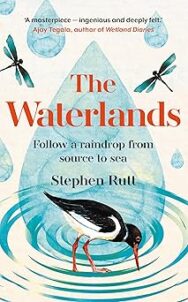
From the award-winning author of The Seafarers and Wintering comes an utterly original and compelling exploration of the most miraculous substance on Earth: water. In this extract, Stephen Rutt reflects on an early childhood accident that left him unable to swim, yet deeply drawn to water throughout his life.
The Waterlands
By Stephen Rutt
Published by Elliott & Thompson Ltd
When I was two years old, I fell into a river.
It was my mother’s birthday. We were walking through Cambridge and I saw a flower growing out of the bank of the River Cam. In the family story, I wanted to pick it for her. Before my parents could react, I had pitched through the overhanging bank, into the river, cheated by land that wasn’t solid. For a moment all was dumb – the absolute suddenness of surprise cold water – and I remember the light of the sky and the feel of the water and then being heaved out by my frantic father, sodden and shivering with shock.
It is one of my earliest memories.
It would be cheap to say that is why I can’t swim. But I can’t swim, and not for want of trying. I merely thrash about with unsynchronised limbs, chlorinated pool water stinging; feeling the shame of my body, the shame of being the worst in school; never able to take that step of faith into the deep end. It is as alien to me as dancing. In the shallow North Sea I can wade for a distance up to my knees before the anxiety rises. At midriff I have to stop. Cold water grasps with a tight grip. It makes me gasp and suck at air that feels like the asthma attacks that plagued my childhood. I fight breathlessness as I stumble back to a warm beach. My attitude is like the fisherman of folklore who thought it was bad luck to learn to swim; or like Gavin Maxwell, another non-swimmer, who thought the Mesopotamian marshes ‘as good a place to drown as any other’.
My daughter, a toddler, has been in a swimming pool more times in the first two years of her life than I have in the last twenty years of mine.
And yet: water holds me. Water holds my mind and my heart. I am drawn to be near it. To walk beside the river, to seek out the loch on the map and catch a glimpse of it through tree trunks, the ground a mirror of the sky. I learned to birdwatch by wetlands, holidayed by lakes. Popular anthropology suggests that we are apes who evolved to be near water. The first records we have of life on Earth – nearly 4 billion years ago – are bacteria that were laid down in shallow seas and are readable in rocks.
Water is life. The cells in your body – in all bodies – rely on water to work, to hold their structure and use oxygen. Everything on Earth requires water to live. All life beyond Earth probably relies on water to live. At least we think so: when we scope the far corners of our galaxy, our satellites spinning through space are searching for the signs of water. We don’t know how it is that Earth stands alone in the vastness of space as the only wet planet – perhaps some miracles are destined to be unexplained – but we do know it is essential. Every glass of clear fresh water that we pour from our kitchen taps is an example of a miracle that sustains and explains life on Earth. We can’t conceive of life existing without water as its animating magic. The science writer Alok Jha puts it this way: ‘Every living thing is simply a different inflection of water; a deviation of a few per cent from purity.’
I have forgiven land for the trick it played on me as a toddler. But I now walk carefully towards riverbanks, holding my daughter’s hand tightly, aware that the ground might not be so solid. I stop at the boundaries of the marsh, where the surface can be quicksilver and self-willed; happy to wait by the lapping of the lochshore while others swim. While they let their bodies be held by water, I am happy to let it hold my mind.
*
In Belonging bell hooks wrote, ‘The idea of place, where we belong, is a constant subject for many of us.’ Water, one of my constant subjects, draws me deeper. It is not a place, but one of the building blocks of the many types of wetland; they vary depending on the water – its motion, its chemistry, its interaction with a location. Water has a profound effect on the landscape, shaping its appearance, the nature it holds, how we interact with and respond to it. Its subtle variations give light and shade to a place. Rather than tying me to a location, it allows me to travel, taking my fascination with habitat with me. There is water (almost) everywhere. It joins land to sea and sky; life to rock; past to present; climate to weather.
A wetland simply means a habitat where the land is flooded by water regularly. Ramsar, the international convention on wetland conservation, classifies them as places of water no deeper than six metres at low tide. Wetlands are normally categorised not by the water but by the type of vegetation that grows with it. I’m no botanist, so I’d rather define it by the play of water and land, and the permeable border between the two.
Water and land are not separate, nor are they two sides of the same coin, but more profoundly intertwined. They are the blood and bone of the earth. So I call them waterlands, partly as a nod to the Graham Swift novel and partly because a looser definition better fits the unfixed nature of water. Any place where water and land join together is where an alchemical sort of magic occurs. Life blossoms out of the mix of rock and mud and water; the sort of ever-shifting, ever-changing kind of life. Heraclitus, in 500 bce, is supposed to have said, ‘No man ever steps in the same river twice.’ Or as Mr Crick, the narrator of Swift’s Waterland has it, when he describes the process of silt in the fenland rivers, it ‘shapes and undermines . . . demolishes and builds . . . is simultaneously accretion and erosion; neither progress’. In the waterlands, change is a given: things are always in a state of flux and flow, always being done and undone at the same time; as liquid, water performs a give and take with land, scrubbing away at riverbanks and building marshes. Water is never still, even in a lake; it is withdrawn and deposited elsewhere, the water cycle feeding and refreshing the waterlands.
The Waterlands by Stephen Rutt is published by Elliott & Thompson Ltd, priced at £16.99
RELATED BOOKS
ALSO IN THIS ISSUE


 Enter Eddie Shakespeare: A Q & A with Barbara Henderson
‘Being human hasn’t changed. We still have the same concerns: we seek love, meaning, recognition. Ou …
ALSO ON BOOKS FROM SCOTLAND
-

The Scottish Colourists: Art & Life by Alice Strang
‘Together the quartet embodied a new spirit in Scottish art and they are celebrated as Scotland’s le …
-
David Robinson Reviews: Our Noble Selves by Kate Atkinson
‘As I suggested at the start, there’s a whole heap of plot in Our Noble Selves – spies, murders, and …
-
‘They had spoken perhaps ten sentences each and it had already begun. Moira’s resentments, her preju …
-

Ayont the Thistle by Jim Mackintosh, Alan Riach and James Robertson
‘Nane ae this then but – ma hert daen its hing/ an yon wee smile ae yours in the saft smir ae the ga …
-

David Robinson Reviews: This Door of the Seas
‘He sees what he wants to. And it makes a kind of sense too – especially to colonists from Scotland, …
-

The Broons and Oor Wullie Celebrate their 90th Birthdays!
‘Whatever the future may hold, we can be sure that The Broons and Oor Wullie will always be a part o …
FEATURED AUTHOR:
Allan Gaw

Allan Gaw studied medicine at Glasgow University and trained as a pathologist. Having worked in the NHS and universities in the UK and the US, he took early retirement and now devotes his time to writing. His published non-fiction works include medical …
FEATURED PUBLISHER:
Forest Research

Forest Research is Great Britain’s principal organisation for forestry and tree related research and it provides evidence and scientific services to support sustainable forest management. The Agency publishes a wide range of information in support of s …