


EXPLORE ISSUES



‘McLeod uses these moments to great comic effect, while also showcasing the class tensions and ingrained behaviours that underpin the time.’
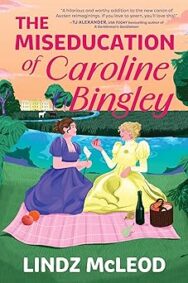
Chantelle Streete finds that Lindz McLeod’s The Miseducation of Caroline Bingley, is every bit as entertaining and sharp a romance as the tale she seeks to celebrate.
The Miseducation of Caroline Bingley
By Lindz McLeod
Published by Carina Adores
What becomes of a Regency woman who has always been told she is too sharp-tongued, too forthright, and too unkind? That’s what Lindz McLeod seeks to investigate in her second Austentatious novel, The Miseducation of Caroline Bingley. Reimagining one of Pride and Prejudice’s most infamous secondary characters, McLeod places Bingley at the heart of a sapphic Regency romance that has just as much pride and prejudice in it as its source material.
The novel takes place almost immediately after Pride and Prejudice ends, with Caroline’s dissatisfaction over Mr Darcy’s decision to marry Miss Elizabeth Bennet over her. Seeking an explanation, Caroline confronts Mr Darcy, and he responds with what is, in effect, an itemised list of Caroline’s shortcomings. Among other reasons, he considers her to be vain, arrogant and suffering from a massive superiority complex. Most damningly, he tells her that if she continues as she is, she will never find a husband, and like many women of the Regency era, Caroline has always assumed that marriage is the ultimate goal and measure of success.
Determined to secure both a husband and a better reputation, Caroline embarks on what she dubs her ‘Great Endeavour’: a mission to become the kind of woman society finds agreeable.
Enter Georgina Darcy, Mr Darcy’s younger sister and the very model of refinement. Yet we come to learn that Georgina, too, exists under the weight of expectation. Outwardly, she is everything Caroline believes she must become (graceful, composed, and admired by every eligible bachelor in town) but this apparent perfection comes at a cost. Georgina has spent much of her life shaping herself around the expectations of others, particularly her brother, and suppressing her own wants in favour of what she should do. As she later confesses, she is ‘so tired… of being perceived as faultless.’ Where Caroline is criticised for saying too much, Georgina has been conditioned to say too little.
We then follow the pair through the trials and small triumphs of the ‘Great Endeavour’. Caroline’s attempts at self-improvement are often hilariously disastrous. She unintentionally terrifies a housekeeper by simply saying ‘good morning’, prompting Georgina to remark, ‘Yes, that would have done it. You’ve never said good morning to any of the staff before.’ McLeod uses these moments to great comic effect, while also showcasing the class tensions and ingrained behaviours that underpin the time.
The novel finds its real strength in the dynamic between Caroline and Georgina. Through their companionship, McLeod explores what it means to be a young woman that doesn’t adhere to society’s standards. Together, Caroline and Georgina question the rigid expectations that have always been placed upon them, and what kind of future they are permitted to imagine. The ‘Great Endeavour’, rather than teaching the girls how to navigate their space properly causes them to question these expectations, to reconcile who they are with who they have been taught to be. This reversing of expectations is reinforced where McLeod introduces new characters who broaden the social landscape beyond the Darcy estate. When Caroline (to her immediate horror) is confronted with those of lower status, and discovers that they too are amiable company, she’s again forced to confront her prejudices and dismantle what she has been raised to believe.
Caroline and Georgina’s relationship begins to shift, marked by lingering glances and a growing sense of ease in each other’s company. Georgina is more experienced than Caroline when it comes to exploring her sexuality, and Caroline doesn’t fully understand at first that she is experiencing attraction. McLeod handles this progression with care, allowing their feelings to emerge naturally from the trust they build, rather than forcing a sudden transformation.
Alongside their growing affection for each other comes an increasing awareness of the risks they face. The fear of discovery and the shame it would bring upon themselves and their families casts an ever-growing shadow over their relationship. Caroline questions why nothing ‘sparks’ when she imagines a conventional match, fearing that ‘something was wrong with her,’ while Georgina continues to carry the exhausting burden of perfection, knowing that she is ‘unable to make mistakes like a normal person, for the consequences of a fall from grace would be twice as hard.’ Yet, the two gain courage to imagine a different kind of life.
McLeod balances this emotional development with sharp and witty prose. Her writing is often laugh-out-loud funny, while still retaining the elegance of its Regency setting. She places the reader in familiar social situations (calls, visits, long walks, picnics) and infuses them with humour that transcends the time between the characters and the readers. McLeod also has a remarkable talent for crafting striking sentences, such as ‘Caroline opened her mouth to retort, found she had nothing loaded on the gun of her tongue, and closed it again with an audible snap of her teeth.’
The Miseducation of Caroline Bingley is a thoughtful, witty, and quietly subversive exploration of identity, expectation, and companionship. McLeod has fun with Regency mores, and her love and care for Austen’s characters is obvious, and a wonderful compliment.
The Miseducation of Caroline Bingley by Lindz McLeod is published by Carina Adores, priced £10.99.
RELATED BOOKS
ALSO IN THIS ISSUE


 Abyss by Nicholas Binge
‘There is only Joe, and this man, who looks like he’s been waiting for him.’
ALSO ON BOOKS FROM SCOTLAND
-


The Scottish Colourists: Art & Life by Alice Strang
‘Together the quartet embodied a new spirit in Scottish art and they are celebrated as Scotland’s le …
-

David Robinson Reviews: Our Noble Selves by Kate Atkinson
‘As I suggested at the start, there’s a whole heap of plot in Our Noble Selves – spies, murders, and …
-

‘They had spoken perhaps ten sentences each and it had already begun. Moira’s resentments, her preju …
-

Ayont the Thistle by Jim Mackintosh, Alan Riach and James Robertson
‘Nane ae this then but – ma hert daen its hing/ an yon wee smile ae yours in the saft smir ae the ga …
-

David Robinson Reviews: This Door of the Seas
‘He sees what he wants to. And it makes a kind of sense too – especially to colonists from Scotland, …
-

The Broons and Oor Wullie Celebrate their 90th Birthdays!
‘Whatever the future may hold, we can be sure that The Broons and Oor Wullie will always be a part o …
FEATURED AUTHOR:
Mairi Kidd

Mairi Kidd is the Director of The Saltire Society. She leads on delivery of the Society’s programmes championing the arts and culture of Scotland. She has previously worked at Creative Scotland providing strategic leadership for literature, languages a …
FEATURED PUBLISHER:
404 Ink

404 Ink is an alternative book publisher based in Edinburgh. Established in mid 2016 we sought to provide an alternative literary programme for the Scottish reader market and beyond by publishing unusual fiction, non-fiction, poetry and comics in Engli …