


EXPLORE ISSUES

‘The pain is real because the love of place is real.’
David Robinson finds the common ground with Kapka Kassabova’s latest book, Borrowed Land: A Highland Story, with her backlist books set in the Balkans.
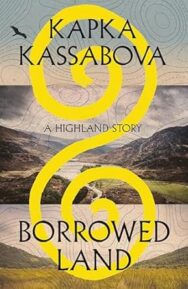
Borrowed Land: A Highland Story
By Kapka Kassabova
Published by Jonathan Cape
Kassabova’s writing isn’t about visible geography as much as it is about invisibilities of place – history, folklore, culture, and everything else that links people with the land on which they live. In some parts of the planet – that part of southern Bulgaria she explored in her 2023 book Elixir, for example – the bond between humans and nature still exists. ‘People in the Mesa basin knew suffering,’ she wrote, ‘but they had something precious – the forest. Everything was still connected – peaks, people, plants.’
When she left her home in the Highlands to research Elixir in 2000, it wasn’t clear that you could say the same thing about Scotland. In 2011, when she moved from Edinburgh to live by the Beauly River with her partner Tony, it had seemed paradisical. Within a few years, all that had changed. A gravel quarry near their cottage was rapidly expanding and Scotland’s largest power substation right next to it was about to come online. That meant pylons marching across the mixed forest they loved to walk in. A large swathe of it was felled in the first spring of the pandemic, and more followed.
As she explained at the start of Elixir, the noise of that quarry, the hum of the electricity wires, and the destruction of nature all around her, made her long to get away. Southern Bulgaria – her native land after all, though she was born and raised in Sofia – beckoned. She needed to find out more about its herbal remedies, folk medicine and the healing power of nature. An elixir is a cure, and Scotland had left her needing one.
And so to Kassabova’s new book, Borrowed Land. As before, it opens with a map. As before, there are places on it that we may know: Glen Affric, Glen Strathglass, Glen Strathfarrar, and Struy, where their rivers meet. East of Struy, though, she opts for English translations of Gaelic – Talorgan’s Village, River of the Monks, The Monks’ Place, The Crossing Place etc. These are the places that mean or meant most to her, and only at the end of the book does she give their names by which most of us would recognise them.
The map on the book’s opening pages is different to those in the Balkan Quartet in one important way. Its legend, or key, is divided into two sections. The first is labelled ‘The Land’, and on it we see the Caledonian woods of Glen Affric, drovers’ roads (the only ones marked), a fair scattering of stone circle remains, burial cairns, hill forts, and all the villages, castles, and peaks. There’s also a symbol for nature reserves, although I can only find one: maybe that’s the point.
The second part of the map symbol key is marked ‘Industry’, and this is where the 20th century- and particularly the 21st – comes in. Here, drawn as straight and wide as motorways, are the hydro tunnels blasted through the mountains between the 1940s and 1960s – the 9km one from Loch Morar, the 6.4km one to Loch Millardoch, the 5km one from Loch Affric, along with the dams and accompanying power stations. Here too are the planned power stations and battery energy storage system, various switching or converter stations and all the wind farms that feed into them. Next to the turbine symbol is a small number showing how many turbines (up to 230m in height) there are. The numbers are vast.
That two-page map poses the question that lies at the heart of Borrowed Land. Can all this industry be placed on some of Scotland’s most scenic landscape without ruining it for future generations? Given that Kassabova takes her book’s title from the North American saying ‘We don’t inherit the land from our ancestors; we borrow it from our children’, her answer is obvious. We might be decarbonising the grid, she argues, but we are ruining the land in the process.
The latest tranche of what she calls ‘wastelanding’ began with the Beaulieu-Denny line and the mass of speculative wind farms built that same decade at a cost of 17 million felled trees on public land alone. But the ‘extractive mindset’ spread like a disease. Their neighbouring forest, a model of woodland diversity where 150 species used to live, was cut down in nesting time, its Pictish cairns destroyed, to clear the war for a bigger quarry. They thought about moving to a croft near prehistoric hill forts above the valley but it was bought by a developer who started another quarry. Power started flowing through the pylon-supported wired over their cottage, humming ‘like permanent tinnitus’. Transmission amped up to 235 volts. For the first time ever, Kassabova started having migraines, along with feelings of vertigo, and of wasting fatigue.
The pain is real because the love of place is real. Kassabova dedicates her book to ‘mo ghleann’ – my glen – (in Gaelic, she emphasises, an expression of affection rather than possession). Those personalised places on the map are where she has chosen to live, to buy her first house, to explore and understand. There was something about the glens that she could identify with, that reminded her of Bulgaria; the Cailleach of the Highlands wasn’t so different from the Baba of the Balkans, the people she met in the glens not too dissimilar to those of the Bulgarian highlands. True, the deracination of the Highlands went deeper because it had happened a full two centuries before it did in Bulgaria when entire populations were cleared from the land under Communism and forced to work in the towns. Landlordism, depopulation, property speculation – even, she insists, colonialism – have shaken the old bonds between the land and people. But they are, she insists, still there.
Her faith in that is deeper than my own, indeed it verges on the mystical, as when she imagines the last big drove of sheep between Cannich and Affric back in 1966, or Ronnie Burn, the first Munroist, striding over the hills from Kintail, or all the other stories she has heard about the long-ago people who lived in the glens loves, stretching right back to the 13th century monks who settled in what she calls Monks’ Place and we call Beaulieu or the Pictish Christians saint Talorgan (he of Talorgan’s Village on Kassabova’s map but Kiltarity on most others) before that.
She doesn’t, I think, need to go so far back. To my mind, the real value of her book is the way she gives a voice to those who continue to break that disconnect with nature. Many of them live off grid, like the family with a horse trekking business near Loch Affric, a woodsman near AIgas who uses an axe, not a chainsaw to fell trees, or man who lives in a shack near Beauly (‘I am the first person who has ever stopped to talk to him’) who tells her about his father’s life working on the post-war hydro schemes and sawmills. In such interviews as these, or ones with the ghillies, gatekeepers or under stalkers who tell her the secrets of her glen, she captures its essence perfectly.
It would have been easy for Kassabova to write a book with a wider focus. True, Beaulieu is a key hub on the Scottish network, with lines radiating north south, east and west from a power station planned for nearby Fanellan which will take up as much land as Glasgow Airport, but the energy infrastructure is being built on a scale we have never seen before. The 107-mile line skirting the east coast from Wick to Beauly via the peat bogs of the Flow Country is just one of them. Whether you think all of this is a necessary part of fighting climate change and securing energy independence or follow Kassabova in calling it ‘a ecological Culloden’, the battle has only just started.
Here’s an extract from Borrowed Land too:
Iain lives in the woods in a self-built house so fairie-like it has become a tourist attraction. Iain too is an attraction, with his hobbit looks, kilt with sporran and feathered beret. In summer, visitors drop in on their way to the falls, to see the woodsman and his creations. In winter, neighbours come to check up on him.
Radio music blasts from the shed. We admire his sun- struck garden that backs onto the dark forest: his arched bridges over the pond, the lilac trees. Iain comes out and smiles a practised smile. He is in wellies.
‘This is a catenary bridge. From Latin catena. How did the Romans make bridges? Inverted catenary. And the meaning of catenary?’ He tests us.
‘Padlock,’ I say.
‘Very good. Chain. Havenae seen you in a wee while,’ to Tony. ‘You look like Jesus these days.’
‘And you still look about eighty years old.’
Iain is pleased. He is ninety. Iain is known in the glen for giving his income to a family in Vietnam, his pension and any money that tourists leave in the post- box at the bottom of the driveway.
There’s no small talk because when I ask about Vietnam, he starts from the beginning. But soon we lose the thread of his story.
‘I was in a regiment. Then you join a battalion. I hated the army. The Korean War had just finished. Actually it never finished. It just stopped.’
The cuckoo clock goes off twelve times. He made it out of cherry wood. He made everything. Every door handle is a work of art. A table from red wood that shines like autumn.
‘Also called sequoia. Introduced from the United States by large estates. Hard wood is everything with leaves. Soft wood has needles. The best tree for building shelters is larch. That’s introduced too.’
His house is made from larch. Lots of things are traditionally made from larch. Wheelbarrows, horse carts, fishing boats, field posts, gates and cabins in the wood. Next to oak it’s number one for standing up to the weather. A set of rounded stools is made from yew and elm, with little drawers from sequoia. The stairs are oak. An ornate table from Caledonian pine.
‘I like beauty. I’m visual, like.’
He shows us the diamond stool, from sycamore, with diamond- shaped hollows inside the legs. It was made from cast-offs.
‘Ach, everything is made out of rubbish. I’m not clever, or strong, or lucky. Just curious.’
Something scurries in the roof: pine martens. They have moved in to keep him company while his girlfriend is away. The window frames are exquisite.
‘I knew these windows when they were a tree.’ All his lines are well rehearsed, but behind the hosting manner, there is pain and loss.
After Korea, Iain came back and set up a sawmill. A one- man organisation. He made good money. But he couldn’t stay put. In those days, you could buy a sailing ticket to Australia for £10. He told us that he spent a decade in Australia, had a child with a First Nations woman, then married another woman and had two more children with her. He worked as a builder and they moved from house to house, following his jobs. In his spare time he built their dream house. Later, it transpires that he fabricated two women out of one. His biography shifts all the time. The couple came back to the glen, back to the sawmill, and lived in a cabin. His wife went on walkabouts deep in the glen, but he didn’t tell us that, he only talked about himself. She’d walk out the door of the cabin with nothing but the clothes on her back and would be gone for two or three days. The odd person would see her and think she was lost, but she was getting to know the glen.
In his spare time he did up this place, which was then a roofless byre.
‘It was all temporary but I got carried away.’
The Australian house he’d built was on the edge of an Aboriginal reserve and they couldn’t sell it. They returned to Australia but became estranged, she sickened and died young, and once again he came back to the glen, and the children drop out of the story altogether.
‘You’re leaving already!’
Next time we visit, he has dressed for the occasion in full kilt regalia. He tells us about the time he and his friend the priest were walking along this road. It was around Samhain, the silent month of November.
‘The priest’s wife ran away with another priest. But that’s not the point.’
The point is, Iain and the priest were consoling themselves in the hotel bar and walking back along the road at twilight when a tall man appeared out of nowhere on the edge of the road. He looked at them. He was not of this reality, they could see through him – literally. Staggered, they watched him wade into the bracken and vanish.
‘Was he trying to tell us something?’
Or maybe he had popped into this reality to retrieve something. Like the truth. Since then, Iain always walks in the middle of the road and avoids the edges of things. Because the spirit world has its own ways.
Borrowed Land by Kapka Kassabova is published by Vintage, priced £22.
RELATED BOOKS
ALSO IN THIS ISSUE
 The Waterlands by Stephen Rutt
‘Water and land are not separate, nor are they two sides of the same coin, but more profoundly inter …
 Everything Everyday by Hannah Lavery
‘We will remember what we did. We will / be remembered for what we did not do.’
ALSO ON BOOKS FROM SCOTLAND
-

The Scottish Colourists: Art & Life by Alice Strang
‘Together the quartet embodied a new spirit in Scottish art and they are celebrated as Scotland’s le …
-
David Robinson Reviews: Our Noble Selves by Kate Atkinson
‘As I suggested at the start, there’s a whole heap of plot in Our Noble Selves – spies, murders, and …
-
‘They had spoken perhaps ten sentences each and it had already begun. Moira’s resentments, her preju …
-

Ayont the Thistle by Jim Mackintosh, Alan Riach and James Robertson
‘Nane ae this then but – ma hert daen its hing/ an yon wee smile ae yours in the saft smir ae the ga …
-

David Robinson Reviews: This Door of the Seas
‘He sees what he wants to. And it makes a kind of sense too – especially to colonists from Scotland, …
-

The Broons and Oor Wullie Celebrate their 90th Birthdays!
‘Whatever the future may hold, we can be sure that The Broons and Oor Wullie will always be a part o …
FEATURED AUTHOR:
Muriel Spark

Muriel Spark was the grande dame of Scottish letters. A prolific writer, she has produced over twenty novels as well as works of poetry, drama, biography, non-fiction and children’s stories. Spark was born Muriel Camberg in Edinburgh in 1918 and educat …
FEATURED PUBLISHER:
Royal Botanic Garden Edinburgh
The Royal Botanic Garden Edinburgh (RBGE) is a world renowned centre for plant research, conservation and education. Our four Gardens are also popular visitor attractions, offering fun and inspiring events for adults and children. The RBGE Publications …