


EXPLORE ISSUES



‘There were no hallucinations. No voices, at least, not in the here and now. Only memories.’
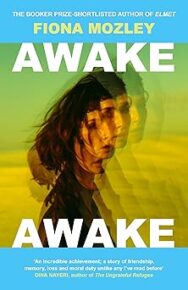
Mary is struggling with her memory. She does not have too few recollections but too many, including some that are downright absurd and seemingly impossible. In Awake Awake, we follow Mary as she goes over her life, trying to decipher fact from fiction. In this excerpt, we follow Mary recalling how she was first put in contact with her psychiatrist, Sita.
Awake Awake
By Fiona Mozley
Published by John Murray
The first time I met with Sita, she asked me about my earliest memory; my elemental impression of conscious ness. Her consulting room was dimly lit and smelled of incense. I’d originally been given her name, as far as I could recall, by one of the men who now claims to have no idea who I am, and when I told her this in my initial email, she expressed delight – he’s a significant figure, after all, and it was understandable that she would have been pleased to have been on his radar. Now that I’m slowly reconciling myself to the idea that I never in fact met him, I’m left to surmise that I must have spotted her name somewhere or other – possibly when researching psychoanalysts to help my younger brother, Jos – and it must have burbled up from somewhere in my brain.
I placed my hands on my knees, studied the ceiling and tried to answer her question. ‘My dad rowing a boat,’ I said. ‘I was standing on the beach, watching. He was out on the waves. It was rough. I remember it being rough. And I was scared for him.’
I tried to figure out where it was, and when. I guessed that I was perhaps three years old, but she reminded me that veracity wasn’t the point, and I studied the floor and the soft rug with its knotted vine-leaves.
We return to the image often. She asks about the fear I felt in that moment, and I find it difficult to respond. We interrogate the motif of the turbulent sea and why I was on the shore alone. One week it represents the deep unconscious with my tiny self unmoored. The next week it is a broken mirror.
In recent years, I have had difficulties with my memory. It began a couple of years ago, or rather, I began to be aware of it a couple of years ago. In truth, I think the problems commenced earlier, but just how much earlier I do not know. Although there was a catastrophe – a moment that we might usefully refer to as a breakdown – there was also a gradual accrual of uncertainty; a kind of fog that descended upon me over time, and the breakdown was as much a rapid dispersal of that fog as it was its most opaque point.
It was not a sickness of forgetting. I did not have too few memories, but too many. They came at me like du Maurier’s birds: one, then two, then abundantly. Memories of three discrete events, only fabricated. A psychic concoction. The details were astonishing, not only in their quantity but in their quality. The evidentiary layers; the scope. Each was furnished with familiar touchstones, or content upon which my mind could depend. There were incidents from real life – I mean, from my verifiable life – and from my family’s history, and these slotted together with the marvellous so adroitly that I can forgive myself for relinquishing control. The persons I remember were – indeed, are – as real to me as anyone else I have ever encountered. Yet – I am told – I never met any of them. They are likewise wraiths, who came to me with news. Recollections of their own. Fabulous tales.
It was Eric who suggested I contact a psychiatrist. At first I told him to sod off, but after a while I decided I would play along. I was careful with the memories, being always aware of their absurdity even as I was – as it were – living them. But he and I had always been so close – so proximate in our mental movements – that the words came. We spoke on the phone, he in New York City, of course; I in the other York, in the house I shared with a woman called Elizabeth who worked for an environmental charity and basically considered me to be a complete degenerate because I drank alcohol, had casual sex and didn’t recycle. Eric expressed concern, his voice quiet but firm. As I say, I resisted, then relented. He said he’d check in with me the next day, and the next. And so he did. Sometimes he’d message and sometimes he would phone.
I was guarded in what I told my GP. Knowing something of the psychiatric process (having experienced the system when my brother was ill), I made sure to convey just enough to get a referral, not so much that I would be admitted to a ward. Although pressed into action by my distant friend, I thought myself highly skilful in all of this, as if my efforts were coherent. In my presence, the GP wrote a letter to a psychiatrist called Dr Raymond Hoggett, relating what I had described, keeping intact my chosen words, thus burnishing my sense of agency. I informed Eric that I had an appointment, and went to speak to Amelia about it too at her house one evening after she’d wrangled Romy into bed. I couldn’t understand why she was so concerned. It was amazing to me that neither she nor Eric – both so intelligent – were able to comprehend the logic behind what I was telling them. It all fitted together so neatly, after all. Why couldn’t they see it?
Dr Hoggett’s office was in a hospital across town, a building with long corridors, low ceilings, hand- washing stations and works of art that were at once innocuous and ill at ease. He was handsome, Irish, in his forties. In a different context, I might have tried something, brought him home for the night and put up with the sharp looks from Elizabeth the next morning as I sent him on his way. But, as I say, that would be a different context.
He sat at his desk, turned occasionally towards his bright computer screen, listened and spoke. He was welcoming and lively and, in general, not at all what I had expected. I held back again, careful not to reveal too much, partly out of concern for his response, partly because I still believed. It seemed futile to give him the full story. Like Eric and Amelia, he seemed to think it all had something to do with ‘trauma’. With our recent bereavement. I agreed that it did, but not in the way they all thought.
Dr Hoggett prescribed Sertraline, which I’d been on before, and a mixture of Olanzapine and Aripiprazole, each of which was new. They were both anti- psychotics, although, as I explained to him, it wasn’t quite like that. It wasn’t quite like the illness I had witnessed in my brother, Jos. There were no hallucinations. No voices, at least, not in the here and now. Only memories. He told me he had never encountered a presentation quite like mine, which, I’ll admit, made me feel both special and unhinged. I have always enjoyed standing out from the crowd, but this enjoyment is generally accompanied by a flickering panic, as if difference might lead either to untold riches or to being singled out and shot.
He explained that the waiting list for psychotherapy was very long and asked if I had funds to pay for my own treatment. I told him that I didn’t. But that I would. That’s how I met Sita.
Awake Awake by Fiona Mozley is published by John Murray, priced £20.00.
RELATED BOOKS
ALSO IN THIS ISSUE

 Caledonia Screaming: Scottish Punk 1976 – 1977 by Grant McPhee
‘Punk didn’t need Scotland, but Scotland needed punk.’
 Awake Awake by Fiona Mozley
‘There were no hallucinations. No voices, at least, not in the here and now. Only memories.’
ALSO ON BOOKS FROM SCOTLAND
-


The Scottish Colourists: Art & Life by Alice Strang
‘Together the quartet embodied a new spirit in Scottish art and they are celebrated as Scotland’s le …
-

David Robinson Reviews: Our Noble Selves by Kate Atkinson
‘As I suggested at the start, there’s a whole heap of plot in Our Noble Selves – spies, murders, and …
-

‘They had spoken perhaps ten sentences each and it had already begun. Moira’s resentments, her preju …
-

Ayont the Thistle by Jim Mackintosh, Alan Riach and James Robertson
‘Nane ae this then but – ma hert daen its hing/ an yon wee smile ae yours in the saft smir ae the ga …
-

David Robinson Reviews: This Door of the Seas
‘He sees what he wants to. And it makes a kind of sense too – especially to colonists from Scotland, …
-

The Broons and Oor Wullie Celebrate their 90th Birthdays!
‘Whatever the future may hold, we can be sure that The Broons and Oor Wullie will always be a part o …
FEATURED AUTHOR:
David Torrance

David Torrance is a constitutional specialist at the House of Commons Library and a widely published historian of Scottish and UK politics. He has written unauthorised biographies of SNP politicians Alex Salmond and Nicola Sturgeon, as well as the biog …
FEATURED PUBLISHER:
Birlinn

Birlinn Ltd is an independent publishing house based in Edinburgh, Scotland. The company is built on traditions of the written and spoken word and is constantly looking to the future. Established by Hugh Andrew (2022 recipient of the Royal Scottish Geo …