


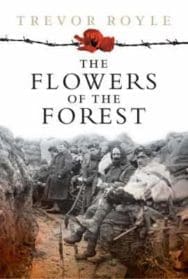
ABOUT THIS BOOK
PUBLISHER: Birlinn General
FORMAT: Hardback
ISBN: 9781843410300
RRP: £25.00
PAGES: 320
PUBLICATION DATE:
September 20, 2006
BUY THIS BOOK
As an Amazon Associate and Bookshop.org affiliate we earn from qualifying purchases.
The Flowers of the Forest: Scotland and the Great War
Trevor Royle
Today we are as far away from the First World War as the Edwardians were from the Battle of Waterloo, but it casts a shadow over Scottish life that was never produced by the wars against Napoleon. The country and its people were changed forever by the events of 1914-1918. Once the workshop of the empire and an important source of manpower for the colonies, after the war, Scotland became something of an industrial and financial backwater. Emigration increased as morale slumped in the face of economic stagnation and decline. The country had paid a disproportionately high price in casualties, a result of the larger numbers of volunteers and the use of Scottish battalions as shock troops in the fighting on the Western Front and Gallipoli – young men whom the novelist Ian Hay called ‘the vanished generation [who] left behind them something which neither time can efface nor posterity belittle.’ There was a sudden crisis of national self-confidence, leading one commentator to suggest in 1927 that ‘the Scots are a dying race.’Royle examines related themes such as the overwhelming response to the call for volunteers and the subsequent high rate of fatalities, the performance of Scottish military formations in 1915 and 1916, the militarisation of the Scottish homeland, the resistance to war in Glasgow and the west of Scotland, the boom in the heavy industries and the strengthening of women’s role in society following on from wartime employment.
Trevor Royle
Trevor Royle is a broadcaster and author specialising in the history of war and empire. His most recent books include Patton: Old Blood and Guts and The British Civil War: The Wars of the Three Kingdoms 1638-1660. He is associate editor of the Sunday Herald and a Fellow of the Royal Society of Edinburgh.


ALSO ON BOOKS FROM SCOTLAND
-

The Scottish Colourists: Art & Life by Alice Strang
‘Together the quartet embodied a new spirit in Scottish art and they are celebrated as Scotland’s le …
-
David Robinson Reviews: Our Noble Selves by Kate Atkinson
‘As I suggested at the start, there’s a whole heap of plot in Our Noble Selves – spies, murders, and …
-
‘They had spoken perhaps ten sentences each and it had already begun. Moira’s resentments, her preju …
-

Ayont the Thistle by Jim Mackintosh, Alan Riach and James Robertson
‘Nane ae this then but – ma hert daen its hing/ an yon wee smile ae yours in the saft smir ae the ga …
-

David Robinson Reviews: This Door of the Seas
‘He sees what he wants to. And it makes a kind of sense too – especially to colonists from Scotland, …
-

The Broons and Oor Wullie Celebrate their 90th Birthdays!
‘Whatever the future may hold, we can be sure that The Broons and Oor Wullie will always be a part o …
FEATURED AUTHOR:
D. V. Bishop

D V Bishop is the author of more than twenty published novels, an award-winning screenwriter, and a TV dramatist. His crime fiction debut City of Vengeance won the Pitch Perfect competition at Bloody Scotland 2018 and was published by Pan Macmillan in …
FEATURED PUBLISHER:
Luna Press Publishing

Luna Press Publishing is an independent press founded in 2015. We deal with Science Fiction, Fantasy and Dark Fantasy, in both fiction and academia. We work with agents, published authors and new writers, with PhD students and researchers. We take prid …